What the Vanderbilt cyberattack teaches about campus-wide recovery
Public report: 9 November 2026. Updated: 17 November 2026.
The Vanderbilt cyberattack demonstrates how a university-wide response can become a coordination problem across thousands of people and many different activities. Staff, students and researchers need clear instructions, while technical teams restore identity and applications safely. A recovery process must make legitimate access possible without weakening the checks intended to protect it.
What happened
Vanderbilt University publicly reported a cybersecurity incident on 9 November 2026. Its updates described restrictions on systems, instructions to shut down university devices and disconnect from campus networks, and a requirement to reset university passwords during recovery.
The university provided staged service and support updates. These statements establish a significant operational incident, but they should not be expanded into a confirmed attacker attribution or a final data-theft count based only on external claims. The article follows the university's account and preserves the distinction between reported response actions and independently established exposure.
Why the reporting date matters
The article is dated to the initial 9 November public updates. Later password and service-restoration instructions belong to the response timeline. A requirement to reset credentials does not establish that every identity was used by an attacker, and restored access to one platform does not mean all services are available.
The case remains recent at this article's last update. Its practical lessons concern containment, identity recovery and communication rather than an unsupported claim that the full investigation has concluded.
A campus contains several operating models
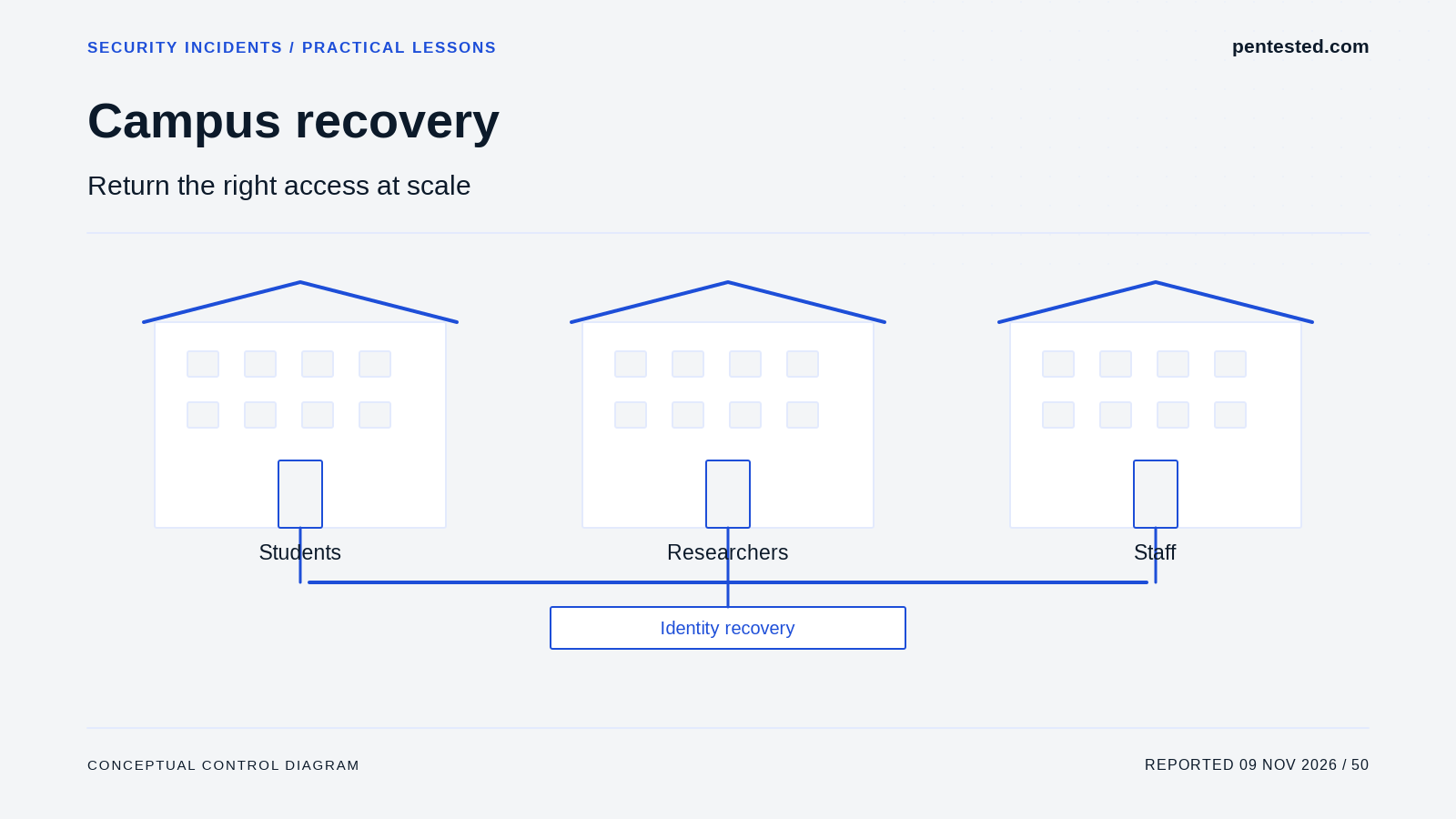
Campus identity restoration needs to support staff, students, visitors and people working away from the main site. Different groups may depend on different applications and verification routes. A process designed around one office team may not scale to that variety.
Research and teaching can also have different recovery priorities. A platform used for routine administration, an examination-related workflow and a specialised research environment may each have constraints the central team needs to understand. Prioritisation should follow the actual consequences and dependencies.
University recovery communications must reach people who cannot use the affected mailbox or sign-in route. Established public status pages and verified support channels are therefore part of the security design. Users should not have to trust an unexpected message merely because it appears during an incident.
The response also needs to account for personal and managed devices without treating them as identical. Instructions should explain which device or service is affected and what action the user is authorised to take. Ambiguous guidance can produce both unnecessary disruption and missed containment steps.
Identity recovery is a high-pressure workflow
A mass reset creates many legitimate requests at once. Support teams need a verification method that remains effective under that pressure, including for people who have lost access to their usual recovery channel. Knowledge of a name or university affiliation alone should not become sufficient authority to recover an account.
Password changes and removal of active sessions should be assessed separately according to the platforms involved. The recovery team needs to know which operations invalidate which forms of access. A successful reset is a useful milestone, but its effect should be verified rather than assumed.
Users also need a clear way to report unexpected behaviour after access returns. A suspicious message, missing file or unusual application prompt may be relevant evidence or an ordinary recovery problem. The support process should preserve useful information and route it to the right team without asking users to investigate beyond their role.
Temporary working arrangements need ownership. Local file storage, alternative communications and manual records can support continuity, but the organisation should define how sensitive information is protected and later returned to the normal environment. Otherwise recovery leaves a dispersed set of unmanaged copies.
How penetration testers assess comparable campuses
An authorised assessment should map the shared identity service, important applications and different user groups. Use synthetic accounts and agreed test environments to examine permissions and recovery behaviour. The scope must respect separate research, clinical or partner systems where authority differs.
A controlled social-engineering exercise can assess the recovery process using fictional identities and approved pretexts. The objective is to identify process weaknesses and support needs, not to obtain real credentials or blame individual helpdesk staff.
Technical testing should establish the effect of account disablement, password reset and session revocation across connected services. Record any access that persists and whether responders have a practical method for removing it. This produces platform-specific evidence for the incident runbook.
A continuity exercise can select one teaching task and one administrative task, then remove a shared dependency in a tabletop scenario. Require the team to demonstrate the approved alternative, the communication route and later reconciliation. The exercise should measure usable service, not just application availability.
How to reduce the risk
Prepare identity recovery for the full population, including remote users and people without their normal recovery method. Define who can verify an individual and what evidence is appropriate. Provide support capacity and escalation so safe verification remains practical during a surge.
Maintain trusted communication channels independent of the affected identity service. Publish clear instructions naming the relevant devices, applications and user groups. Give users a way to verify a message before acting on it.
Document and test revocation behaviour across connected platforms. Include active sessions, application access and recovery factors where relevant. A shared identity architecture should have an understood shutdown and restoration sequence.
Control temporary information handling. Provide approved tools and storage locations, define restrictions on sensitive material and plan how temporary work will be reconciled or removed. Staff and students should not have to invent their own data-transfer process.
Validate restored services through representative user journeys and an observation period appropriate to the incident. Track remaining restrictions and unresolved support cases separately from completed technical tasks. This gives leadership a more accurate picture of useful recovery.
A campus exercise should include people who cannot visit a central support desk. A remote researcher, a student away from campus and a contractor may each need a different approved verification route. Define those routes before a general password reset creates demand across the whole institution. Otherwise, staff may improvise exceptions that are difficult to audit or withdraw later.
After restoring an account, verify its practical access in one representative service. Check that the user's current role is correct, that old sessions have been invalidated and that temporary privileges have not become permanent. Keep the result linked to the recovery request. This turns identity recovery into a demonstrable return of appropriate access, rather than simply a successful password change followed by assumptions about every connected application.
A practical readiness check
Ask the recovery team to restore a fictional remote student's access without using the normal mailbox, then demonstrate that the old session no longer works. Follow the account into one important application and verify its permissions.
That exercise connects verification, technical revocation and actual service restoration. A university is better prepared when the process can return legitimate users to work at scale while preserving the identity boundary under the very pressure the incident creates.
References
<https://news.vanderbilt.edu/2026/11/09/nov-9-active-cybersecurity-incident-updates/>
Related issues
- What the C2k cyberattack teaches about education-system recovery
- What the Canvas data breach teaches about repeat intrusion
- What the Berlin Senate cyberattack teaches about safe reconnection
Read about our methodology or contact pentested.com to discuss security testing for your organisation.


