What the Berlin Senate cyberattack teaches about safe reconnection
Public report: 17 August 2026. Updated: 17 November 2026.
The Berlin Senate cyberattack illustrates why reconnecting a government department is a security decision, not simply a networking task. Isolation can limit uncertainty while investigators work, but a disconnected department still needs to serve people and coordinate with others. The recovery process must restore both useful service and confidence in the environment's administrative state.
What happened
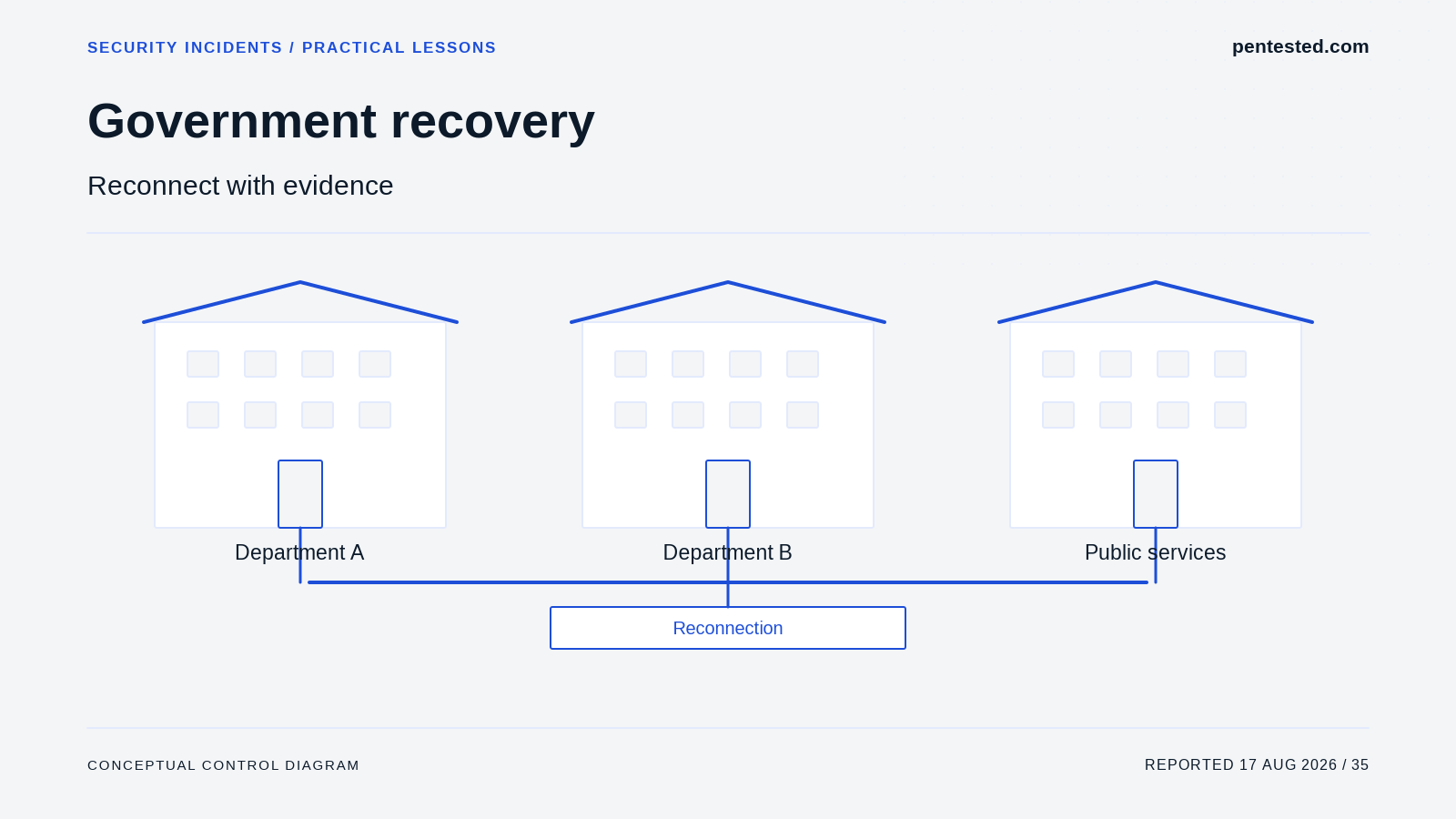
Berlin publicly reported an incident in its state network on 17 August 2026. Its statement said two Senate departments had been isolated from the network since the preceding Friday while forensic investigation and protective work continued. A later announcement described their reconnection over the weekend of 22 and 23 August.
Subsequent official updates addressed the ongoing investigation and the immediate threat. These milestones should not be treated as identical. Reconnecting departments, restoring business processes and concluding particular response work can happen at different times.
Why the chronology matters
The article is dated to the initial public announcement on 17 August. The earlier isolation date and later reconnection belong in the timeline. An early statement describing limited available detail should not be read as a complete final assessment of exposure.
The public notices do not establish every technical step of initial access or justify assuming that every part of the state network was compromised. The practical analysis concerns government network isolation and the evidence needed for safe departmental service restoration.
Isolation changes the business boundary
A department may depend on shared identity, document exchange, financial systems and specialist applications. Disconnecting its network can therefore remove more than internet access. The recovery team needs an operational map of what stops working and which shared services remain necessary.
Departmental service restoration should be measured through actual tasks. A restored connection is useful only if staff can retrieve the correct information, complete the required checks and communicate the outcome safely. Testing a network route alone does not establish that the service is ready.
The isolation decision also needs clear authority. Network teams may be able to disconnect systems, while service owners understand the consequences and incident responders understand the uncertainty. A defined decision process helps those perspectives work together without delaying necessary containment.
Temporary exceptions require particular care. A department under pressure may request access to one shared system or an alternative transfer route. Each exception should have an owner, a stated purpose and a review point, so emergency connectivity does not quietly recreate the boundary the organisation intended to remove.
Reconnection needs evidence, not optimism
The recovery team should establish which identities, devices and configurations are trusted before reopening their routes to the wider network. The exact checks depend on the incident, but the standard should be defined and recorded. A service being urgently needed is not evidence that its security state is understood.
Identity and management systems deserve early attention because they can carry authority between departments. A rebuilt workstation may still use a suspect account or trust a compromised administrative service. Recovery needs to follow those relationships rather than treating each device as an isolated object.
Data integrity is another concern. Staff need a way to identify missing, altered or duplicated information and report it through a controlled process. Technical restoration may bring systems back quickly while reconciliation and assurance continue for longer.
Communications should reflect that staged recovery. A public announcement can accurately describe reconnection while still warning of delays. Clear wording helps avoid the impression that every service and every investigative question has been resolved at the same moment.
How penetration testers assess comparable recovery plans
An authorised assessment should map the shared services and administrative relationships between departments. Use agreed test accounts and representative systems to establish whether routine access crosses boundaries unnecessarily. The engagement needs explicit authority for each organisational area involved.
An assumed-compromise review can examine the reach of a departmental support identity or management workstation. Testers should use controlled demonstrations and avoid interrupting public services. The finding should identify the shared authority that could carry an incident beyond its original area.
A tabletop exercise can isolate one fictional department and ask its service owners to complete essential tasks through approved alternatives. Include document handling, communication and later reconciliation. This tests whether the continuity design works at the level staff actually experience.
The reconnection exercise should then require evidence. Ask the team to demonstrate the checks supporting the return of one test system and one test identity. Record who accepts the result and what monitoring remains in place during the observation period.
How to reduce the risk
Maintain a dependency map connecting departmental services with shared applications, identities and administration. Validate it with operational staff and review it when services or suppliers change. A network diagram alone may omit the information flow needed to complete a public-service task.
Separate administrative authority where practical and document any cross-departmental privileges. Review standing access and emergency accounts according to their reach. Shared infrastructure should not make every support role an administrator of every participating service.
Define isolation and reconnection criteria before an incident. Include the evidence required, the people authorised to accept it and the conditions under which an exception is permitted. This reduces pressure to substitute a quick technical check for a broader trust decision.
Prepare safe temporary working arrangements. Give staff approved communication and record-handling methods, with a way to track work that needs reconciliation. Review temporary access and remove it when its purpose ends.
Monitor restored services for a defined period using events that can reveal renewed misuse or unexpected administrative changes. Ensure the responders understand which activity is part of legitimate recovery. An unreviewed flood of alerts can hide the few events that need action.
Give service owners a defined role in reconnection. They should be able to identify the minimum dependency needed for a particular public service, the limits of any temporary arrangement and the evidence required before reconnecting more widely. This turns a broad request to restore the network into a series of decisions that can be reviewed.
Check temporary access at the end of recovery. Emergency accounts, alternate file-sharing routes and relaxed restrictions may have been introduced for a valid reason during isolation. Each needs an owner and a closure condition. A service restored through an undocumented exception can leave a continuing weakness after the original incident has been contained. Include those exceptions in the final handover to routine operations rather than relying on individual staff to remember them.
A practical decision exercise
Ask a service owner and an incident responder to agree what evidence would justify reconnecting one representative departmental system. Have the technical team demonstrate that evidence in a controlled exercise.
The exercise is valuable when it exposes a disagreement before an actual emergency. Safe recovery needs a shared definition of trust and usefulness. Without it, the organisation may either remain disconnected longer than necessary or reconnect on an assumption that nobody has formally accepted.
References
<https://www.berlin.de/rbmskzl/aktuelles/pressemitteilungen/2026/pressemitteilung.1706036.php>
<https://www.berlin.de/rbmskzl/aktuelles/pressemitteilungen/2026/pressemitteilung.1703898.php>
<https://www.berlin.de/en/news/10700588-5559700-following-a-cyberattack-immediate-threat.en.html>
Related issues
- What the London councils cyberattack reveals about shared IT
- What the Vanderbilt cyberattack teaches about campus-wide recovery
- What the Stryker cyberattack teaches about operational continuity
Read about our methodology or contact pentested.com to discuss security testing for your organisation.


