What the London councils cyberattack reveals about shared IT
Public report: 25 November 2025. Updated: 17 November 2026.
The London councils cyberattack illustrates how a technical incident can become a prolonged public-service problem. Shared infrastructure brings economies of scale, but it also creates dependencies across organisations that retain separate responsibilities to residents. Recovery requires a clear understanding of both the technology and the services that rely on it.
What happened
Kensington and Chelsea Council says it discovered unusual activity on 24 November 2025. The incident affected it, Westminster City Council, and Hammersmith and Fulham Council, which shared a number of IT systems and services. The councils isolated systems and worked with external specialists and public authorities.
Kensington and Chelsea's subsequent frequently asked questions describe a lengthy recovery for some functions, including a system unavailable until early June 2026. This makes the case important even without a fully public technical account of initial access. The consequences of losing a shared service can last much longer than the initial containment activity.
The chronology matters
The attack was identified in November 2025, while restoration and investigation continued afterwards. An early announcement, a later service update and a final recovery statement answer different questions. This article incorporates the later information rather than presenting the entire recovery picture as something known on the first reporting day.
The published account does not justify inventing a particular malware family or a detailed route between council networks. The assessment below concerns the resilience of comparable shared environments, rather than a claim that any specific configuration caused this incident.
Why shared services need explicit boundaries
A shared service can be a common directory, application, support function or hosting platform. The operational relationship may be well understood by the team that built it but much less visible to people responsible for individual council services. That gap becomes serious when a decision to isolate infrastructure affects several organisations at once.
Shared council systems should have a documented division between common administration and each authority's information. Administrative convenience can otherwise make a single support account unusually powerful. The design should make it possible to contain one affected service without unnecessarily removing unrelated functions elsewhere.
Segmentation is more than a network diagram. Applications may share identity providers, databases, backup credentials and remote-support tools even when their servers sit on different networks. A review needs to trace those dependencies through to the administrators and recovery processes that control them.
Responsibility must also survive organisational boundaries. A hosting team may restore a server successfully while the service owner still cannot process a housing request. Technical restoration should be measured against a resident-facing transaction, including any identity checks, supporting documents and communications needed to complete it.
The human cost of a long recovery
Local authorities provide services that some residents cannot simply postpone or buy elsewhere. A website outage is therefore only one part of the impact. Staff may lose access to case histories, appointment information or correspondence needed to make safe decisions.
Manual workarounds can preserve services, but they create their own information-handling requirements. Staff need approved methods for recording requests, checking identities and transferring information between teams. An improvised spreadsheet or personal mailbox can create a second incident while the original one is still being managed.
Public service recovery also produces a backlog. Once systems return, staff must reconcile requests taken through temporary channels, identify duplicates and ensure urgent cases were not overlooked. The cost of that work belongs in the recovery plan, alongside rebuilding infrastructure and restoring data.
Residents need information they can act on. A useful update identifies which service is affected, how an urgent request can be made and when the next update will appear. It should avoid declaring normal service merely because a website loads while important supporting processes remain unavailable.
How penetration testers assess a shared environment
Testing should begin with the participating organisations' agreement on scope and authority. Access to a platform serving three organisations does not automatically authorise testing every dataset on it. The engagement needs named contacts, permitted identities and clear limits on cross-organisational activity.
Within those limits, testers can assess whether an account from one service has unnecessary access to another. Synthetic records and dedicated test accounts make it possible to demonstrate excessive permissions without examining resident information. Findings should identify the precise trust boundary and the service consequence.
An assumed-compromise exercise can then examine administrative reach. The team can review what a compromised support workstation or service account could control, including backup and identity services. Any intrusive activity should be agreed separately; a resilience review should not create a real outage to prove that an outage would matter.
Finally, a recovery exercise should test a complete service journey. For example, staff could process a fictional urgent housing enquiry using the documented fallback arrangements, then reconcile it after restoration. The resulting evidence is much stronger than a statement that a continuity document exists.
How to reduce the risk
Start with a service dependency register that links each critical public function to its applications, identities, suppliers and recovery owner. Validate the register with operational staff, because a technically complete inventory may still omit the telephone process or document store that makes a service usable.
Separate routine support access from exceptional administrative access. Record who can cross organisational boundaries, why they need that capability and how its use is reviewed. Avoid making shared administration an unrestricted default for every support task.
Protect backups and restoration identities independently from the systems they recover. A backup is useful only if the recovery team can access it safely, identify a suitable restoration point and operate the restored service without reintroducing suspect access.
Agree a common incident decision process across the participating bodies. It should define who can isolate infrastructure, who communicates with each service owner and how disagreements about reopening a service are resolved. Those decisions become harder under pressure if they are left to personal relationships.
Give temporary working arrangements the same attention as the main systems. Provide approved communication channels, minimum information-handling rules and a method of tracking cases for later reconciliation. Staff should not have to choose between abandoning a resident and inventing an unsafe process.
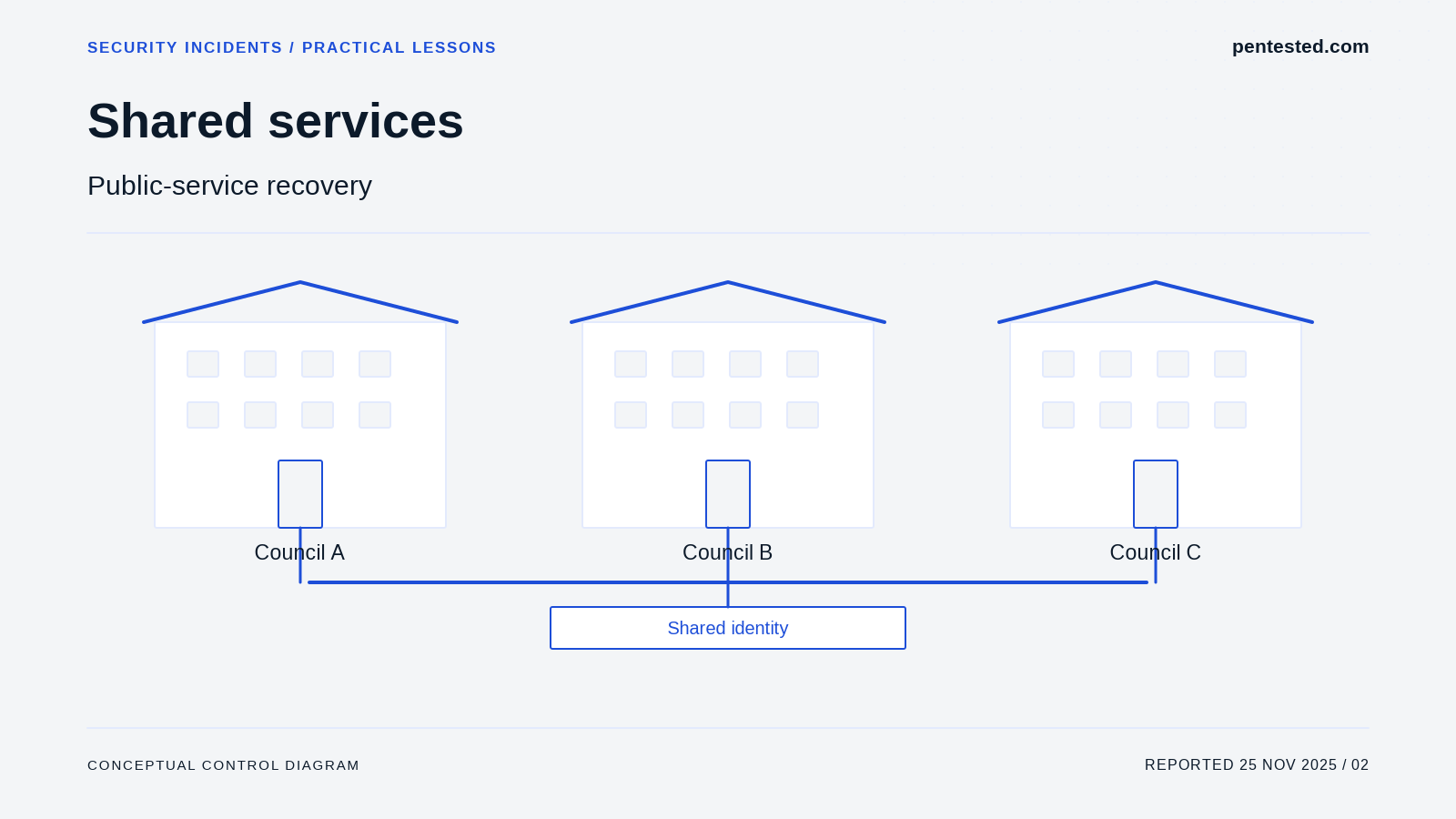
Consider a shared identity service used by three authorities with different urgent obligations. Restoring a single application may be technically possible while the shared authentication path remains untrusted. The recovery plan needs to identify who can accept that dependency, what evidence they require and which restricted service can operate in the meantime. Include communications teams in the exercise: residents need instructions that match what staff can actually deliver. A technically accurate status message is insufficient if it directs people towards a support route that has also been disconnected.
What leadership should measure
Measure recovery by the proportion of essential service journeys that can be completed reliably. Include the time needed to clear backlogs and the number of cases requiring manual correction. Server availability alone can make a difficult recovery appear more complete than it is.
Ask service owners to demonstrate one fallback arrangement and one restoration check. A practical exercise often reveals missing access, unclear responsibility or a dependency that was assumed to work. Resolve those issues while the normal service is available.
The lasting lesson is to design shared services so that efficiency does not obscure accountability. Each participating organisation needs an understandable picture of its dependencies, a tested way to continue essential work and an agreed standard for declaring that recovery is complete.
References
<https://www.rbkc.gov.uk/cyber-security-incident-faq>
Related issues
- What the Berlin Senate cyberattack teaches about safe reconnection
- What the C2k cyberattack teaches about education-system recovery
- What the Vanderbilt cyberattack teaches about campus-wide recovery
Read about our methodology or contact pentested.com to discuss security testing for your organisation.


