What the C2k cyberattack teaches about education-system recovery
Public report: 3 April 2026. Updated: 17 November 2026.
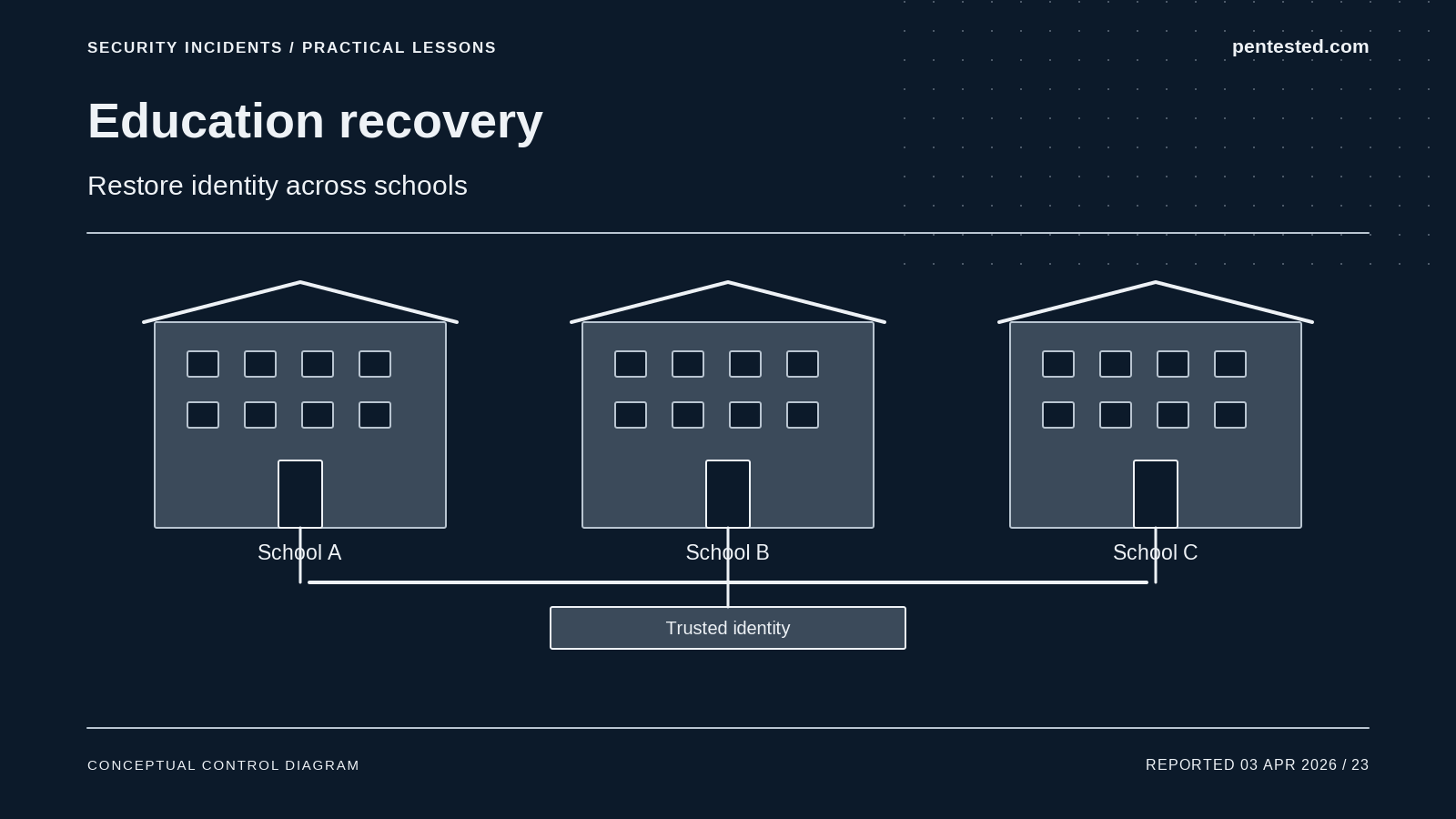
The C2k cyberattack shows why recovering a shared education platform is partly an identity-verification problem. Restoring the servers is only one stage. Schools need a safe way to return access to staff and pupils, preserve essential work and distinguish legitimate recovery requests from attempts to take advantage of the disruption.
What happened
Northern Ireland's Education Authority publicly confirmed in April 2026 that the C2k school system had been targeted by a cyberattack. Its update said the system manager, Capita, had taken steps to contain the issue and investigate. The response included password resets across the environment.
The public statement supports a case study in large-scale recovery. It does not establish that every school account was individually compromised or that every category of school data was stolen. A reset can be a protective recovery action without proving that each affected identity was used by the attacker.
Reporting date and recovery activity
This article follows the Education Authority's public reporting in early April. Later service-restoration updates belong to the recovery timeline. They should not be confused with the date the attack began or with a definitive statement about the full technical cause.
The distinction matters for schools interpreting instructions. A requirement to change a password, a restriction on an application and confirmation that a service is restored each answer a different question. Communications should explain the action required at that stage.
Why education identity recovery is difficult
School identity recovery operates across people with very different roles and support needs. A teacher, an administrator, a young pupil and a parent contacting a school may each need a different route to verify an access request. A single process designed for office staff may not work consistently across that population.
The school may also rely on the affected system to communicate recovery instructions. If the normal mailbox or sign-in route is unavailable, staff need an alternative that was established before the incident. An improvised link circulated through informal groups can create confusion about which instructions are genuine.
Shared education continuity depends on knowing which services use the same identity. Changing one password may affect several learning tools, devices or administrative applications. The recovery team needs to understand those dependencies and explain what users should expect after a reset.
Temporary support capacity becomes an important control. If staff cannot obtain help promptly, they may share accounts, reuse credentials or invent local workarounds. The process should make safe recovery easier than bypassing the intended boundary.
What needs to remain trustworthy
Access restoration should preserve the relationship between the person and the account. A caller knowing a pupil's name or a staff member's email address is not necessarily entitled to reset that identity. Verification should use an established relationship or another approved method suitable for the user group.
The organisation also needs to distinguish password changes from session revocation. Depending on the platform, existing access may require separate action. Recovery should verify the behaviour of the deployed systems rather than assuming that one administrative operation has identical effects everywhere.
School records and learning materials introduce another concern: integrity. A restored application should contain the right information and permissions, not merely accept a login. Staff need a method for reporting unexpected changes without assuming that every ordinary error is evidence of further attack.
Backlogs should be part of the plan. Assignments, administrative updates and support cases may have accumulated through temporary channels. Reconciliation needs ownership and a record of what occurred while normal access was restricted.
How penetration testers assess comparable environments
An authorised assessment should map the shared identity service and the applications depending on it. Use dedicated staff and pupil test accounts, with suitable oversight and clear limits. Real children's records should not be used when synthetic data can demonstrate the same boundary.
Review account recovery for each relevant user group. A controlled exercise can examine whether a fictional request reaches the correct verifier and whether the support team can resist a plausible but unverified request. The objective is to improve the process, not to pressure individual school staff into disclosing real credentials.
Technical testing should establish what a password reset and account disablement actually do. Check relevant sessions and connected applications within scope, using test identities. Record any remaining access and whether the response team knows how to remove it.
A continuity exercise can then ask a representative school to complete one essential task using the approved fallback. Include communication with users, access to necessary records and the process for transferring work back into the restored system. That measures usability as well as technical design.
How to reduce the risk
Document recovery routes for different user groups and validate them with school staff. The process should identify who can verify an individual, who can authorise the reset and what evidence is retained. Avoid treating personal information that is widely known as sufficient proof of identity.
Maintain trusted alternative communication channels. Schools should know where official status updates and instructions will appear if the normal platform is unavailable. Make it clear how staff can verify an instruction before forwarding it to families or colleagues.
Test account and session revocation across connected services. Keep a record of which operations remove access and which require additional action. This prevents a large reset programme from creating an inaccurate impression that all prior authority has necessarily ended.
Provide safe temporary working arrangements. Define approved tools, minimum information-handling requirements and a method for recording work for later reconciliation. Shared accounts and informal transfers of sensitive records should not become the default continuity plan.
Restore access in a sequence matched to essential tasks and available support. Monitor errors and unexpected behaviour as services return, with a clear escalation route. A phased process can be more manageable when each phase has an understandable validation standard.
Schools need recovery instructions that work for people with different access needs and levels of technical familiarity. Test the instructions with a representative staff role and a fictional pupil account. Establish how identity is verified when the usual mailbox is unavailable and who can resolve an exception without creating a shared password or an overly broad temporary account.
Plan the return to teaching as a sequence of trusted services. A device may be usable before a shared drive or classroom platform is ready. Staff should know which work can resume safely and where to record activity completed through temporary arrangements. Those records reduce confusion when normal services return and help avoid unnecessary duplication of pupils' information.
What school leaders should ask
Ask whether the school could verify and recover one staff account and one pupil account without the normal email system. Then ask how it would confirm that the restored identity has the right permissions and that temporary work has been recorded correctly.
Those practical checks make a shared-platform incident relevant at the individual school level. The objective is a recovery process that returns legitimate users to useful work without weakening identity assurance or leaving sensitive information scattered across emergency workarounds.
References
<https://www.eani.org.uk/news/update-on-cyber-security-incident>
<https://www.eani.org.uk/news/work-ongoing-to-restore-access-following-cyber-attack>
Related issues
- What the Vanderbilt cyberattack teaches about campus-wide recovery
- What the Canvas data breach teaches about repeat intrusion
- What the London councils cyberattack reveals about shared IT
Read about our methodology or contact pentested.com to discuss security testing for your organisation.


