What the Canvas data breach teaches about repeat intrusion
Public report: 1 May 2026. Updated: 17 November 2026.
The Canvas data breach demonstrates why containment needs to be verified against the wider application boundary, not just the first access route observed. A large learning platform serves many institutions and user types. An incident can therefore affect information, service availability and confidence in the separation between ordinary accounts and privileged platform functions.
What happened
Instructure detected unauthorised activity in Canvas on 29 April 2026 and publicly acknowledged an incident on 1 May. Its fact sheet says attackers obtained information including usernames, email addresses, course and enrolment details, and messages. It said its investigation had not identified core learning content or credentials as involved.
On 7 May, the same actor gained access through a second vulnerability and changed pages shown to some users. Instructure said it stopped that activity quickly, found no additional data theft in that phase and placed Canvas into maintenance mode while validating scope. Its account says both episodes involved a Free-for-Teacher account.
Why the two episodes should stay distinct
The article date follows public acknowledgement on 1 May, not the earlier detection. The second intrusion and subsequent restoration belong later in the timeline. A report about the first data theft should not silently absorb every consequence of the second event.
Instructure also described an agreement with the actor concerning return and deletion of data. That is the provider's account of its response, not independent proof that no copy could remain. Assurance about technical containment and assurance about the fate of copied information are separate questions.
Multi-user platforms have several boundaries
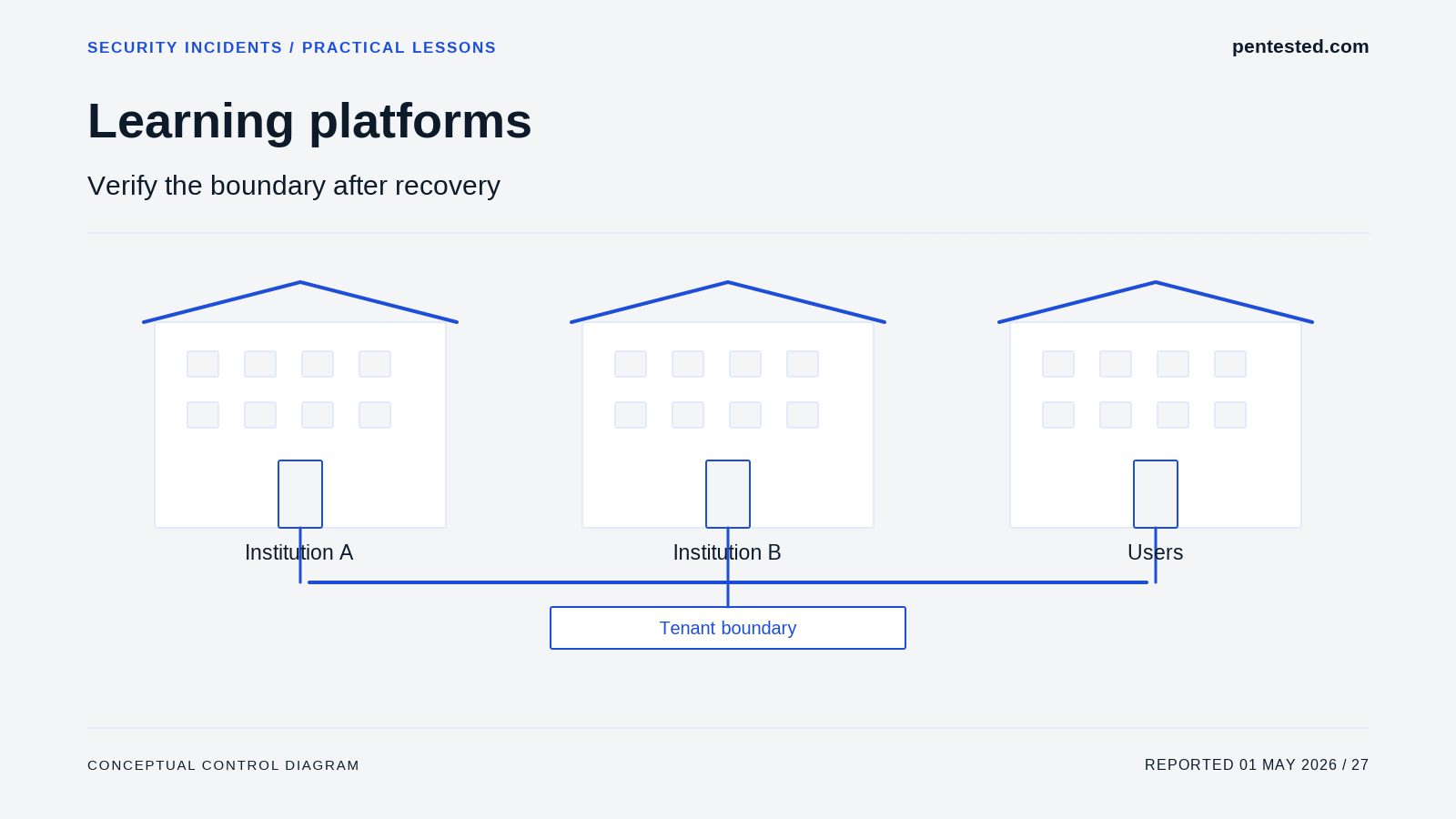
Learning-platform tenant boundaries determine which institution, course and individual can access a record. Those relationships can be more complex than a simple customer identifier. Instructors, students, administrators and platform staff may have different legitimate capabilities over related information.
The existence of a free account is not itself a vulnerability. The security question is whether any account can cross the authority assigned to it. A review should examine the operations available to each role and the server-side rules that enforce those limits, rather than assuming that an approved account is an inherently trusted actor.
Messages and enrolment details also deserve deliberate classification. They may reveal associations and personal context even when grades or passwords are unaffected. The sensitivity follows the information and its relationships, not just whether it sits inside the platform's main coursework store.
Repeat intrusion containment requires looking for adjacent routes and shared assumptions. Closing one weakness can leave another operation relying on the same overly broad role or trust condition. The investigation should establish the boundary that failed, then review comparable operations without assuming they are identical.
Why service disruption compounds data exposure
Education users need access at specific times, including teaching and assessment periods. A precautionary maintenance window can be necessary while still creating a serious operational burden for institutions. The provider and its customers need a shared understanding of the functions affected and the alternatives available.
Institutions also hold their own responsibilities to staff and students. They need information about their population, the data categories involved and whether local action is required. A platform-wide announcement may not answer those institution-specific questions immediately.
Communication should avoid turning exclusions into broad reassurance. Saying that no additional data was taken in the second episode is useful, but it does not erase the first exposure. Similarly, restoring availability does not establish that notification and investigation work are complete.
The incident can also affect trust in what users see. If pages have been altered, institutions need a reliable route for confirming official instructions. A service-status channel independent of the affected application helps users avoid relying on content whose integrity is still being assessed.
How penetration testers assess comparable platforms
An authorised assessment should create separate synthetic institutions, courses and role types. Testers can then compare access across records, messages, administrative operations and platform features. The scope must define the permitted tenants and avoid accessing real students' information.
Review low-privilege accounts with the same care as invited institutional accounts. An assessment should establish the effective permissions of each account type and whether exceptions created for onboarding or free use weaken shared enforcement. Findings should describe a demonstrated boundary rather than treating account availability as the problem.
After a significant finding, review comparable operations and entry points. The objective is to determine whether the same trust assumption appears elsewhere, not merely to confirm that one request is now blocked. A retest should include the underlying authorisation condition and its neighbouring workflows.
Detection exercises can simulate a controlled unauthorised action within test tenants and measure whether the platform identifies it promptly. Recovery testing should include both access revocation and verification that altered test content has been restored correctly.
How to reduce the risk
Define tenant and role relationships centrally and enforce them for every relevant operation. Include account types with unusual commercial or onboarding arrangements. The application should not rely on the interface hiding an operation that the server still accepts.
Separate platform administration from ordinary teaching and learning capabilities. Review any feature that can affect several institutions or change content shown to many users. Its authority should be explicit and supported by suitable approval and monitoring.
Treat incident remediation as a review of the failed boundary. Examine related endpoints, account types and data paths, then test the corrected rule using controlled accounts. A narrow fix can be appropriate, but the decision should follow analysis rather than convenience.
Prepare institution-specific communication and evidence processes. Customers should know how they will receive scope information, what they can investigate locally and which actions remain the provider's responsibility. Keep status communication independent of the affected application where practical.
Validate restoration through representative user journeys and integrity checks. Include login, course access, messaging and administrative work according to the incident scope. Track notification and data-exposure work separately so an available service is not mistaken for a fully concluded response.
An education platform's recovery should address the trust of both the institution and its individual users. An administrator may confirm that a service is available while a student still has an exposed session or an unanswered question about their records. Provide a coordinated route for technical recovery, account support and privacy enquiries so that each group receives consistent instructions.
When later unauthorised activity is reported, revisit the earlier closure evidence. Identify which credentials were invalidated, which applications were reviewed and what monitoring was introduced. Do not assume the later event has the same entry point, but do not assume the earlier response covered it either. Compare the new evidence with the original containment boundaries and record the resulting changes.
A useful assurance outcome
A learning platform should demonstrate that a low-privilege account remains inside its intended boundary even when the user deliberately explores unexpected workflows. That outcome is clearer than a general assertion that only registered users can access the service.
For institutions buying the service, ask what evidence supports that boundary and how a repeat intrusion would be detected and communicated. Those questions connect platform security with the practical work of keeping education available and protecting the people whose information the service holds.
References
<https://www.instructure.com/sites/default/files/pdf/InstructurebyCanvas-Incident-Fact-Sheet-051326.pdf>
<https://its.umich.edu/nationwide-canvas-security-incident-faq>
Related issues
- What the C2k cyberattack teaches about education-system recovery
- What the Nottingham University breach teaches about student-record security
- What the Vanderbilt cyberattack teaches about campus-wide recovery
Read about our methodology or contact pentested.com to discuss security testing for your organisation.


