What the Stryker cyberattack teaches about operational continuity
Public report: 11 March 2026. Updated: 17 November 2026.
The Stryker cyberattack demonstrates how an incident in enterprise technology can become a material operational event. For a medical-technology business, administration, manufacturing, ordering and distribution form a connected service chain. Security resilience needs to consider whether that chain can continue delivering useful work when shared systems become unavailable or untrusted.
What happened
Stryker disclosed a cybersecurity incident on 11 March 2026. In a later regulatory amendment, it said the incident disrupted business operations and had a material impact on operations and first-quarter financial results. The company subsequently reported restoration across its global manufacturing network and commercial, ordering and distribution systems.
That regulatory account supports a substantial operational case study. It should not be expanded into an unsupported claim about a particular malware family, a complete technical attack path or compromise of every medical device. The published operational consequences are significant without adding details the source does not establish.
Initial disclosure and later materiality assessment
The article's date follows the initial public disclosure. The later amendment reflects information and assessment developed during recovery. It is important to distinguish that subsequent judgement from the facts available on the first day.
The company also separated the incident's operational impact from its assessment of full-year guidance. Those are different measures. An event can materially affect a quarter or a set of operations without the same conclusion applying to every financial period or business measure.
How enterprise dependencies concentrate risk
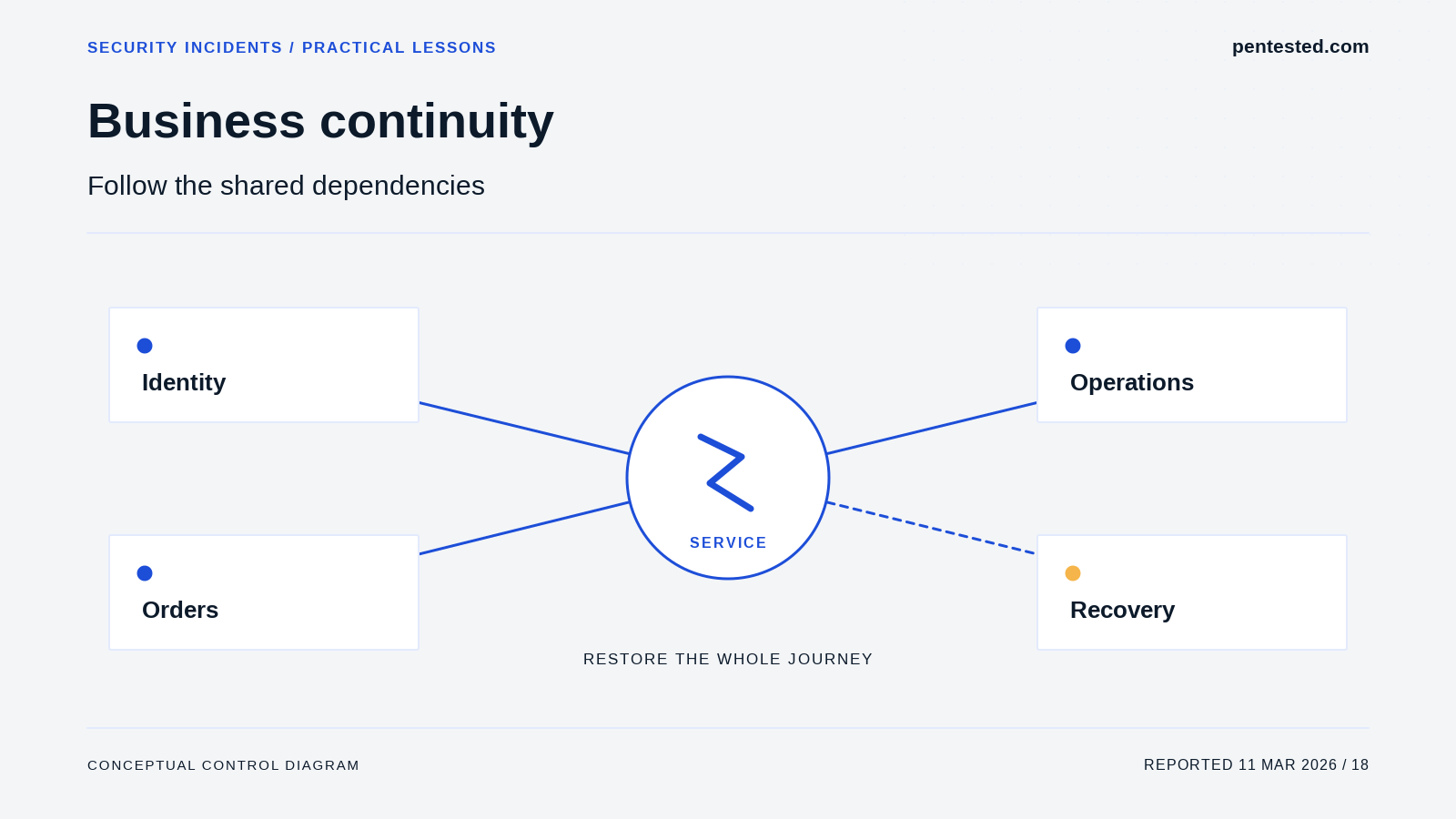
Enterprise management concentration can make a central service an important dependency for many otherwise separate functions. Identity, device administration and business applications may each support staff across several sites. Losing trust in one shared component can therefore require restrictions well beyond the initially affected machine.
The relevant resilience question is not simply whether factories have a separate network. Manufacturing staff may depend on corporate identities, scheduling systems, documentation or order information. A process can remain physically capable of production while the business cannot authorise, organise or distribute its output reliably.
Medical-device business continuity should follow those dependencies through to the customer. An order may require validation, stock allocation, shipping records and confirmation that the correct product reaches the intended destination. A partial workaround must preserve those controls, not merely keep a production line moving.
This is an architectural lesson for comparable businesses, rather than a claim about the exact technical cause at Stryker. The practical value is to identify where one enterprise service can interrupt several critical journeys and whether an independent fallback actually exists.
Why a material incident is broader than an outage
Business impact includes delayed work, recovery costs and the effort required to operate through temporary arrangements. A system may be restored while orders still need reconciliation or staff remain occupied with a backlog. The end of technical downtime is not necessarily the end of operational consequences.
Temporary processes can also change risk. Staff may need to handle orders or shipment details through alternative tools. Those arrangements require suitable access, verification and record keeping, particularly where product identification and delivery accuracy matter.
Recovery decisions need an appropriate level of confidence. Restoring connectivity quickly can help operations, but reconnecting a system before its identity and management state are understood may create another incident. The organisation should define what evidence is required for each stage of reopening.
Leadership needs measurements that reflect those trade-offs. A percentage of servers restored is useful operational information, but it should be accompanied by the proportion of essential business tasks that can be completed reliably. Otherwise the dashboard may improve faster than the service experienced by customers.
How penetration testers assess comparable exposure
An authorised resilience assessment should begin with a small number of critical business journeys, such as accepting an order and fulfilling it correctly. Map the applications, identities and management functions needed at each stage. Validate the map with operational users rather than relying entirely on technical inventories.
An assumed-compromise review can examine the reach of a representative enterprise administrator or management service. The exercise should use test identities and agreed systems, with production-impacting actions excluded unless separately authorised. The useful finding is a demonstrated concentration of authority and its consequence.
A tabletop exercise can then remove one dependency and ask the business to complete the selected journey. Staff should demonstrate the fallback, including access to necessary records, approval of exceptions and later reconciliation. A written continuity plan is only the starting point.
Recovery testing should assess the sequence of identity, management and application restoration. It should establish which systems must be trusted before others can safely return and which evidence supports that decision. This makes restoration an engineered process rather than a queue of servers to restart.
How to reduce the risk
Identify the enterprise services that support several critical functions and assign clear owners. Document their administrative authority, dependencies and recovery requirements. Use that map to prioritise protective controls and resilience work according to business consequence.
Separate routine administration from the most powerful management capabilities. Review standing privileges, shared accounts and supplier access, especially where one identity can affect many sites. An emergency access process should be available without turning exceptional authority into everyday practice.
Design fallback arrangements around complete tasks. Provide approved tools and minimum verification requirements so staff can continue essential work without inventing unsafe shortcuts. Include a method for tracking temporary transactions and reconciling them once normal systems return.
Protect recovery identities and configuration independently from the environment they restore. Verify that the team can obtain trusted information, rebuild required systems and validate the result without depending on a potentially compromised administrative path.
Measure recovery through business outcomes and remaining backlogs. Record temporary exceptions and review them after the immediate response. An emergency configuration should not become the permanent design merely because the organisation is relieved to be operating again.
Map a business process from the customer's request to its final fulfilment. Include identity, communications, manufacturing or service scheduling, logistics and the records used to confirm completion. A process that looks distributed on an organisation chart may still rely on one shared application at every stage.
Set recovery priorities using the consequences of delay, with business owners involved in the decision. The same outage duration can have different effects on an urgent order and a routine internal task. Test whether the temporary process preserves the information needed for later reconciliation. Recovery becomes harder when teams restore access but cannot reliably establish which commitments were made while normal systems were unavailable.
The question to put to service owners
Ask each owner what would prevent their function from completing essential work if the central identity or management service were unavailable for several days. Then ask them to demonstrate one approved alternative.
The answers reveal which dependencies are genuinely resilient and which are protected mainly by an assumption that the shared service will always work. Closing those gaps makes a business better prepared for both malicious disruption and serious technical failures, while producing clearer evidence for future incident decisions.
References
<https://www.sec.gov/Archives/edgar/data/310764/000119312526149607/d112875d8ka.htm>
Related issues
- What the Boston Scientific cyber incident teaches about manufacturing continuity
- What the ChipSoft ransomware attack reveals about healthcare suppliers
- What the Ahold Delhaize cyberattack teaches about retail resilience
Read about our methodology or contact pentested.com to discuss security testing for your organisation.


