What the ChipSoft ransomware attack reveals about healthcare suppliers
Public report: 9 April 2026. Updated: 17 November 2026.
The ChipSoft ransomware attack illustrates how a healthcare software supplier can become a common dependency across many care organisations. A provider may operate its own clinical services while depending on external portals, mobile access or exchange platforms. An incident at that supplier can require urgent decisions about connectivity, patient information and continuity of care.
What happened
ChipSoft was attacked on 7 April 2026. Dutch healthcare incident-response organisation Z-CERT subsequently confirmed ransomware and the precautionary disconnection of several hosted services. Its 17 April update said forensic work had established theft of patient information, including medical data, affecting some Dutch customers.
Z-CERT distinguished those customers from organisations running the software themselves or through other hosting arrangements. That deployment distinction is important: sharing a product name does not mean every customer shares the same exposure or outcome.
On 30 April, Z-CERT relayed ChipSoft's statement that publication had been prevented and the attackers had destroyed the stolen data. Z-CERT said it had not seen the evidence and cautioned that it was never completely certain that attackers no longer held the information. That later claim does not erase the confirmed theft or independently establish that every copy was deleted.
Why early and later statements differ
The initial response concerned containment and service availability. Later forensic work established additional information about data theft. This article is dated to public reporting of the April attack and incorporates the subsequent confirmation, rather than assuming the full scope was known immediately.
The public account does not establish that every clinical function stopped or that every patient record in the wider customer base was exposed. The analysis below concerns the dependencies and assurance questions revealed by the incident.
Product, hosting and data flows are separate questions
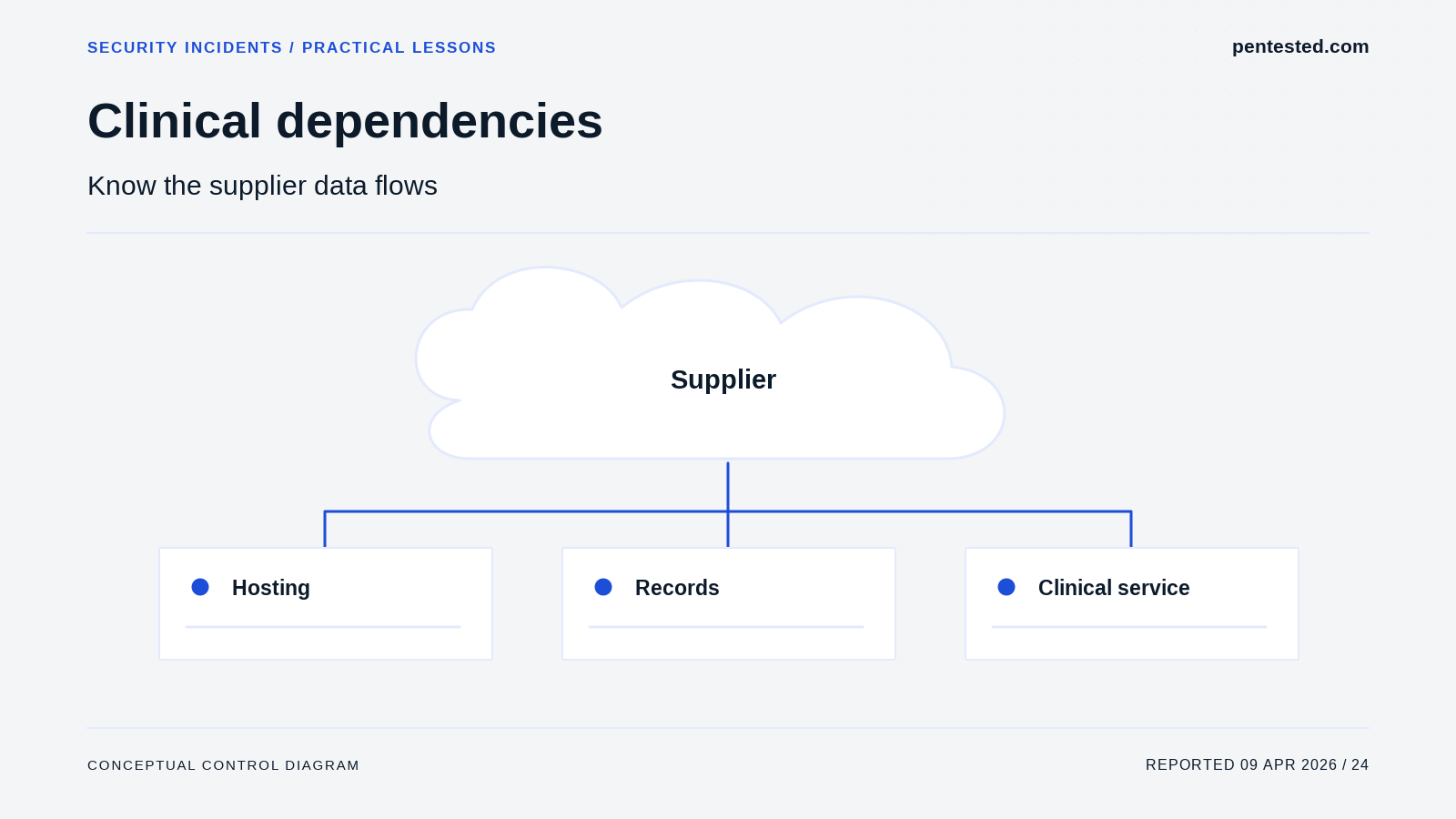
Clinical supplier dependencies should be mapped by service and deployment. A locally hosted application, a vendor-hosted portal and a mobile interface can use the same brand while relying on different infrastructure and administrative identities. An inventory containing only the product name is therefore insufficient for incident decisions.
Hosted patient-record exposure also depends on where information is stored and which services can retrieve it. An organisation may hold its main record locally while copies or selected fields appear in an exchange platform. The security boundary follows those actual data flows.
Connectivity decisions need clinical input. Disconnecting a supplier can reduce further exposure, but it may also affect access to information needed for appointments or coordination. The appropriate decision requires a current picture of which workflows depend on the connection and what alternative is safe.
Supplier administration deserves the same attention as patient-facing access. Support accounts, deployment systems and integrations may reach several customers. The customer should understand the boundaries between those environments and the evidence available if the supplier's own authority is misused.
Availability and confidentiality can evolve together
A service outage is immediately visible; the scope of copied information may take longer to establish. Responders need parallel workstreams so restoring access does not displace investigation of patient-data exposure. The two questions may require different specialists and evidence.
Care providers also need usable guidance. A statement that a supplier is investigating may be accurate but insufficient for deciding whether a particular connection can remain active. Advice should identify the affected deployment or function and the action appropriate to it.
Temporary processes need control. Staff may turn to telephone calls or alternative documents when normal exchange services are unavailable. Those methods should preserve identity checks, accurate patient matching and a record of decisions, with a plan for reconciliation afterwards.
Notification responsibilities can be complicated when several organisations contribute to or use the same record. Provider and supplier agreements should establish how affected information is identified and how consistent explanations reach patients. That work becomes harder if nobody has mapped the data before the incident.
How penetration testers assess comparable services
An authorised assessment should begin with a service and data-flow map agreed by the care provider and relevant supplier. Identify locally hosted components, supplier-hosted functions and the identities connecting them. The engagement must define which party can authorise each part of the testing.
Use synthetic patients and representative roles to assess data separation. A test should establish whether one organisation or role can reach information outside its legitimate scope, including through mobile and exchange interfaces. Real medical records should not be collected to demonstrate a boundary that test data can prove.
Review supplier support access and the reach of integration credentials. An assumed-compromise exercise can assess those permissions in a controlled environment, with clinical and availability limits clearly stated. The report should connect any excessive access to the specific services and customer information affected.
Continuity testing should remove one external dependency in a tabletop or non-production exercise. Ask staff to complete a defined care-administration task using approved alternatives, then reconcile the result. This tests the practical consequence of disconnection without endangering live care.
How to reduce the risk
Maintain an inventory organised around services, hosting arrangements and information flows. Record who administers each component, what patient data it holds and which functions fail if it is disconnected. Validate the inventory when suppliers or deployment models change.
Constrain integration and support identities to their required duties. Separate customer environments and avoid giving routine maintenance a broader reach than necessary. Customers should obtain meaningful assurance about those boundaries rather than relying on a general product-security statement.
Agree incident information and decision routes with suppliers. Define who can recommend disconnection, what evidence supports reconnection and how deployment-specific advice will be communicated. Ensure the contact process works outside ordinary business hours where the service requires it.
Prepare approved continuity arrangements with operational and clinical teams. Include secure communication, accurate patient matching, recording of temporary decisions and later reconciliation. A fallback should be safe and usable, rather than merely described in a generic plan.
Retain evidence needed to investigate data access and administrative changes. Agree which records the supplier can provide, how quickly they can be obtained and how the customer can identify its own affected population. Availability restoration should not erase the evidence needed for that work.
A supplier dependency map should identify where the organisation's records actually reside. Product licensing, hosted services, support access and document exchange can create different relationships with the same supplier. A single entry in a procurement register may conceal those differences. Ask each service owner to confirm the data flow and the practical consequence of losing that part of the relationship.
Use the map when an incident update changes. A statement about one hosted service should reach the customers using that service, while users of another product receive the guidance relevant to their deployment. This reduces both missed action and unnecessary disruption. It also gives privacy and clinical teams a firmer basis for deciding what information an individual patient needs.
A focused supplier review
Choose one hosted healthcare service and ask what would happen if the supplier recommended immediate disconnection. The answer should identify the clinical and administrative consequences, the safe alternative and the person authorised to decide.
Then ask what evidence would be required before reconnecting it. Those two questions reveal whether the organisation understands the dependency in operational terms. A supplier incident is easier to manage when the customer already knows which services, identities and patient-information flows are involved.
References
<https://z-cert.nl/actueel/nieuws/ransomware-incident-chipsoft-nieuwe-informatie-17-april>
<https://z-cert.nl/actueel/nieuws/update-over-ransomware-incident-bij-chipsoft>
<https://z-cert.nl/actueel/nieuws/ransomware-incident-chipsoft-update-donderdag-30-april>
Related issues
- What the Barts Health data theft reveals about finance-system security
- What the Manage My Health breach teaches about patient documents
- What the DentaQuest breach reveals about combined health and identity data
Read about our methodology or contact pentested.com to discuss security testing for your organisation.


