What the Manage My Health breach teaches about patient documents
Public report: 1 January 2026. Updated: 17 November 2026.
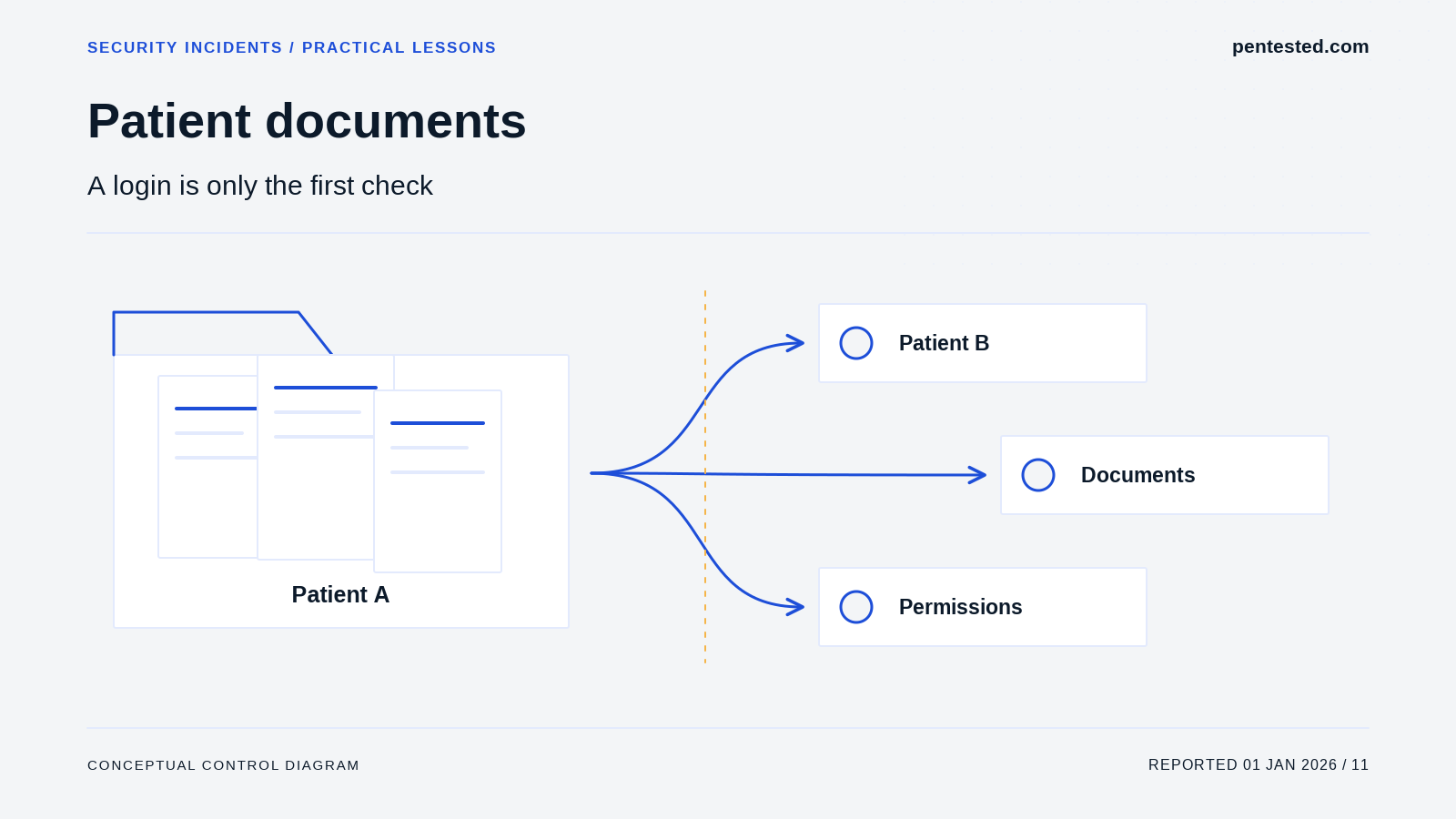
The Manage My Health breach shows why signing in successfully must never give a patient access to another person's documents. A patient portal combines identities, uploaded files and information supplied by healthcare organisations. Each document request needs to enforce the relationship between the current user and the specific record being requested.
What happened
Manage My Health detected an incident on 30 December 2025 and issued a public statement on 1 January 2026. The affected feature was its My Health Documents module. The company distinguished that feature from live GP clinical systems, prescriptions, secure messaging and appointment functions.
New Zealand's Privacy Commissioner later reported that stolen valid patient credentials had been used to enter the portal and obtain documents belonging to other patients. The regulator's phase-one report identified 99,416 affected patients, revising earlier estimates. This later finding provides a more specific explanation than the initial public holding statements and should be identified as subsequent information.
How the timeline changes the interpretation
The article is dated to the public disclosure on 1 January, rather than the December discovery. The regulator published its phase-one findings in May 2026. Readers should not assume those findings were available to patients during the initial response.
The distinction also matters technically. A statement that credentials were stolen describes entry to an account. It does not explain why that account could obtain other people's documents. Both boundaries require examination, and strengthening only the login process would leave the second question unanswered.
Patient identity and document authority
Patient document permissions should be checked by the server for every relevant operation. A list of files shown in the interface is not a security boundary if another file can be requested directly. The application needs to establish that the authenticated person is entitled to the particular document at that moment.
Access relationships can be complicated. Portals may support carers, parents, delegated access, shared family devices and records originating from different providers. These are legitimate requirements, but they need explicit rules. An exception created for one relationship should not silently expand into access across unrelated accounts.
Files can also have several access paths. A document may be available through a preview, download, search result, notification link or storage URL. Protecting the main page while leaving another route less constrained creates inconsistent enforcement. A review should follow the document through each route.
Clinical document containment depends on understanding where copies exist. An uploaded report may be stored in an object store, indexed for search and included in an export. Access revocation and deletion need to account for those locations, with clear limits on what the organisation can establish about copies already obtained elsewhere.
Why document breaches can be especially harmful
Health documents can contain information about relationships, treatment and circumstances that people have shared in confidence. The impact is not adequately described by a generic count of names or email addresses. Different documents can have very different consequences for the people concerned.
The organisation also needs to communicate carefully about scope. Saying that only one module was affected can be technically accurate while still describing a serious breach. The useful explanation identifies the module, the information it held and the other functions that the evidence indicates were unaffected.
Notification can be difficult where a patient did not personally upload the document or no longer uses the portal. Healthcare providers and platform operators need an agreed process for identifying affected people and providing consistent information. That responsibility should be considered when data-sharing arrangements are designed.
The response should avoid creating unnecessary additional exposure. Support staff need safe ways to verify an enquiry and explain which records were affected. Sending sensitive documents through an improvised channel merely to confirm the original breach can make the situation worse.
How penetration testers assess similar portals
An authorised assessment should use several synthetic patients with clearly separated records, plus any supported representative or delegated roles. Testers can then assess whether each role can list, preview, download or search for another test patient's documents. Real clinical information should not be used to prove a boundary that synthetic data can demonstrate.
The review should cover changes in the relationship over time. For example, a delegated permission may be granted and then withdrawn, or a document may be replaced. The application should enforce the current relationship across all access routes, including previously issued links where the design promises revocation.
Storage and caching deserve separate attention. Testers can examine whether a direct storage link remains usable outside the intended session or audience, using agreed test files. The finding should explain the effective protection rather than assuming that a difficult-to-guess address is sufficient authorisation.
Detection testing should establish whether repeated access to documents outside an account's expected context is visible. A controlled exercise can use a small number of test records and measure whether responders can identify the user, the requested documents and the result of each request.
How to reduce the risk
Centralise document authorisation rules and apply them to every server-side operation. Make the permitted relationships explicit, including representative access and provider-supplied records. Ensure that a valid login alone does not become authority to retrieve arbitrary stored files.
Use storage access mechanisms that match the sensitivity and revocation requirements. Review the lifetime, audience and distribution of download links. If a link is intended to be shareable, make that decision clear and limit the information exposed through it.
Strengthen patient authentication and session protection while recognising their separate purpose. These controls reduce account takeover, but they should complement record-level authorisation rather than replace it. Recovery procedures need to address both the compromised account and any wider document access it enabled.
Retain useful access evidence without creating another uncontrolled clinical dataset. Logs should identify the action, account, document reference and outcome, with restricted access and suitable retention. Avoid copying unnecessary clinical contents into general monitoring systems.
Review data-sharing and notification arrangements with healthcare partners. Establish who can identify affected patients, who contacts them and how support questions are handled. Test that process with a fictional document incident before it is needed urgently.
Use test patients with deliberately different relationships to the service: a patient with one provider, a patient with several providers and an authorised representative with limited access. Compare document permissions across those relationships. A portal may correctly protect an ordinary record while handling a delegated relationship differently. The expected result should come from the service's intended care and consent model, with each permitted action demonstrated explicitly. That gives both developers and clinical stakeholders a concrete account of which boundary is being protected.
A practical assurance outcome
A portal should be able to demonstrate that one patient's compromised credentials do not expose another patient's records. That is a clear test objective with a clear business meaning, even when the underlying storage and application architecture are complicated.
Use that objective to join authentication, application authorisation, storage controls and incident evidence in one review. The outcome should be a demonstrated boundary and an understandable response process, rather than a collection of separate controls whose interaction has never been checked.
References
<https://managemyhealth.co.nz/public-notice/>
<https://managemyhealth.co.nz/mmh-cyber-breach-update-january-2026/>
<https://www.privacy.org.nz/focus-areas/manage-my-health-inquiry/executive-summary-manage-my-health-phase-one/>
Related issues
- What the DentaQuest breach reveals about combined health and identity data
- What the Nottingham University breach teaches about student-record security
- What the MyDr data breach teaches about historical medical records
Read about our methodology or contact pentested.com to discuss security testing for your organisation.


