What the MyDr data breach teaches about historical medical records
Public report: 12 August 2026. Updated: 17 November 2026.
The MyDr data breach demonstrates why historical medical information remains a security concern even when current services continue operating. A record's age does not necessarily reduce its sensitivity. A supplier may hold years of information on behalf of many organisations, creating a concentration of data that needs clear ownership, restricted access and an understood retention purpose.
What happened
On 12 August 2026, Poland's Ministry of Digital Affairs reported unauthorised access to historical medical-practice data held in MyDr systems. Its notice said the incident could concern approximately 18.8 million people and more than 12,000 medical facilities, with the historical data extending to April 2024.
The authorities distinguished the affected stored information from the continued operation of current healthcare services. Poland's health ministry said central e-health services had not been breached. The figures and scope should retain the qualifications used in those notices, rather than being presented as a final independently verified count of every exposed patient record.
What the reporting date represents
The article is dated to the August public statements. The age of the stored information is not the date of public disclosure or necessarily the date of unauthorised access. Those points need separate evidence.
The published notices do not establish a complete technical entry route. It would therefore be misleading to label the incident as a particular vulnerability, exposed backup or authentication failure without further support. The established issue is the exposure of a large historical dataset at a supplier.
Historical information has a continuing risk
Historical clinical data can remain personally revealing long after the original appointment or transaction. Unlike a password, much of that information cannot simply be replaced. Retention decisions should consider the continuing consequence of exposure as well as the convenience of keeping old records available.
Medical supplier retention can become complicated where the same platform serves many practices. Different organisations may have different needs, while the supplier uses common storage or support processes. The arrangement needs an explicit understanding of whose information is held, why it remains and who can authorise its removal or restriction.
The dataset may also outlive the active customer relationship. A practice can move to a new system while historical information remains in an archive, migration copy or support environment. Closing a commercial account does not establish that every relevant copy has been addressed.
An information inventory should therefore distinguish active records, required archives and temporary copies. Each category needs a purpose, owner and access model. Treating all historical data as one undifferentiated store makes both prevention and incident analysis harder.
Why availability is not the whole outcome
An organisation may continue issuing appointments or prescriptions while historical information is exposed. Continued service is important, but it does not resolve confidentiality concerns. Incident updates should explain those different dimensions rather than using one as a proxy for the other.
Affected practices may need to understand which of their records are involved before they can support patients. A supplier-level estimate is useful context, but operational decisions require an organisation-specific view and a clear method for communicating corrections.
Historical datasets can also contain duplicate or changed identities. A person may appear under several contact details or across multiple practices. Counting records, unique identifiers and people requires a defined method. A precise-looking total can be misleading if those populations are not distinguished.
Support and verification processes should avoid asking people to provide unnecessary new medical information. The organisation needs a secure route for enquiries and a clear explanation of what can be established about an individual's exposure. Public interest in a breach does not justify redistributing the affected records.
How penetration testers assess comparable stores
An authorised assessment should identify the historical data stores and the identities able to access them. Include archives, migration environments and supplier support copies within the agreed scope. Use synthetic records or approved metadata to establish boundaries without examining unrelated clinical contents.
Review separation between practices and between active and historical information. Testers can assess whether a routine support or customer role can obtain records beyond its legitimate purpose. A useful finding identifies the store, operation and effective permission involved.
Lifecycle testing should examine what happens when a customer leaves or a retention decision changes. The organisation should be able to demonstrate the outcome across relevant copies, subject to its documented obligations and purposes. A closed billing account is not evidence that data access has ended.
An incident-readiness exercise can name a fictional affected archive and ask the supplier and a test customer to identify the corresponding people and communication responsibilities. This assesses whether the data map supports real decisions rather than simply recording that storage exists.
How to reduce the risk
Maintain a data register organised by purpose and customer relationship. Identify the information held, its location, its age and the reason for retaining it. Review temporary and historical copies separately from the active clinical application.
Restrict archive access according to actual duties. A historical store may need fewer routine users and integrations than the live system. Protect exceptional access and retain evidence of who used it and why.
Define supplier offboarding and retention workflows that reach the actual storage. Establish how customers can obtain evidence of deletion, restriction or continued required retention. Avoid assuming the commercial and technical lifecycles complete themselves automatically.
Minimise unnecessary joins and copies. A reporting or support task may need aggregate information rather than a complete identifiable medical history. Review the content of exports and diagnostic material before they become long-lived secondary datasets.
Prepare organisation-specific incident information. The supplier should be able to identify affected customers, explain the relevant data categories and provide a consistent route for updates. Customers need enough evidence to make their own support and communication decisions.
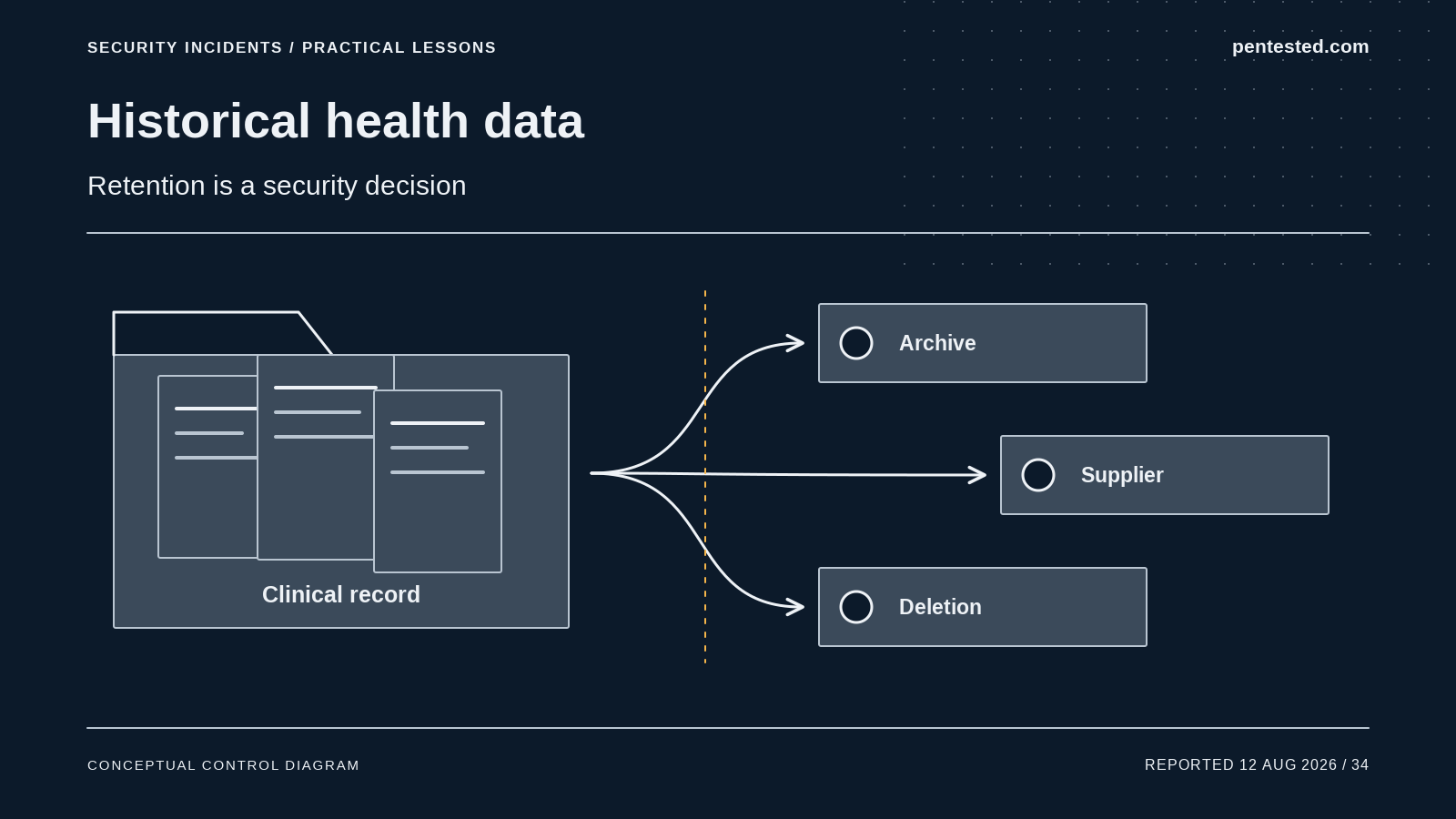
Retention decisions should account for old records that are still easy to retrieve. A database may be described as historical while remaining connected to a live support account or export function. Review the practical access path, the purpose for keeping the information and the evidence that deletion takes effect across the relevant copies.
Test deletion with a synthetic record and a documented retention condition. Establish what disappears from the active service, what remains in a restricted backup and how a later restoration avoids silently returning the record to ordinary use. That last step is important: deleting an unnecessary record today is less effective if the next recovery exercise makes it broadly accessible again. Data retention and recovery design should therefore be reviewed together.
A useful retention exercise
Choose one historical dataset and ask its owner to explain why it still exists, who can access it and how it would be identified during a supplier incident. Compare that answer with the actual permissions and copies.
If the purpose is no longer clear, resolve it before adding more protective controls around an unnecessary store. Where retention remains necessary, make access and incident evidence proportionate to the continuing sensitivity of the information. Historical data should remain because of an understood purpose, not because nobody has revisited its lifecycle.
References
<https://www.gov.pl/web/cyfryzacja/komunikat-po-spotkaniu-polaczonego-centrum-operacyjnego-cyberbezpieczenstwa>
<https://www.gov.pl/web/zdrowie/informacja-w-zwiazku-z-incydentem-dotyczacym-firmy-mydr>
Related issues
- What the Manage My Health breach teaches about patient documents
- What the DentaQuest breach reveals about combined health and identity data
- What the Barts Health data theft reveals about finance-system security
Read about our methodology or contact pentested.com to discuss security testing for your organisation.


