What the DentaQuest breach reveals about combined health and identity data
Public report: 16 July 2026. Updated: 17 November 2026.
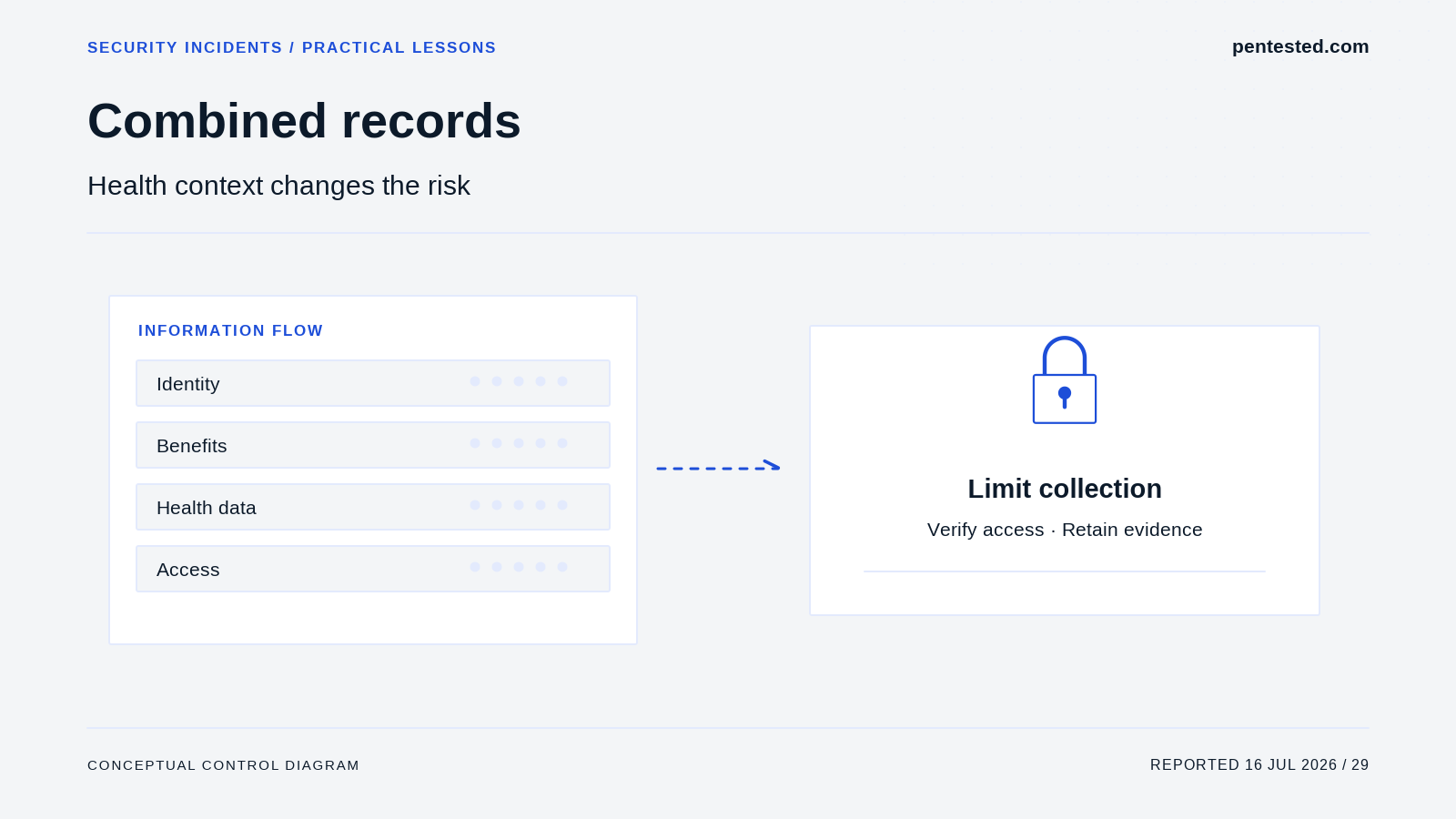
The DentaQuest breach illustrates the consequences of storing identity, eligibility and health information together. Each field may support a legitimate benefits-administration task, but the combined record can reveal considerably more than an ordinary customer profile. Security reviews should consider the value of the joined dataset and the different parties whose information it contains.
What happened
DentaQuest published a breach notice on 16 July 2026 concerning unauthorised access between 17 and 20 May. The notice describes personal identifiers and dental or vision health information, with the information varying by individual. Examples include names, addresses, Social Security numbers, member identifiers and treatment or billing information.
The company described notification and identity-protection support. Its notice did not provide a complete public technical account of initial access. This article therefore focuses on the sensitivity and handling of the affected information, without inventing a vulnerability or attributing the incident to a particular attacker.
Why July is the reporting date
The article is dated to the public breach notice, rather than the May access period. Discovery, data analysis and individual notification are separate stages. A later notice may describe an earlier intrusion and include findings that were not established when access was first detected.
The affected population can also differ from the set of current service users. Benefits administration may include providers, former members and other people whose records remain relevant to earlier transactions. An investigation needs to identify those relationships accurately.
The combined record changes the risk
Combined health identifiers can link a person's identity to treatment and financial administration. That relationship may support useful services, but it also increases the consequence of unnecessary access. A review should assess the complete record rather than assigning each field a sensitivity rating in isolation.
Dental-benefits data exposure is a useful example because the business process crosses several roles. A provider needs information to confirm eligibility, an administrator needs information to process a claim and a member may need access to their own history. Those purposes do not automatically require identical visibility.
Free-text notes, attachments and historical records can make the actual dataset broader than its formal schema suggests. A supporting document may contain additional identifiers or clinical context. Classification and retention reviews should include those objects rather than stopping at the main database tables.
Information may also move into reporting, support and export systems. The security boundary follows those copies. A restricted primary application provides incomplete assurance if a secondary store makes the same combined records available to a wider set of staff or suppliers.
Business consequences and individual support
The potential consequences depend on the fields involved for each person. Identity information can support impersonation, while health context can create confidentiality concerns. An organisation should explain those categories accurately without claiming that every possible misuse has occurred.
Notification requires a reliable relationship between the affected record and the person. Duplicate member records, changing contact details and provider relationships can complicate that work. A data model designed only to process transactions may need additional preparation to support incident analysis.
Support channels also need security. People seeking information about a breach may be asked to verify their identity, but the process should not collect unnecessary additional sensitive information or direct them through untrusted links. Established contact methods help maintain confidence.
The organisation needs to measure completion beyond sending an initial letter. It should track unresolved records, returned communications and the information supplied to people who ask about their specific exposure. That operational work can continue after the technical access route has been contained.
How penetration testers assess comparable datasets
An authorised assessment should map the roles and data flows across member, provider, administrative and support functions. Use synthetic identities and representative records to test whether each role sees only the information its task requires. The test should include attachments and exports as well as the main interface.
Record-level access controls should be assessed independently from authentication. A valid provider or member login should not become authority to retrieve unrelated records. Demonstrations should use a small controlled dataset and identify the precise boundary that fails.
Review service accounts and reporting identities that join or export data. Their reach can be broader than that of ordinary users, and their ownership may be less visible. A useful finding explains the actual dataset available and the business process that grants that access.
An incident-readiness exercise can identify a fictional affected table or document set and ask the team to establish the corresponding people and data categories. Measure whether the answer is reproducible and whether the team can explain uncertainty rather than presenting an unjustified exact count.
How to reduce the risk
Classify information according to the combined record and the purpose of access. Separate views for eligibility, treatment administration and support where the workflow permits it. Avoid making the fullest record the default response for every role.
Minimise information in secondary systems. Review what is copied into analytics, support tickets and bulk exports, and whether those copies retain a current purpose. Apply access and retention decisions to attachments and historical stores as well as active database records.
Constrain machine identities and exceptional export functions. Give them clear owners, documented purposes and reviewable activity. A broad service account should not remain permanently available simply because it was convenient during an earlier integration project.
Retain useful evidence of sensitive access. Logs should support investigation of the identity, operation and affected record references without copying unnecessary health contents into general monitoring tools. Protect access to those logs according to the information they reveal.
Prepare data analysis and notification processes with operational teams. Agree how duplicate records, former members and incomplete contact information will be handled. A small exercise using synthetic records can expose gaps long before an urgent public notice is required.
Data owners should assess the usefulness of a combined record to someone outside the organisation. Information that appears ordinary in separate systems can reveal a much more specific picture when linked by a common identifier. Review which exports and service accounts can perform that combination and whether the business actually needs it in each workflow.
Support arrangements should be designed around the people receiving the notice. Explain what is established, what remains under investigation and how the person can authenticate further communications. Avoid directing recipients to provide additional sensitive information through an unverified channel. A breach response should not create an unnecessary new collection of the same personal information the organisation is trying to protect.
A focused review for data owners
Choose one benefits-administration workflow and identify the minimum information needed at each stage. Then compare that with the actual screen, API response, export and supporting document available to the user.
That comparison often produces specific improvements: a narrower view, a removed attachment copy or a better-defined export role. The objective is to make necessary information available for the task while reducing the amount of joined identity and health data exposed through any single compromised account or system.
References
<https://www.dentaquest.com/en/notice-of-data-breach>
Related issues
- What the Barts Health data theft reveals about finance-system security
- What the Manage My Health breach teaches about patient documents
- What the MyDr data breach teaches about historical medical records
Read about our methodology or contact pentested.com to discuss security testing for your organisation.


