What the Barts Health data theft reveals about finance-system security
Public report: 5 December 2025. Updated: 17 November 2026.
The Barts Health data theft demonstrates why a hospital's finance platform deserves the same careful information classification as its clinical applications. An invoice can identify a person, reveal their relationship with a healthcare provider and supply convincing material for impersonation. The system's business label does not determine the sensitivity of the records inside it.
What happened
On 5 December 2025, Barts Health disclosed that Cl0p had stolen files from an invoice database through an Oracle E-Business Suite vulnerability. The trust said the information included names and addresses associated with patients, some former staff and suppliers. It dated the theft to August, with the risk to its data becoming apparent in November.
Barking, Havering and Redbridge University Hospitals also disclosed affected information because Barts provided accounting services for it. The trusts said clinical systems were unaffected. Those distinctions matter: this was a finance-system data theft with healthcare consequences, rather than evidence that every clinical record or hospital application was compromised.
Why the reporting date differs from the theft
This article is dated to the December public disclosure. The August intrusion and November discovery of exposed files belong in the incident timeline, but neither should be silently substituted for the date on which the trusts informed the public.
The published notices establish a vulnerable enterprise-software route and the types of files involved. They do not provide a complete account of every defensive control. The recommendations below apply to organisations reviewing comparable business applications and shared finance services.
Finance systems can contain unexpected sensitivity
Hospital invoice data is often handled by different teams from clinical information. Finance staff need details to arrange payment, resolve queries and keep accounting records. Over time, supporting documents and free-text explanations may accumulate beside the transaction itself.
A review should therefore examine actual records and attachments, using approved samples or synthetic examples. A database schema that labels a field as a reference or description may conceal sensitive business context. The same issue appears in legal billing, insurance administration and professional services.
Oracle finance-system exposure also illustrates the importance of enterprise applications that are less visible than a main website. Their interfaces may support suppliers, staff or administrative workflows and can remain critical for many years. Security responsibility needs to follow the deployed application, its supporting software and its internet-facing routes.
Shared accounting services add another boundary. One provider's platform may hold records for several separate organisations. A customer needs to understand where its information sits, who can administer it and what evidence it will receive if the shared service is affected.
Data theft has consequences without an outage
A business can continue operating while stolen records create ongoing risks. An attacker may use genuine invoice details to impersonate the organisation, invent a payment problem or persuade a recipient to disclose more information. The impact depends on the fields involved and the credibility they add.
That is an illustrative fraud scenario, not a claim that every affected person experienced it. Good communication explains the exposed information and the warning signs relevant to it. It should also make clear which official channels can be used to verify a payment request.
The organisation must identify people in documents that were not designed for incident notification. A supplier entry, a former employee and a paying patient may require different contact methods. Data discovery and notification planning should account for those categories before an emergency.
Legal action can help restrict further use of stolen information, but it does not substitute for technical containment or individual support. Security teams still need to establish the affected period, remove the access route, examine reachable credentials and improve the controls around the application.
How penetration testers assess similar systems
Start by identifying the finance platform's exposed interfaces and the business purpose of each. Administrative functions, supplier access and system integrations should be mapped separately. The assessment needs to cover the deployed enterprise components as well as custom application code.
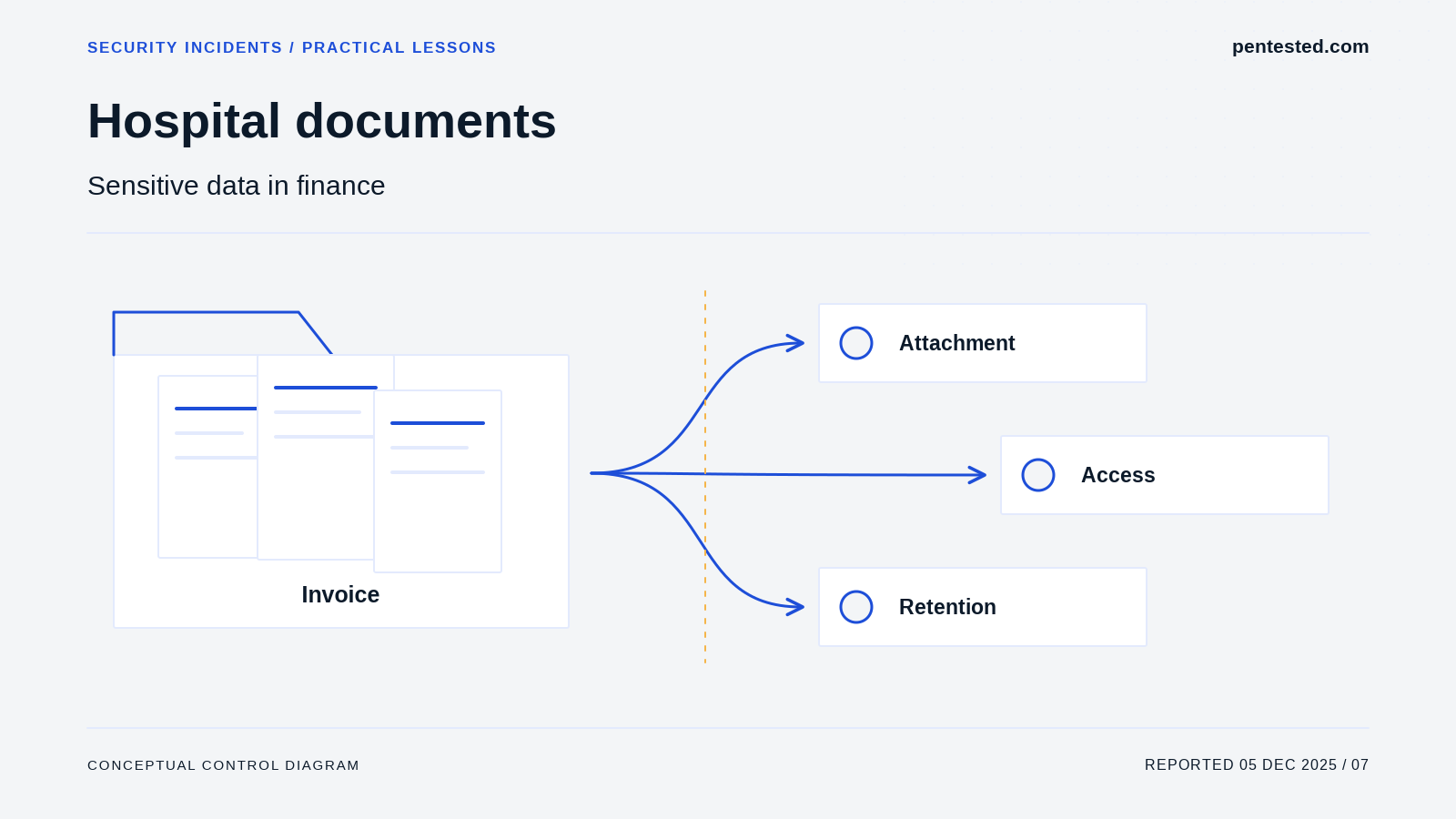
Testers should use authorised roles to examine which invoices, attachments and customer records each role can access. Synthetic records can demonstrate whether a supplier account can reach another supplier's information or whether routine finance access includes unnecessary historical exports.
The supporting environment matters too. An assumed-compromise review can examine what the application identity could read from storage, databases and connected services. A vulnerability that appears confined to one application may be more consequential if that identity holds broad authority elsewhere.
Finally, assess whether the organisation can investigate a limited data-theft scenario. The exercise can trace a controlled download of test invoices through application and platform logs, then ask the response team to identify the records involved. The quality of that answer is a useful measure of readiness.
How to reduce the risk
Classify finance information according to its contents and context. Review whether invoice descriptions and supporting attachments contain more personal information than the accounting purpose requires. Where sensitive details are necessary, apply suitable access restrictions and retention rules.
Maintain a clear application owner and an inventory of supporting components. Security updates should reach every relevant instance, including interfaces hosted for shared-service customers. Record the version actually running and the evidence that the update was completed.
Restrict administrative access and separate routine accounting work from platform administration. Use service identities with limited permissions, especially where one platform supports several organisations. A shared service should not make every customer's records accessible through every routine support task.
Prepare a response process for data theft that does not depend on systems being visibly unavailable. Include suspicious exports, unusual file access and supplier notifications as possible triggers. Preserve the evidence needed to establish both the affected records and the organisations responsible for communicating with individuals.
Agree incident-information requirements with shared-service providers. Customers should know what the provider can disclose about access, timestamps, affected datasets and remediation. A general assurance that the platform is now available is insufficient to answer questions about historical exposure.
A finance data owner should be able to explain why each sensitive document is present and how long it is needed. Attachments deserve particular attention because they may be retained under the application's general policy even when their contents have a different sensitivity. Review a small, approved sample using records selected by the business rather than copying a large dataset into a new analysis tool.
Recovery should also address the people affected by disclosure. A restored application does not remove information that has already left it. Establish who decides on notification, which support route can answer individual questions and how staff distinguish verified advice from opportunistic messages. Those responsibilities need to continue after the technical remediation team has moved to its next task.
A practical starting point
Ask the finance owner to identify three representative records: an ordinary invoice, an invoice with a supporting attachment and an old record involving an individual. Review what each reveals and which roles can obtain it.
Then test whether the team can identify who downloaded those records using controlled activity. That small exercise links data classification with access control and incident evidence. It often provides a more useful starting point than treating the finance platform as a low-sensitivity back-office system until a public breach proves otherwise.
References
<https://www.bartshealth.nhs.uk/news/cl0p-cyberattack-update-18178/>
<https://www.bhrhospitals.nhs.uk/news/data-incident-5328/>
Related issues
- What the ChipSoft ransomware attack reveals about healthcare suppliers
- What the DentaQuest breach reveals about combined health and identity data
- What the MyDr data breach teaches about historical medical records
Read about our methodology or contact pentested.com to discuss security testing for your organisation.


