What the Boston Scientific cyber incident teaches about manufacturing continuity
Public report: 26 August 2026. Updated: 17 November 2026.
The Boston Scientific cyber incident shows why manufacturing resilience should be assessed through the movement of a correct order, not simply through the availability of machines on a factory floor. A business needs reliable information to decide what to produce, release, process and ship. Losing shared applications can interrupt that chain even when individual production capabilities remain intact.
What happened
Boston Scientific disclosed an incident identified on 25 August 2026 that caused global operational disruption. Its subsequent regulatory update described affected IT systems and the continuing work to investigate, contain and restore operations. The company said the incident was likely to have a material effect on third-quarter results.
Those disclosures establish a serious business interruption. They do not provide a complete public technical entry route or justify attributing the event to a particular ransomware group. The analysis below addresses manufacturing dependencies and recovery assurance without inventing those missing details.
Reporting date and financial assessment
The article is dated to the initial public disclosure in August. The later regulatory update reflects information developed during the response. An expectation about quarterly impact should remain identified as an assessment made at that stage, rather than being silently converted into a final audited loss figure.
The chronology also separates identification, containment and restoration. A company can make progress on one system while important business functions remain constrained elsewhere. Recovery needs to be understood as a sequence of service outcomes.
Orders connect several forms of trust
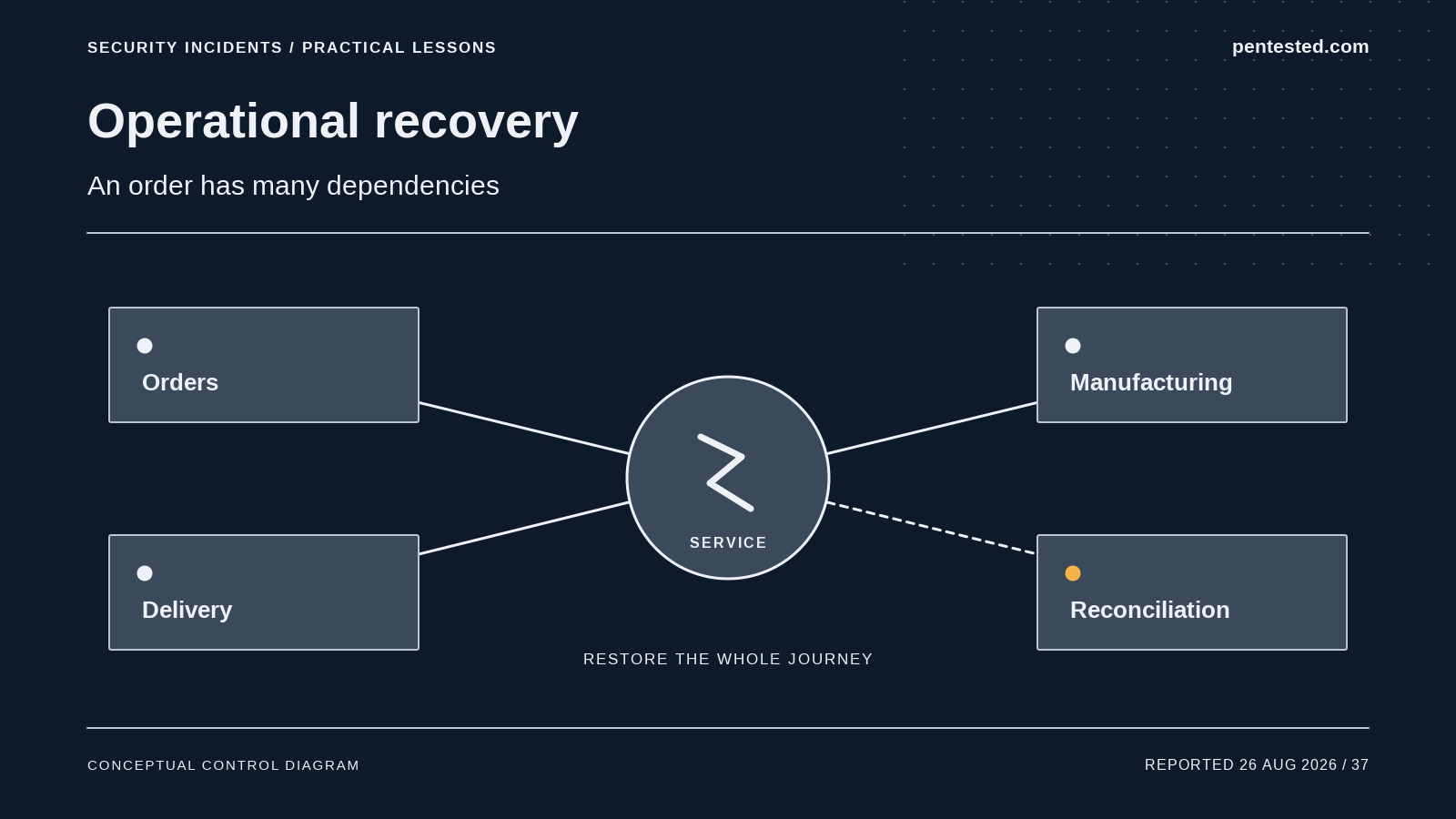
Manufacturing application dependencies can include scheduling, inventory, product information, release records and distribution systems. Each holds part of the information needed to complete an order correctly. A resilience review should establish which dependencies are essential and which can operate through an approved alternative.
The integrity of the information is as important as access to it. A temporary record may be sufficient to continue a task, but it needs appropriate verification and a way to reconcile it later. An organisation should not assume that a workaround is safe merely because it allows activity to continue.
Medical supply-chain recovery adds a need for accurate communication with customers and partners. A delayed shipment, an uncertain order status and a substituted delivery plan require different decisions. Staff should be able to identify which information is verified and which is still being reconstructed.
These are general dependencies to test in a comparable business, not a list of systems confirmed as compromised at Boston Scientific. The practical value is to identify where a shared application can interrupt the organisation's own order-to-delivery process.
Why restoration can create a second workload
During an outage, teams may process work manually, accept requests through alternative channels or defer updates. When systems return, those actions need to be reconciled. Otherwise the business can create duplicate orders, missed transactions or inconsistent status information.
Reconciliation should have a defined source of truth. If several temporary records exist, staff need rules for resolving conflicts and escalating uncertainty. A recovery plan that ends when the application starts does not address this operational workload.
The organisation also needs confidence that restored data is current and appropriately protected. A backup may recover a service to an earlier point, while later legitimate work exists in other records. The recovery team should understand those differences before normal automation resumes.
Leadership should therefore measure both the restored capability and the outstanding consequences. Useful measures include the number of tasks that can be completed reliably, the backlog awaiting reconciliation and the exceptions still operating. Server availability is a supporting metric rather than the complete business outcome.
How penetration testers assess comparable operations
An authorised review should select a representative fictional order and map every application, identity and record needed to fulfil it. Validate the map with staff responsible for planning, release and shipping. Technical inventories often miss the document or shared identity that makes a process usable.
An assumed-compromise assessment can examine the reach of a relevant business-application or management identity. Use controlled data and explicit limits, with no changes to live production instructions. The report should connect excessive authority to the process information it could affect.
A continuity exercise can make one dependency unavailable in a tabletop or isolated test environment. Ask staff to complete the agreed task through approved alternatives, including verification and communication. The aim is to identify unsafe assumptions, not to create a real manufacturing interruption.
The exercise should continue into reconciliation. Introduce a small controlled discrepancy between the temporary record and the restored system, then observe how it is resolved. This tests the recovery process that is often omitted from ordinary availability testing.
How to reduce the risk
Maintain a process-level dependency register with named operational and technical owners. Identify the information and authority required for each essential step. Use that register to prioritise protection and recovery investment according to the consequence of failure.
Separate administration and routine business access. Review whether one identity can alter several records or systems that are supposed to provide independent checks. Apply suitable approval and monitoring to changes with a broad operational effect.
Prepare approved fallback records and communication routes. Define the minimum verification required and how uncertainty is escalated. Make the process usable for the staff and partners who would actually carry it out under pressure.
Protect recovery identities and trusted configuration separately from ordinary application access. Verify that restored systems contain the intended permissions and data state before reconnecting automated workflows. A successful restore job is evidence of one technical operation, not proof that the whole process is ready.
Plan for reconciliation and review of temporary exceptions. Assign owners, preserve the records needed to join work back together and monitor for duplicated or missing tasks. Include this effort in recovery estimates and leadership reporting.
A temporary order process needs a reliable way to identify a request when the normal system returns. Agree which reference is created, who can approve a change and how staff identify an order already handled through another channel. A spreadsheet can be a useful short-term aid, but it needs controlled access and a defined route back into the system of record.
Test recovery using deliberately awkward fictional cases: an urgent request, a changed delivery address and a customer who submits the same order twice. Ask the team to reconcile the records without guessing. The result should show which evidence survives the temporary process and which decisions require an authorised person. This connects technical restoration with the accuracy of the service customers actually receive.
A useful operations exercise
Take one fictional customer request from acceptance to confirmed dispatch while assuming a key business application is unavailable. Require the team to show where each decision is recorded and how the result would later be reconciled.
The exercise often reveals that resilience depends on information and authority as much as physical capacity. A strong plan keeps essential work accurate during disruption and returns it to the restored environment without leaving an unmeasured backlog of uncertain transactions.
References
<https://www.sec.gov/Archives/edgar/data/885725/000088572526000059/bsx-20260907.htm>
Related issues
- What the Stryker cyberattack teaches about operational continuity
- What the ChipSoft ransomware attack reveals about healthcare suppliers
- What the Ahold Delhaize cyberattack teaches about retail resilience
Read about our methodology or contact pentested.com to discuss security testing for your organisation.


