What the Ahold Delhaize cyberattack teaches about retail resilience
Public report: 12 October 2026. Updated: 17 November 2026.
The Ahold Delhaize cyberattack demonstrates how disruption to digital services can have a substantial commercial effect while physical stores continue trading. Retail operations depend on many linked decisions about stock, prices, orders and delivery. Security resilience should follow those complete customer journeys rather than treating online availability as a separate technical concern.
What happened
Ahold Delhaize publicly announced a network security issue on 12 October 2026 and said it had taken some systems offline as a precaution. Its initial statement said stores remained open. Subsequent updates described controlled restoration and continuing investigation.
In its November results, the group estimated that the incident would reduce fourth-quarter net sales by €200 million to €250 million and operating income by €75 million to €100 million. These were forecast business effects at that reporting date, not a ransom payment or a final universal measure of the incident's cost.
Why the financial update belongs later
The article date follows the October public announcement. The November forecast reflects a later assessment of business disruption. It should not be presented as a figure known on the first day or confused with the value of data stolen.
The company's public notices do not provide a complete technical entry route. The analysis below therefore focuses on retail dependencies and recovery measurement without inventing an initial vulnerability, malware family or specific internal system as the cause.
Retail availability is a transaction chain
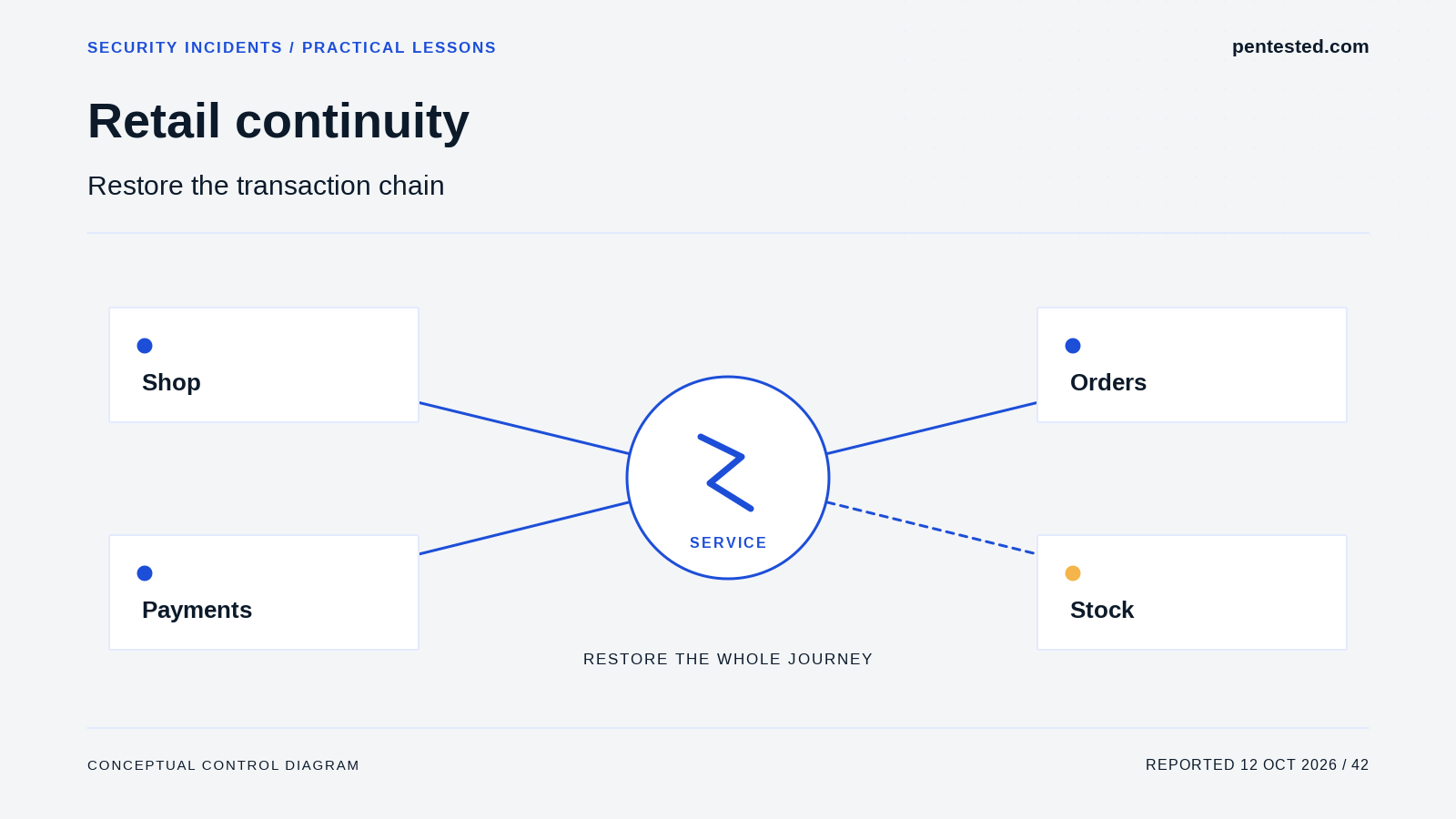
Online grocery continuity can depend on product information, account identity, stock reservation, payment and fulfilment scheduling. A customer may reach the website but still be unable to complete a useful order. The service objective needs to cover the full chain.
Physical trading can also rely on supporting digital systems, although the exact dependencies vary by retailer. A resilience review should map them explicitly and identify which functions can continue independently. Keeping a store open and restoring its complete supporting workflow are different outcomes.
Shared services can concentrate the effect across brands or regions. A common identity, application or integration may support several otherwise distinct businesses. The review should identify those relationships and the authority able to change them, rather than assuming commercial separation creates technical independence.
Retail outage measurement should distinguish failed transactions, delayed transactions and work completed through alternative channels. Those categories matter when estimating impact and deciding which recovery action will produce the greatest practical benefit.
Why reopening creates further decisions
Orders may have been accepted before disruption, interrupted during processing or placed through temporary routes. The business needs a reliable way to establish their state and avoid duplicates, missed fulfilment or misleading notifications. This is a process-integrity question as well as an availability question.
Restored stock and delivery information also needs validation. A system returning to an earlier state may not reflect work performed manually during the outage. Staff need rules for reconciling the differences and escalating uncertainty before automation resumes fully.
Customer communication should identify the functions available and the limitations that remain. A general message that services are returning may be insufficient for someone deciding whether an existing order will arrive. Clear status information can reduce unnecessary retries and pressure on support teams.
The business should also watch temporary exceptions. Emergency access, manual exports and alternative communication channels can be useful during recovery, but they need ownership and a planned end. Otherwise the incident leaves a more complicated and less controlled environment behind it.
How penetration testers assess comparable retailers
An authorised assessment should map representative customer and operational journeys across applications and suppliers. Use synthetic accounts, products and orders to examine access boundaries without affecting real purchases. The scope should identify where payment or third-party systems require separate permission.
Review the authority of shared administrative and integration identities. A controlled assumed-compromise exercise can establish whether one service has unnecessary reach into other brands or business functions. The report should explain that reach in terms of the tasks it can interrupt or alter.
A continuity exercise can remove one key dependency in a tabletop or isolated environment. Ask the team to complete a fictional order using approved alternatives, including verification, customer communication and fulfilment records. This tests whether the fallback supports a complete useful outcome.
The recovery exercise should include reconciliation of interrupted and temporary transactions. Introduce a small controlled inconsistency and observe who resolves it and which record is authoritative. That provides stronger assurance than testing only whether the checkout page loads.
How to reduce the risk
Maintain a business-journey dependency map with clear owners for applications, identities and supplier connections. Identify shared services capable of affecting several trading channels. Use that information to prioritise both security controls and recovery investment.
Separate routine operational access from broad administration. Review credentials that can alter several systems or override important checks. Apply suitable approval and monitoring according to their commercial reach rather than the convenience of a shared support process.
Prepare approved alternatives for essential tasks and document their limits. Include how orders are verified, recorded and later reconciled. Staff need a safe usable process, not merely a general instruction to continue manually.
Define restoration checks for the customer journey and its supporting information. Validate stock, order state and relevant interfaces before normal automation resumes. Record reduced functionality clearly and monitor it during staged reopening.
Measure impact with a consistent model. Keep lost sales, deferred sales, response costs and other effects separate, and identify whether a figure is estimated or final. This improves both leadership decisions and the accuracy of subsequent public reporting.
A retail recovery exercise should follow the same transaction through the shop, the stock record and the financial record. If one system is available before another, establish how staff prevent an apparently successful sale from creating an untracked inventory or payment exception. Include refunds and cancelled orders, where temporary arrangements can produce inconsistent results that appear only later.
Service owners should know what evidence is needed before a location or channel reopens. That may include trusted identity, reliable pricing, safe payment handling and an agreed method for reconciling work completed during the interruption. Avoid a single availability measure that hides these different conditions. A website, checkout or store can be reachable while the supporting transaction chain remains incomplete, creating avoidable work and uncertainty for both staff and customers.
A useful retail resilience exercise
Choose one fictional online order and trace what happens if a shared system becomes unavailable after payment authorisation but before fulfilment confirmation. The exercise should establish the customer's message, the staff workflow and the authoritative transaction state.
That scenario often reveals the difference between a technically available platform and a reliable retail service. Strong resilience preserves accurate decisions during disruption and makes the return to normal trading understandable to customers, staff and business leadership.
References
<https://newsroom.aholddelhaize.com/ahold-delhaize-reports-resilient-q3-2026-results-and-updates-2026-guidance-to-reflect-business-disruption-caused-by-recent-cybersecurity-incident/>
<https://newsroom.aholddelhaize.com/ahold-delhaize-takes-precautionary-measures-following-cybersecurity-incident>
Related issues
- What the La Poste DDoS attacks teach about service resilience
- What the Boston Scientific cyber incident teaches about manufacturing continuity
- What the Stryker cyberattack teaches about operational continuity
Read about our methodology or contact pentested.com to discuss security testing for your organisation.


