What the La Poste DDoS attacks teach about service resilience
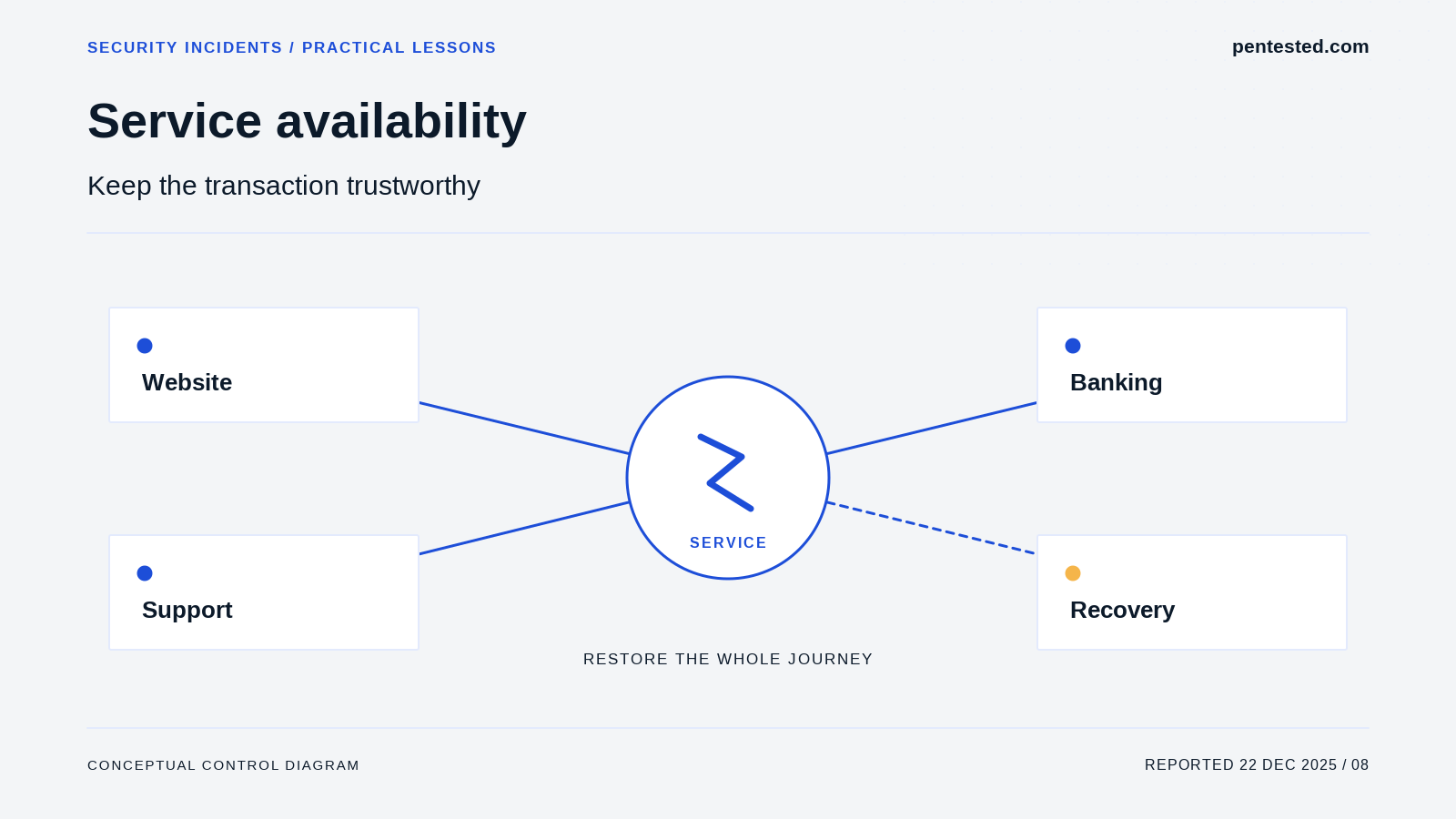
Public report: 22 December 2025. Updated: 17 November 2026.
The La Poste DDoS attacks show how an availability incident can affect several essential services without requiring theft of a customer database. People need reliable ways to track deliveries, manage payments and obtain trustworthy updates. When those channels fail together, the incident becomes a problem of service design and public confidence as well as traffic filtering.
What happened
La Poste and La Banque Postale described a sustained distributed denial-of-service campaign affecting their digital infrastructure between 22 December 2025 and early January 2026. Online postal and banking access was disrupted during a particularly busy period.
The organisations' accounts distinguish digital-channel disruption from the status of other banking and delivery functions. An unavailable website does not, by itself, establish that customer balances, payment records or internal systems were compromised. The case is valuable because the operational harm of lost availability can be substantial even where the public evidence does not show those other outcomes.
Why the duration matters
An initial outage and a recurring attack over several days require different response plans. Temporary measures that work for an hour can become difficult to sustain across a holiday period, changing staff shifts and repeated attempts to restore normal access.
The public reporting date is 22 December 2025. This article also draws on the organisations' later account of the campaign, so the fuller duration should be understood as a subsequent finding rather than something established at the start.
Availability is a chain of dependencies
A digital service depends on more than the server displaying its pages. Name resolution, network connectivity, traffic filtering, identity services and backend systems all contribute to whether a customer can complete a task. A highly available application can still be unusable if one shared dependency becomes a bottleneck.
Peak-period service disruption adds legitimate demand at the same time as malicious traffic. Customers retry failed requests, refresh applications and contact support. That additional demand can complicate diagnosis and place pressure on systems that were not the original target.
Banking channel resilience needs to be assessed through complete customer journeys. Loading a homepage is different from signing in, viewing a transaction and completing an authorised action. A recovery measure that restores one stage while blocking the next may improve a technical dashboard without restoring the service people need.
Attackers can also adapt to defensive changes. A response process needs a route for reviewing whether traffic patterns, infrastructure capacity and filtering rules still match the observed problem. A single protective setting should not be treated as a permanent explanation for every later outage.
Business impact extends beyond downtime
Lost access produces uncertainty. Customers may wonder whether a payment succeeded, whether a parcel will arrive or whether an error means their account is unsafe. Clear service-status information can reduce unnecessary retries and help people choose an appropriate alternative.
Support capacity becomes part of the security response. Call centres, branch staff and social-media teams need consistent information about affected functions and safe workarounds. Without that, well-intentioned staff may offer contradictory advice or direct customers towards channels that are also unavailable.
There is also an impersonation risk during a widely publicised outage. A fraudulent message claiming to offer a replacement login or urgent payment route can appear timely. This is a general risk to plan for, not an assertion that a particular campaign against these organisations succeeded.
Commercial measurement should include delayed transactions, abandoned activity and the work needed to reconcile uncertain outcomes. Counting only the duration of an error page may miss the cost of rebuilding confidence and resolving support cases after the technical service returns.
How penetration testers assess resilience safely
Uncontrolled traffic generation against production is not an appropriate way to establish DDoS readiness. A resilience assessment should agree the objective, safe limits, affected suppliers, emergency contacts and stop conditions before any active work begins.
Much can be learned through architecture review and a tabletop exercise. Testers can map shared dependencies, identify capacity assumptions and ask the team to demonstrate how it would engage its connectivity or protection provider. The resulting gaps often concern authority and coordination rather than raw bandwidth.
Where controlled load testing is authorised, measure complete journeys and supporting systems. The test should separate normal customer demand from the simulated failure condition, with monitoring that identifies which dependency limits service. Production customers and unrelated shared infrastructure must remain protected by the agreed boundaries.
An exercise should also assess communications. The response team can publish a test status update through an independent channel, brief support staff and demonstrate a safe alternative for one essential task. That verifies the service response as well as the technical response.
How to reduce the risk
Document the dependencies required for each important customer journey. Include infrastructure owned by suppliers, the people authorised to request changes and the information those suppliers need during an emergency. Keep contact and access arrangements available outside the affected service.
Use layered protection appropriate to the service architecture. Different controls may be needed for network capacity, application requests and expensive backend operations. Review where filtering decisions are made and which legitimate functions could be affected by a restrictive rule.
Design application behaviour to limit unnecessary work. Caching suitable public content, controlling costly operations and avoiding retry storms can preserve capacity, but each measure needs testing against the business workflow. A protective control that prevents every valid customer transaction does not achieve the service objective.
Maintain an independent status channel with clear ownership. Updates should identify affected functions, available alternatives and the next communication time. Avoid requiring users to sign in through the failing platform merely to learn whether it is working.
Plan staff coverage for a sustained incident, including supplier escalation and handovers. Record decisions and rule changes so the next shift can understand why the current configuration exists. Review temporary restrictions after the incident to remove unnecessary friction safely.
Define an acceptable degraded service before an outage. For a customer-facing transaction, decide which steps can be paused, which must fail safely and which can use another verified channel. A fallback that accepts an instruction without the usual identity check can exchange an availability problem for a fraud problem. The exception needs a limit, an owner and a reconciliation process.
Measure the return to normal as well as the interruption itself. A backlog can generate duplicate requests, uncertain payment status and contradictory customer messages. Test how the service identifies a completed transaction after a customer has retried through another route. The recovery objective is a consistent record of what happened, not simply a website that responds again.
What good recovery looks like
Verify recovery using representative customer tasks and measured performance over a suitable observation period. Check that queued work, delayed notifications and uncertain transactions are handled consistently. Declaring success at the first successful request can create another cycle of failure and confusion.
The central lesson is to treat availability as a business capability. Traffic mitigation is essential, but customers also need safe alternatives, reliable information and confidence that their requests will be handled correctly. A strong exercise demonstrates all of those outcomes together.
References
<https://www.labanquepostale.com/newsroom-publications/actualites/2026/cyberattaque-banque-groupe-la-poste.html>
Related issues
- What the Ahold Delhaize cyberattack teaches about retail resilience
- What the London councils cyberattack reveals about shared IT
- What the Vanderbilt cyberattack teaches about campus-wide recovery
Read about our methodology or contact pentested.com to discuss security testing for your organisation.


