React2Shell exploitation and the race to secure exposed applications
Public report: 4 December 2025. Updated: 17 November 2026.
React2Shell exploitation shows how quickly a framework vulnerability can become an operational emergency. When a widely used component sits on an exposed application path, security teams may have little time between a public advisory and attempted compromise. The quality of the response depends heavily on preparation completed before the advisory appears.
What happened
On 3 December 2025, a critical unauthenticated remote-code-execution vulnerability in React Server Components was publicly disclosed as CVE-2025-55182. Google Threat Intelligence subsequently documented widespread exploitation by multiple groups, including activity delivering backdoors, tunnelling tools and cryptocurrency miners. AWS also reported exploitation attempts shortly after disclosure.
The affected technology matters more than the presence of a familiar framework name in a software inventory. Organisations needed to establish whether their actual application architecture and deployed versions exposed the vulnerable component. This article concerns the exploitation campaign, so its reporting date follows early public reporting of attacks rather than treating the advisory and every later intrusion as one event.
The response timeline has several clocks
Vendor disclosure, an available fix, attempted exploitation and an organisation's own deployment do not necessarily occur together. A team may identify the correct update quickly but still need to locate every affected service and validate a safe release.
A separate clock concerns investigation. If the application was exposed before remediation, installing a corrected version does not establish that it was never compromised. The team needs an evidence-based view of the exposure period and activity during it.
Why framework visibility is difficult
React Server Components exposure cannot be assessed reliably from a list of top-level product names alone. Modern applications often combine frameworks, generated code, build tools and hosting services. The deployed artefact can differ from a developer's current source tree or from the version described in an asset register.
An organisation may also operate preview environments, temporary branches and older application instances. Those services can contain useful credentials even when they do not handle live customer traffic. A patch programme limited to the main production URL can leave relevant exposure elsewhere.
The control boundary is between an unauthenticated network request and execution within the application environment. If that boundary fails, the environment's privileges determine the next consequences. A minimally privileged service with restricted network access presents a different risk from an application holding broad cloud credentials and direct database access.
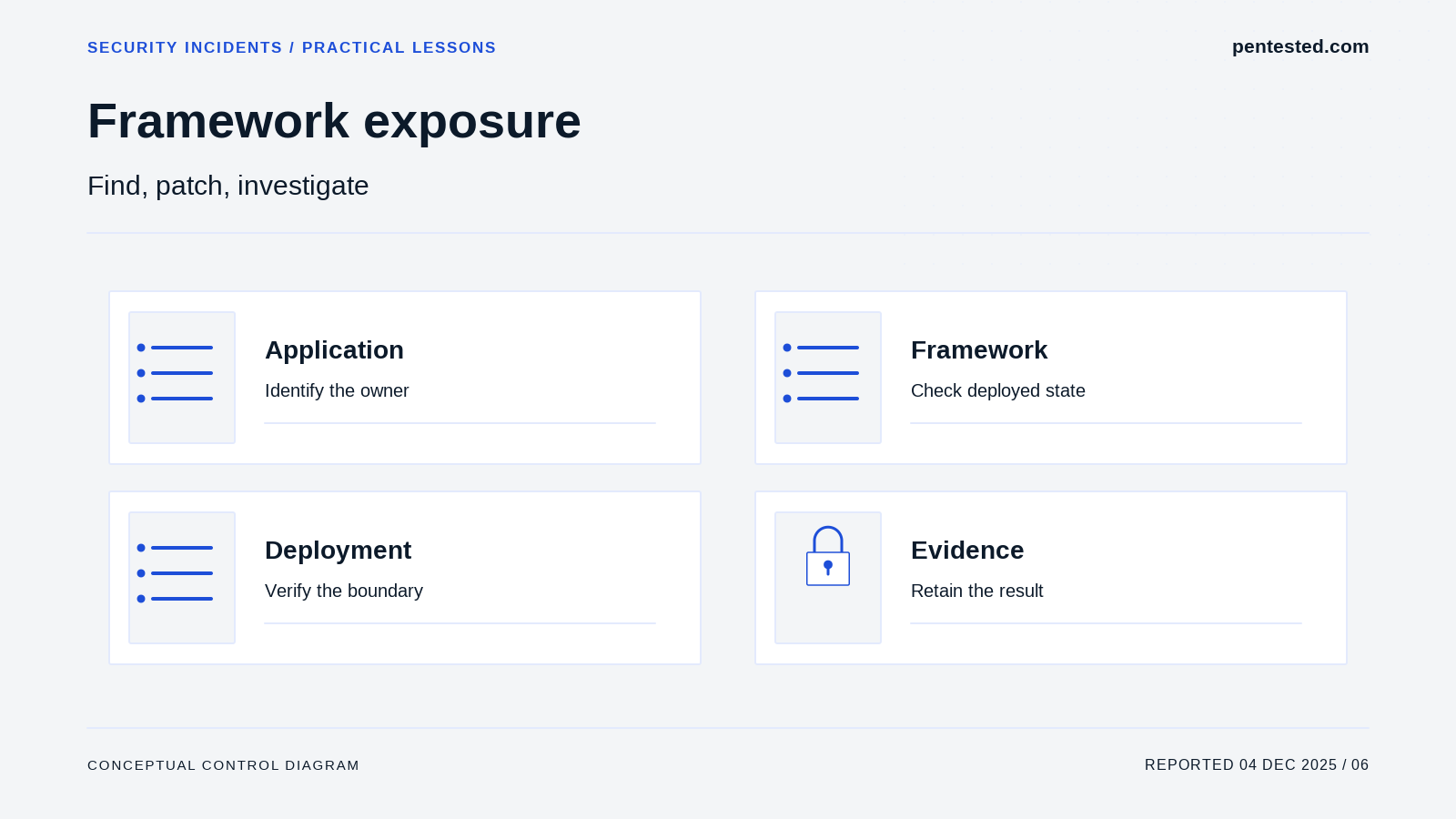
Framework emergency patching therefore needs both software knowledge and operational ownership. Someone must identify the component, someone must own the affected service and someone must verify the deployed change. An alert forwarded to a generic development mailbox is not a completed response.
What matters after code execution
Remote code execution is a capability, not a complete description of business impact. An attacker may inspect the application, obtain secrets, establish additional access or use the environment for unrelated workloads. The investigation should determine which of those actions the evidence supports.
Rebuilding the application can remove files or processes while leaving stolen credentials valid elsewhere. If the service could access a database or cloud API, responders need to examine that authority separately. Recovery should address the application and the reachable identities together.
Logging limitations also matter. A short-lived workload may disappear before a team begins its investigation. Useful evidence may instead live in gateway records, cloud audit events, deployment history or secret-access logs. Planning those sources in advance is more reliable than hoping the affected container retained everything.
A business should also account for emergency changes. Rapid patching can introduce service defects, temporary firewall exceptions or bypassed approval steps. Those changes need review after the immediate threat is contained, so an urgent response does not leave a different long-term weakness.
How penetration testers assess similar exposure
An authorised assessment begins by mapping the deployed application architecture and software versions. Testers should compare the external service with its build records and inventory, including non-production environments agreed in scope. A scanner result should be validated against the actual deployment rather than accepted as a complete answer.
Where active exploitation could affect availability or data, validation should use a controlled environment or a specifically authorised safe method. The engagement should establish the boundary without running public exploit code indiscriminately against production. The report needs to explain exploitability, permissions and likely consequences separately.
An assumed-compromise review can examine what the application identity could reach after execution is obtained. Synthetic secrets, restricted test roles and agreed network checks can demonstrate excessive authority without collecting real customer information. This is often the part that turns a framework finding into a meaningful business risk.
Detection exercises should test the signals associated with unexpected application behaviour: unusual child processes, outbound connections, credential access and administrative actions. The result should include whether responders can connect those signals to the affected service and its owner.
How to reduce the risk
Maintain an inventory derived from deployed artefacts as well as source manifests. Include the framework components that determine exposure, the environment owner and the route used to deploy an emergency fix. Check older instances and preview environments rather than assuming they follow the main release automatically.
Use the vendor's current advisory to determine affected versions and supported remediation. Treat temporary perimeter restrictions as containment measures with an expiry and an owner. They should not become an undocumented substitute for correcting the vulnerable component.
Separate application runtime privileges from build and release administration. Avoid storing unrelated production credentials in the service environment. Restrict outbound access according to the application's genuine dependencies, with a method for reviewing exceptions.
If compromise is suspected, preserve evidence and rebuild from a trusted source. Review credentials available to the affected workload and replace them through a controlled process. Reintroduce the service only after confirming both the corrected software and the intended permissions.
Finally, practise the response. Choose one framework advisory in a tabletop exercise and ask the team to identify every affected deployment, prepare a fix and demonstrate its presence in the running artefact. Measure the time spent finding ownership and evidence, not just the time needed to edit a dependency file.
A framework response should leave an inventory that can survive the next advisory. Record the application owner, the deployed build, the framework components actually in use and the route for producing a replacement release. Package information from a developer branch is insufficient if production runs a different artefact. For a representative service, demonstrate the connection between the build record and the running deployment.
After remediation, check more than the externally visible page. Background workers, regional deployments and an older staging service may share the same vulnerable component. Decide which of those systems can reach production data or credentials. That relationship determines whether a forgotten deployment is merely untidy or a continuing route to a more important environment.
The evidence leadership should expect
A useful response record names the affected services, their exposure periods, the corrective releases and the investigation completed for each. It distinguishes services found to be unaffected from services that were simply not checked.
That record supports decisions about reopening services and prioritising further work. It also makes the next framework emergency less chaotic: the organisation already knows where its applications are, who owns them and what proof is required before an urgent security change is considered complete.
References
<https://cloud.google.com/blog/topics/threat-intelligence/threat-actors-exploit-react2shell-cve-2025-55182/>
<https://aws.amazon.com/blogs/security/china-nexus-cyber-threat-groups-rapidly-exploit-react2shell-vulnerability-cve-2025-55182/>
Related issues
- Oracle PeopleSoft exploitation and the limits of perimeter rules
- What the IDC Frontier ransomware attack reveals about cloud control planes
- Cisco SD-WAN exploitation and the security of the management plane
Read about our methodology or contact pentested.com to discuss security testing for your organisation.


