What the IDC Frontier ransomware attack reveals about cloud control planes
Public report: 7 October 2026. Updated: 17 November 2026.
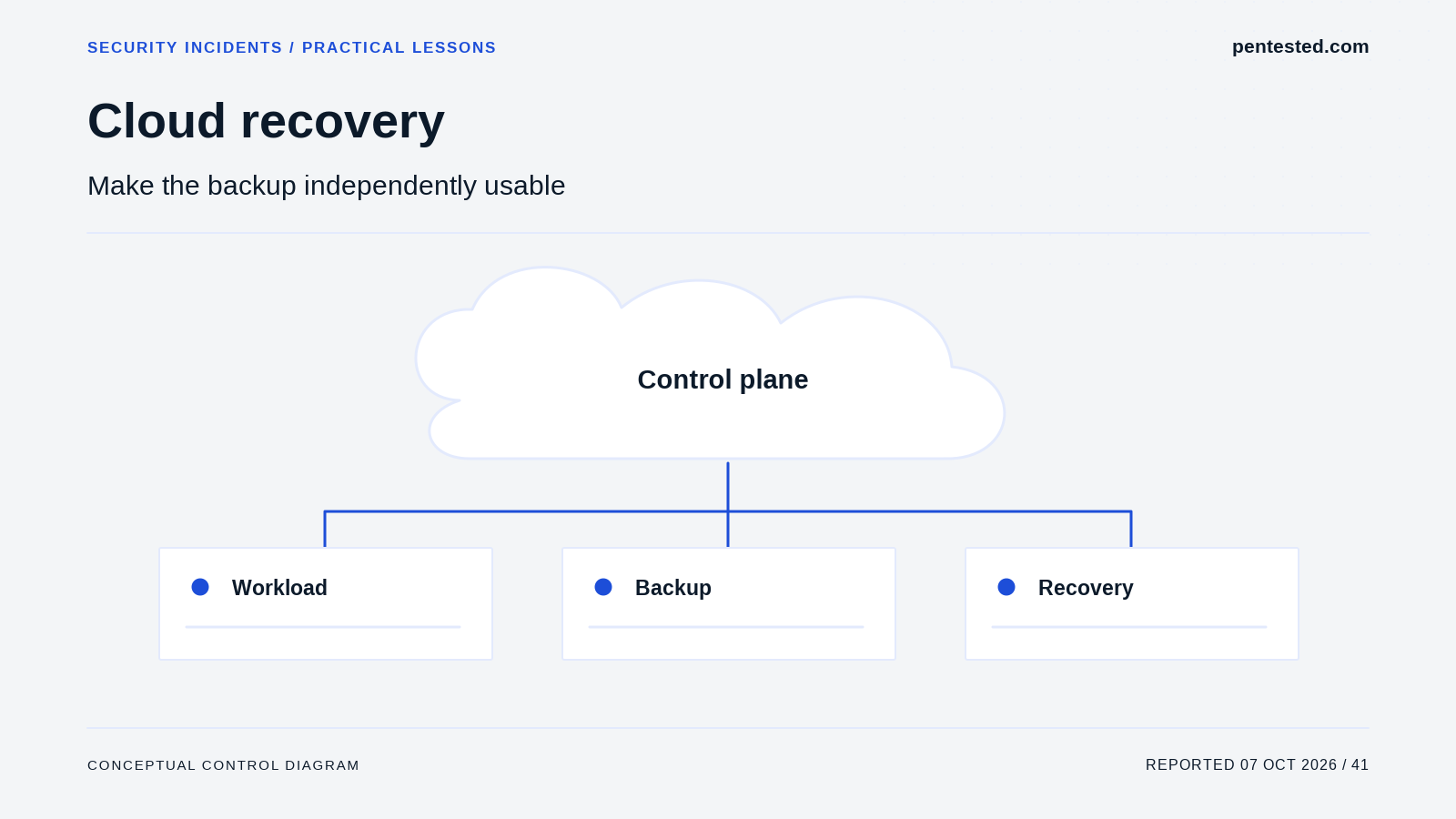
The IDC Frontier ransomware attack demonstrates why a cloud provider's management plane is part of the customer's security boundary. A virtual server may be well configured by its owner while the infrastructure controlling that server holds greater authority. Resilience needs to consider how the customer would recover if the provider's administrative layer became unavailable or untrusted.
What happened
IDC Frontier reported an October 2026 ransomware incident affecting part of its IDCF Cloud service. Its completed investigation describes exploitation of a vulnerability in software used by the cloud portal's authentication system. The attacker obtained virtualisation administration rights and stopped and encrypted customer virtual servers.
The provider identified 495 affected companies and local-government customers in part of one region. It said its investigation found no evidence of external theft of data from the affected virtual servers. That finding should be attributed to the provider and kept separate from the demonstrated availability and integrity consequences.
Public reporting and completed investigation
The article date follows reporting of the outage and attack on 7 October. IDC Frontier's 27 October investigation supplied the fuller technical route and scope. The later findings should not be presented as information available during the first hours of disruption.
The incident concerned a specified part of the provider's service, rather than every cloud region or every customer. Accurate scope matters both for affected organisations planning recovery and for others assessing whether their deployment shares the same dependency.
Cloud control planes hold concentrated authority
Provider virtualisation privileges can include starting, stopping or otherwise administering customer workloads. Those capabilities are necessary to operate infrastructure, but they also represent a route with a wider reach than an ordinary account inside one virtual machine.
The boundary between a customer portal and internal management therefore deserves close attention. An internet-facing business function should not automatically inherit unrestricted infrastructure authority. The review needs to trace the identities and services connecting the two layers.
Tenant separation is also more than network separation between virtual machines. A common administrative service may legitimately reach several tenants. Assurance should examine how that power is constrained, approved and monitored, especially when a lower-trust application can influence it.
Customer server recovery depends on understanding those relationships. A customer may be unable to use its normal console, retrieve a snapshot or rebuild in place while the provider investigates. A recovery plan that assumes the same management service remains trustworthy can fail precisely when it is most needed.
Backup independence needs verification
A backup stored with the same provider can still be useful, but its independence is a question to test. Storage location, administrative credentials and restoration tools can all create common failure modes. The label backup does not establish that the copy will be accessible during a control-plane incident.
The customer should understand which records it can obtain independently, including configuration, application data and the information needed to rebuild elsewhere. Recovery time estimates need to include access to those materials and the people able to use them.
Restoration must also establish the trustworthiness of the recovered workload. A server that boots may contain outdated software, exposed credentials or configuration changes requiring review. The organisation needs a validation standard matched to the incident rather than treating successful startup as the end of recovery.
Communication between provider and customer is essential. The provider may understand the infrastructure scope, while the customer understands the business service running on it. A useful incident update gives each side enough information to make its own restoration decisions without confusing regional service recovery with application readiness.
How penetration testers assess comparable environments
For a provider, an authorised assessment should map the route from public portal functions to infrastructure administration. Use isolated tenants and test workloads to assess role separation and the authority of service identities. The engagement must protect unrelated customers and shared capacity.
For a customer, testing should remain within the authority granted by the provider and the agreed account scope. A review can still assess customer roles, management credentials, backup access and restoration without probing shared provider infrastructure without permission.
An assumed-control-plane-outage exercise can make the normal console unavailable in a tabletop scenario. Ask the team to recover one representative application using approved alternatives and independently held information. This often reveals hidden reliance on the same provider identity or storage path.
The exercise should end with validation of the restored service. Check its data state, credentials, permissions and representative business transactions. That provides evidence about recovery quality as well as recovery speed.
How to reduce the risk
Separate public portal authority from the most powerful infrastructure capabilities. Providers should limit service identities, constrain administrative reach and protect consequential actions with appropriate approval and monitoring. The design should anticipate compromise of a portal component.
Maintain a clear inventory of customer and provider responsibilities. Customers need to know which controls they operate and which evidence or service commitments they require from the host. A shared-responsibility statement is useful only when it leads to practical ownership.
Protect recovery material through an access model that remains usable during a provider incident. Review administrative separation, retention and restoration tooling, and test the result. Where an independent copy or recovery route is necessary, verify it through a real controlled restore.
Keep application configuration and rebuild knowledge available to the responsible team. Avoid dependence on one individual or a console that may be unavailable. Document the steps and credentials needed to establish a trusted replacement service.
Define restoration acceptance criteria before an emergency. Include data integrity, credential review and the operation of essential business tasks. Record the remaining limitations when a service returns in a reduced state.
A cloud customer should establish which recovery actions are possible without the provider's normal management interface. Access to a backup copy is not enough if the customer cannot obtain the identity, configuration or application secrets needed to use it elsewhere. Test the complete recovery path for one representative service, with a defined limit on the time and data needed.
The provider relationship should also explain how evidence is obtained after a control-plane incident. Customers may need resource history, administrative events and backup status to assess their own exposure. Agree the contact route and expected information before an incident. A clear division of responsibility helps both parties avoid assuming that the other organisation has already completed a critical part of the investigation.
A practical customer question
Ask whether one important hosted application could be restored if the provider's normal portal and administrative identity were unavailable for several days. Require evidence of the backup, configuration and access needed to do it.
That question does not assume cloud hosting is inherently unsafe. It tests whether the organisation understands the authority above its virtual server and has a recovery design that remains useful when that shared layer is the part under investigation.
References
<https://www.idcf.jp/news/topics/20261027001>
Related issues
- React2Shell exploitation and the race to secure exposed applications
- Cisco SD-WAN exploitation and the security of the management plane
- What the Berlin Senate cyberattack teaches about safe reconnection
Read about our methodology or contact pentested.com to discuss security testing for your organisation.


