Cisco SD-WAN exploitation and the security of the management plane
Public report: 25 February 2026. Updated: 17 November 2026.
Cisco SD-WAN exploitation shows why a network controller should be assessed as a privileged application in its own right. The management plane can influence connectivity and trust across many sites. An intrusion there may remain consequential even when the controller appears to be running a current software version and ordinary traffic continues normally.
What happened
Cisco Talos publicly described active exploitation of CVE-2026-20127 on 25 February 2026. The vulnerability affected Cisco Catalyst SD-WAN Controller and allowed an unauthenticated attacker to obtain administrative access. Talos grouped the associated activity as UAT-8616 and said evidence of malicious activity extended back to 2023.
Its account also describes escalation involving a software downgrade, exploitation of an older vulnerability and restoration of the original version. This makes the case particularly relevant to investigations that rely on current version information alone. A corrected or restored version does not necessarily explain the system's historical state or the persistence an attacker established earlier.
Public disclosure and earlier activity
The article is dated to the February 2026 public report, rather than to the earliest activity later identified by investigators. Subsequent 2026 activity and advisories should be read as developments in the wider campaign, not automatically as evidence that every customer experienced the same sequence.
The technical account establishes a management-plane threat. It does not justify assuming compromise of every branch device or every service reachable through an affected network. Those consequences require environment-specific evidence.
Why controller trust is consequential
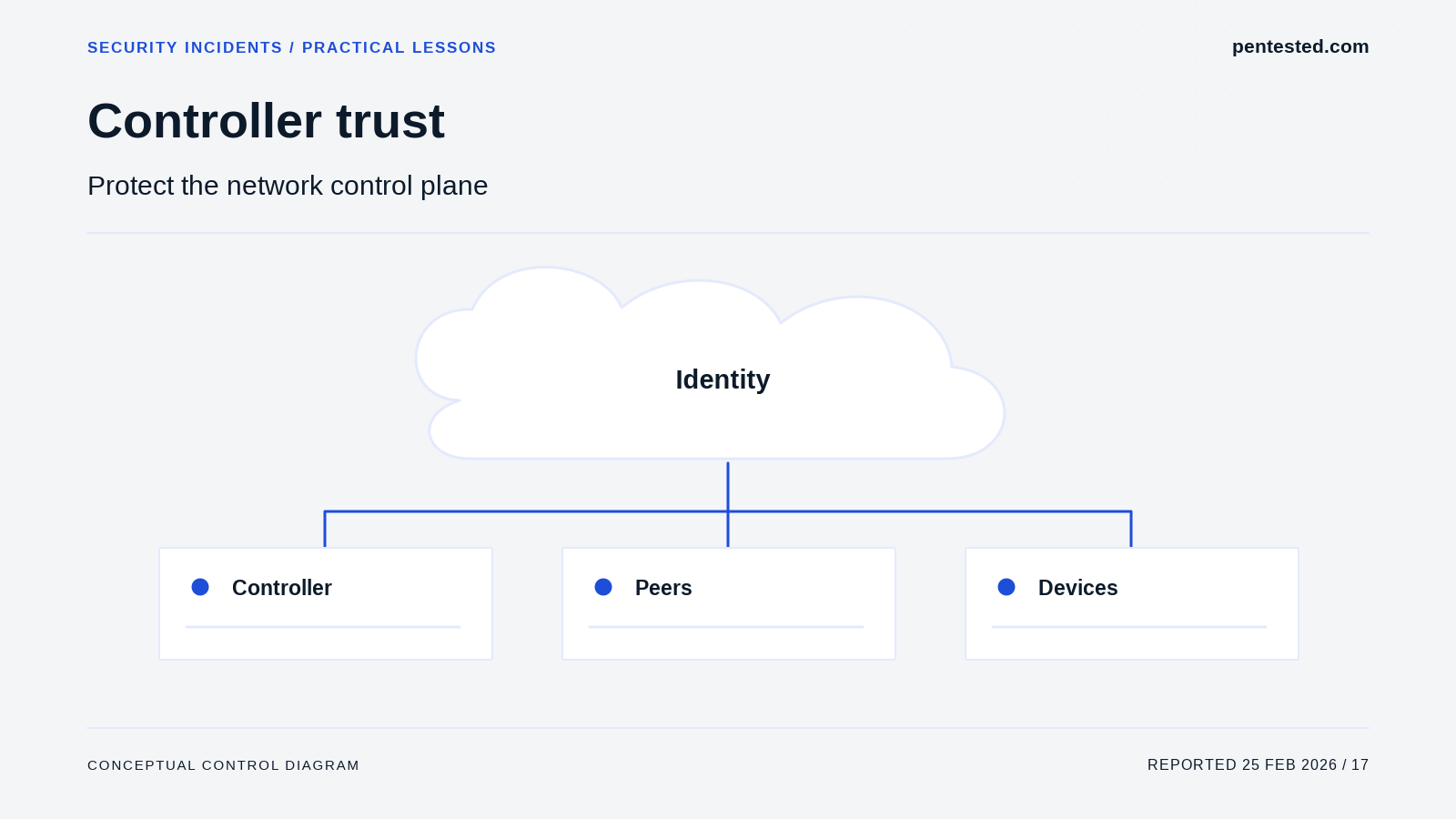
A network controller can hold a central view of devices, policy and authorised relationships. Its legitimate role is to coordinate infrastructure, which also makes its authority useful to an attacker. The review needs to consider both direct administrative actions and the trust other components place in the controller.
Unauthorised control-plane peers are one example of an event that can appear technical but represent a significant change in trust. The organisation needs to know which relationships are expected, who approved them and how a new or changed peer is verified. A connection that looks syntactically normal is not necessarily authorised.
Network-controller persistence also changes the scope of remediation. Updating exposed software can close the initial weakness while additional accounts, keys or altered relationships remain. The response must establish a known configuration and authorised identity set, not merely a supported version number.
The boundary between central management and branch operations deserves particular attention. A highly privileged central service may be necessary, but its access should be understood and recoverable. Routine convenience should not make every administrative workstation an equivalent path to that authority.
What makes investigation difficult
Current state is only one form of evidence. Version history, configuration changes and administrative events may explain activity that is no longer visible in the running system. A downgrade followed by a return to the original version is a good example of why a snapshot can be misleading.
Local logs may also be incomplete after an administrative compromise. Independent records can help establish events that the affected device no longer shows reliably. The organisation should know which controller, identity and network events are collected elsewhere and how they can be correlated.
Operational dependence can delay action. A controller may support sites that cannot easily tolerate a management interruption, and recovery may involve several suppliers or teams. A tested replacement and reconnection process makes it easier to act without choosing between indefinite exposure and an improvised outage.
There is also a communication challenge. A statement that network traffic remains available can be true while the trustworthiness of management infrastructure is still under investigation. Technical and business updates should distinguish availability, integrity and confidence in administrative control.
How penetration testers assess comparable environments
An authorised review should map the controller's management interfaces, administrative identities and authorised peer relationships. Testers can compare the effective configuration with the intended design and approved changes. This often reveals obsolete access or undocumented trust without requiring active exploitation.
Where vulnerability validation is needed, use a representative laboratory or a specifically agreed safe method. Production controllers should not be subjected to uncontrolled tests that may affect many sites. The report should identify the exposure and its business reach while respecting operational limits.
An assumed-compromise assessment can examine the permissions held by management identities and the routes from ordinary administration devices. Synthetic systems or controlled test peers can be used to assess trust enforcement without altering live production relationships.
Detection testing should include agreed changes to administrative accounts, peer configuration or software state. The aim is to establish whether the event is collected, recognised and investigated by someone who understands the deployment. A generic alert about a configuration change is less useful if no one can say whether the change was authorised.
How to reduce the risk
Constrain management access and separate it from general user networks. Review the identities and devices allowed to administer the platform, including supplier access. Apply stronger controls according to the authority held, rather than treating the controller as an ordinary web service.
Follow the vendor's current remediation and threat-hunting guidance for the deployed products. Verify the state of every relevant instance and preserve the evidence needed to assess historical exposure. An update task should not be closed solely because the main controller reports the expected version.
Maintain trusted configuration and relationship baselines. Record authorised peers, administrators and important settings, with a review process for changes. Compare those records during recovery and investigate unexplained differences before restoring full trust.
Collect important management evidence externally. Include the events required to understand software changes, administrative access and new relationships. Protect that evidence from the same identities that manage the controller where practical.
Practise rebuilding or replacing management infrastructure and reconnecting dependent sites safely. The exercise should identify the people, credentials, configuration and validation steps required. It should also establish how the organisation would communicate a period of reduced management confidence while services remain available.
Record which configuration changes should be possible from the controller and which require independent approval. The most useful monitoring covers changes to administrative access, device relationships and routing policy, with records retained somewhere the controller cannot silently rewrite. A management system should not be the only witness to its own integrity.
For a recovery exercise, ask an engineer to demonstrate how a replacement controller acquires its trusted configuration and how connected devices recognise it. Identify the credentials, certificates and backup material needed to complete the process. This reveals whether the proposed clean rebuild depends on authority or records that may have been affected by the original compromise.
A focused assurance exercise
Ask the network owner to demonstrate one authorised controller relationship and the evidence showing when it was approved. Then select a historical software change and trace it through the independent records.
Those checks test whether the organisation can explain both trust and history. That is a stronger position than relying on a clean-looking interface after a management-plane incident. A controller should be considered recovered only when its authority, relationships and relevant configuration can be accounted for.
References
<https://blog.talosintelligence.com/uat-8616-sd-wan/>
Related issues
- FortiCloud SSO exploitation and the danger of persistent administrator access
- What the Ivanti EPMM breaches reveal about device-management security
- What the Bitget security incident teaches about wallet-environment trust
Read about our methodology or contact pentested.com to discuss security testing for your organisation.


