FortiCloud SSO exploitation and the danger of persistent administrator access
Public report: 22 January 2026. Updated: 17 November 2026.
FortiCloud SSO exploitation demonstrates why a network appliance's identity relationships deserve as much attention as its network rules. A firewall can be carefully configured for traffic while its management plane trusts an authentication route that grants powerful administrative access. After that route is abused, removing the initial weakness may leave changes made by the attacker in place.
What happened
Fortinet reported unexpected login activity in January 2026, including cases involving devices updated against earlier FortiCloud SSO vulnerabilities. Its investigation identified a new issue and documented attackers creating local administrative accounts after access. Fortinet disabled FortiCloud SSO temporarily and restored access for corrected devices following remediation.
The vendor clarified that this issue concerned FortiCloud SSO and did not affect third-party SAML identity providers or FortiAuthenticator. That clarification matters because broad descriptions of an SSO problem can otherwise lead organisations to investigate the wrong trust relationship or assume every authentication method has identical exposure.
Why the January update mattered
The public analysis began on 22 January 2026 and received further updates as the issue was investigated. It followed earlier vulnerabilities addressed in December. An organisation therefore needed to distinguish a completed response to the earlier advisory from the new activity being reported.
For affected systems, the investigation also had to consider configuration changes and additional accounts. A corrected authentication route prevents further use of that route; it does not automatically undo administrative actions taken before the correction.
The management plane is a security boundary
Edge-device identity trust determines who can alter the controls protecting the rest of the environment. An administrator may be able to change network policies, remote-access settings or logging. That authority can be more consequential than ordinary access to a single internal application.
Cloud-assisted administration can improve operational consistency, but it adds another identity relationship to review. Teams need to understand which cloud accounts and organisations a device trusts, how that trust is established and what authority a successful sign-in receives locally.
The relevant question is effective permission, not the marketing description of the login feature. A convenient sign-in route may lead to the same administrative capabilities as a traditional local account. Its assurance should reflect those capabilities and the consequences of their misuse.
Unexpected local administrators are especially significant because they can create persistence independent of the original route. An organisation that reviews only the cloud account may miss a local change that remains valid after the cloud credential is revoked.
Why patching and recovery are separate tasks
A patch addresses a software condition. Recovery addresses the state of a system that may already have been administered by an unauthorised person. These tasks overlap, but one is not evidence that the other has been completed.
Configuration review should consider both obvious additions and subtle changes. A new administrator is easy to describe, but a modified access rule, a changed authentication setting or an altered logging destination can also matter. The review needs a trusted baseline and an understanding of legitimate changes made during the same period.
Appliances may also hold credentials or configuration information for connected services. If those materials were readable through the compromised authority, their owners need to consider whether additional investigation or replacement is required. The relevant scope follows the device's access, not just its physical location at the network edge.
There is an operational challenge too. A business may depend on the appliance for remote work or site connectivity. Recovery plans should identify how it can be investigated, rebuilt or replaced without relying entirely on the same potentially compromised management route.
How penetration testers assess similar weaknesses
An authorised assessment should inventory every management interface and authentication method enabled on representative devices. Testers can compare the intended administrative model with the actual roles granted through local, central and cloud-based identities.
The review should examine whether administrative access is unnecessarily exposed or available from unsuitable contexts. Production appliances should not be subjected to uncontrolled exploitation; configuration review and a representative laboratory can establish many weaknesses safely.
An assumed-compromise exercise can test the response to a synthetic unexpected administrator or an agreed configuration change. The aim is to determine whether the monitoring identifies the device, identity and change, and whether the response team can distinguish it from authorised maintenance.
Recovery assurance should include validation of a trusted configuration backup and an independent administrative path. Testers can ask the team to demonstrate how it would identify and remove unauthorised changes after a management-plane compromise. A procedure that assumes the current configuration is trustworthy does not answer that question.
How to reduce the risk
Disable management features that are not required and constrain those that remain. Review the business need for cloud-assisted sign-in separately from its convenience. Document the identities and trust relationships that can obtain administrative access.
Follow the vendor's current advisory for affected versions and remediation. Keep a record of what was deployed and when, including devices that were offline during the initial response. A central inventory should distinguish verified updates from devices merely assigned an update task.
Review local accounts, role assignments and important configuration changes when compromise is possible. Compare them with a trusted baseline and approved change records. Investigate unexplained differences before treating the updated device as recovered.
Consider credentials and secrets reachable through the device's administrative authority. Replace exposed credentials from a trusted environment and verify that old authority no longer works. Coordinate this with connected-service owners so recovery does not leave a secondary access route active.
Retain management and configuration events in a protected location outside the appliance. The organisation should be able to investigate changes even if local records are incomplete or the appliance must be rebuilt. Test that the collected events are understandable and linked to the correct asset.
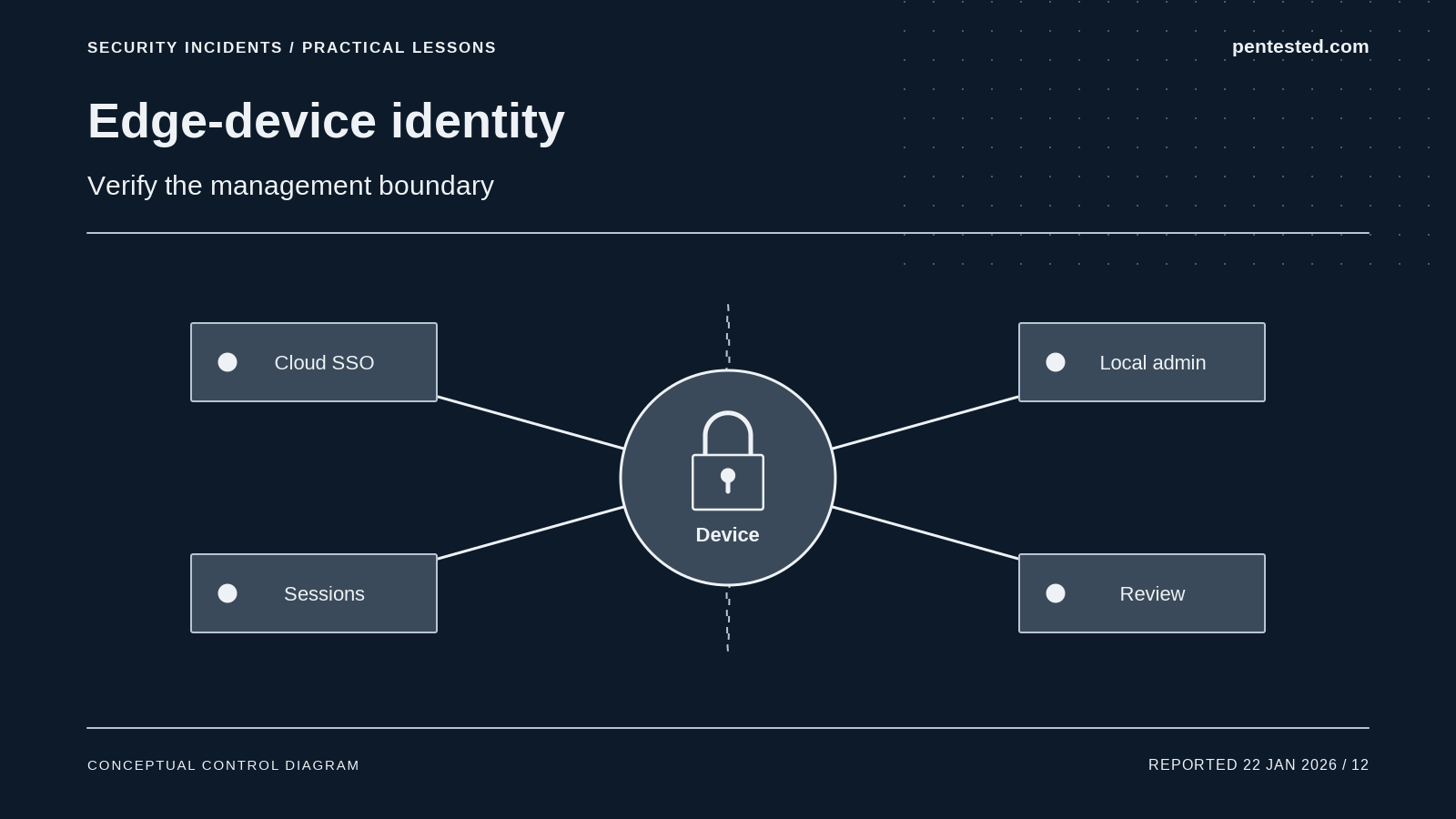
Treat management access as a set of alternative routes rather than a single login screen. Local accounts, federated sign-in, an emergency account and an API may each reach the same device. A control applied to one route should not be assumed to cover the others. Document which routes remain enabled and why, then verify the intended restrictions with approved test identities.
During recovery, compare the device's current administrative state with a known record. Review administrators, trust relationships and configuration changes, including settings unrelated to the original advisory. A device can be patched while retaining an unauthorised account created earlier. The owner needs evidence that both the vulnerable route and any resulting administrative changes have been addressed before closing the incident.
What the next review should demonstrate
Choose one important edge device and ask three teams to explain its administrative boundary: the network owner, the identity owner and the incident-response owner. Differences in their answers often identify undocumented trust or recovery assumptions.
Resolve those differences with a verified access model, a configuration baseline and a practical recovery exercise. The useful outcome is confidence about who can administer the device and how that authority can be removed, including changes made after an initial compromise.
References
<https://www.fortinet.com/blog/psirt-blogs/analysis-of-sso-abuse-on-fortios>
Related issues
- Cisco SD-WAN exploitation and the security of the management plane
- What the Ivanti EPMM breaches reveal about device-management security
- What the ScreenConnect incident reveals about remote-management trust
Read about our methodology or contact pentested.com to discuss security testing for your organisation.


