What the Bitget security incident teaches about wallet-environment trust
Public report: 24 September 2026. Updated: 17 November 2026.
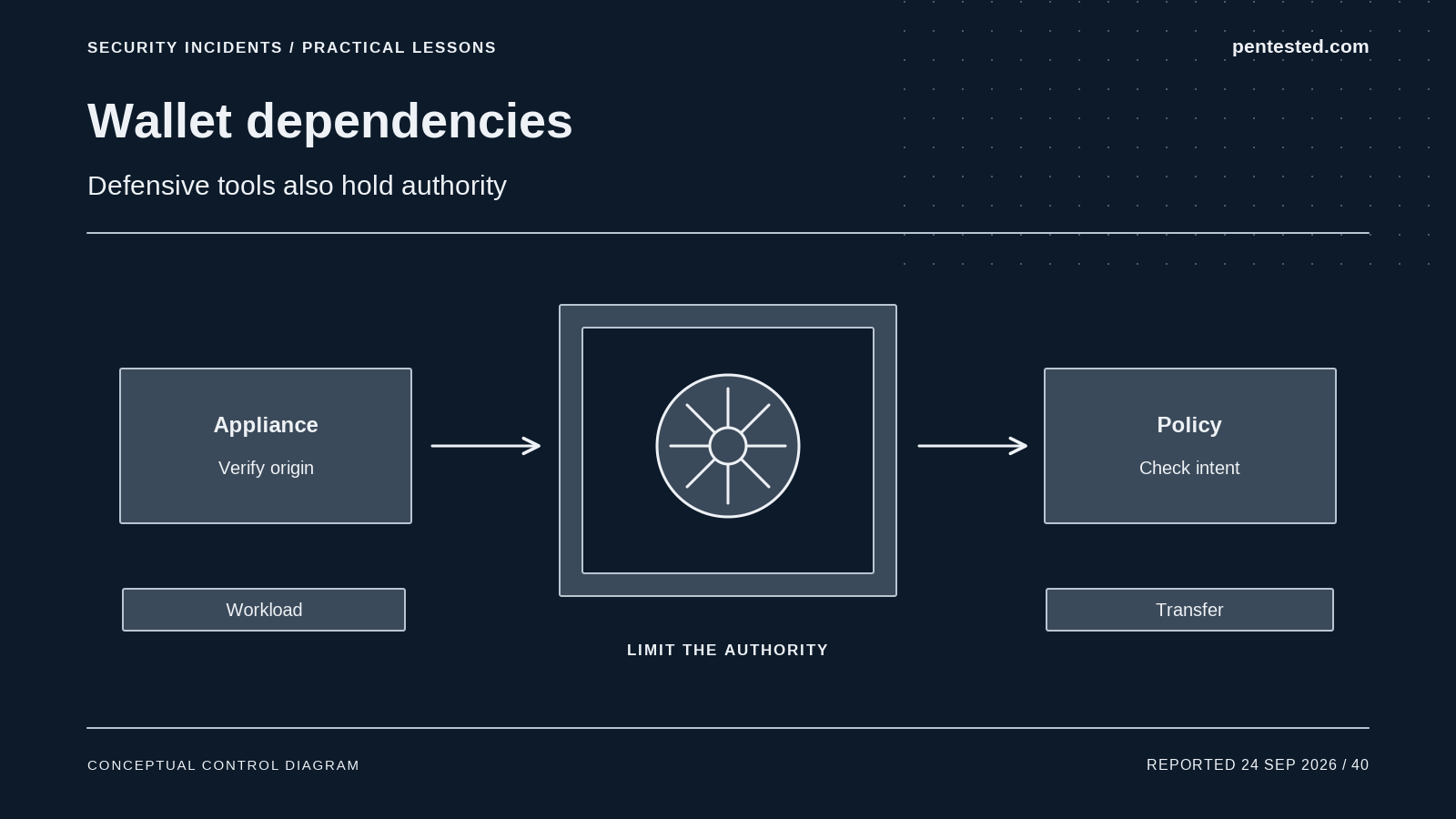
The Bitget security incident demonstrates why software intended to protect a network must also be assessed as part of the route to high-value systems. A security appliance can hold privileged access and sit at an important trust boundary. If it is compromised, its position may help an attacker reach assets the organisation assumed it was defending.
What happened
Bitget publicly reported unauthorised transfers on 24 September 2026. Its later update put the transferred assets at approximately US$387.5 million, increasing an initial estimate as additional transactions were classified. That figure should be described as assets transferred to attacker-controlled addresses, not automatically as the final net loss after recovery.
Bitget subsequently published investigation updates from Mandiant and SlowMist. Mandiant's preliminary account describes privileged access to third-party security appliances, persistence on one appliance and movement to a production wallet job server. The report said malicious packages were deployed there and noted that the investigation remained ongoing at that stage.
Initial alert and later technical findings
The article date follows the September public alert. The appliance findings and revised asset figure came later. Those developments should not be presented as a complete technical explanation available at the moment the first suspicious transfers were detected.
The distinction between wallet-service control and private-key theft also matters. The published account did not identify evidence of private-key compromise. An attacker may cause unauthorised transactions through other authority within the wallet environment, so absence of a stolen key does not end the investigation.
Defensive systems can hold offensive opportunity
Wallet-environment dependencies should include the infrastructure that observes, administers or connects to the wallet service. Security products may need useful permissions to perform their job, but their defensive purpose does not justify unnecessary reach into unrelated production functions.
A review should identify the identities, network routes and update mechanisms associated with each product. It should also establish who can administer the product and what happens if that administrative boundary fails. A diagram labelling an appliance as a protective layer does not answer those questions.
Persistence on a security component can be particularly difficult to investigate if responders rely entirely on the same component's view. Independent host, network and identity evidence helps the team assess whether the trusted monitoring route remains trustworthy.
The production job server is another consequential boundary. It may perform legitimate operations automatically, so a compromised job or package can appear among normal business activity. The security design needs to constrain what those operations may authorise and make unusual results visible.
Transaction authority needs its own controls
Unauthorised asset transfers are the outcome, but preventing them requires attention to several stages. A system may authenticate a service, accept an operation and sign a transaction without independently checking whether the action matches the intended business policy.
The appropriate controls depend on the architecture, but a review should ask which independent limit remains if a production service identity is compromised. Limits on destination, value, operation type or approval may be relevant; none should be assumed effective without testing the actual deployment.
Recovery also needs to address authority outside the initially affected appliance. A copied credential, deployed package or altered job may survive removal of the original foothold. The response should trace the path into the wallet environment and establish a known state at each relevant boundary.
Financial reporting needs an equally clear model. Gross transfers, funds frozen, assets recovered and losses borne by customers or the operator describe different things. Early public estimates can change for legitimate investigative reasons, and the article should retain the publisher and date attached to each figure.
How penetration testers assess comparable infrastructure
An authorised assessment should map security appliances and their effective access to production services. Review administration, service identities and network reach using approved evidence and controlled test systems. A protective product should receive the same scrutiny as another privileged application.
An assumed-compromise exercise can examine what an appliance or support identity could reach next. Use synthetic services and explicit limits; there is no need to access real wallets or move assets. The finding should identify the unnecessary trust relationship and its consequence.
Review the integrity of production jobs and packages. Testers can assess who can change them, which inputs they accept and whether their execution is connected to a reviewed source and approval. A familiar job name is not evidence that its current contents are authorised.
Transaction-policy tests should run in an isolated environment with valueless assets or simulated operations. Establish whether compromised service authority can bypass intended limits and whether the response team receives an actionable signal. The test must not broadcast harmful transactions or risk customer funds.
How to reduce the risk
Inventory security-product privileges and remove unnecessary production reach. Separate product administration from wallet-service administration and review supplier support access. Record the exceptional relationships that remain and the evidence supporting them.
Protect production job configuration and package sources. Limit who can change them, retain independent records and verify the artefact actually executed. Separate routine operation from authority to alter the operation's code or approval policy.
Apply independent transaction controls appropriate to the architecture. Review what happens when a normally trusted service submits an unexpected action. The assurance should concern effective policy enforcement, not merely the success of authentication or signature generation.
Maintain an investigation route outside potentially compromised security products. Preserve relevant host, network and identity events in a protected location. Test whether responders can reconstruct the path from an appliance change to a production operation.
Practise revoking authority and rebuilding the affected service chain. Include the credentials and jobs reachable from the initial foothold, and validate the restored policy before resuming normal activity. Removing one malicious artefact should not be treated as proof that all related access has ended.
Review the permissions of a defensive appliance as carefully as those of an ordinary server. It may store credentials, inspect sensitive traffic or run jobs across many systems. Those capabilities can make it a valuable stepping stone even when it has no direct role in approving a financial transaction. Document the administrative paths from that appliance towards higher-value services.
For a controlled architecture test, remove the assumed trust of one defensive component and ask which boundaries still prevent a transaction. Look for independent policy enforcement, restricted service identities and useful records outside the component's control. This avoids making the entire security argument depend on the appliance that is supposed to observe the environment. The strongest evidence is a demonstrated boundary that remains effective after that assumption is withdrawn.
A practical architecture question
Ask which production function a compromised security appliance could influence and which independent control would stop an unacceptable transaction afterwards. Have the team demonstrate that control in a test environment.
That exercise connects infrastructure assurance with the outcome the business actually needs to prevent. A defensive layer is most useful when its own compromise is anticipated and constrained, rather than treated as an impossible exception to the security model.
References
<https://www.bitget.com/support/articles/12560603896108>
<https://www.bitget.com/support/articles/12560603896305>
<https://img.bgstatic.com/multiLang/events/MFR26-1029_Status_Update_Bitget_0930.pdf>
<https://www.bitget.com/support/articles/12560603896024>
Related issues
- What the Binance security incident reveals about transaction controls
- What the Drift Protocol theft teaches about transaction authority
- Cisco SD-WAN exploitation and the security of the management plane
Read about our methodology or contact pentested.com to discuss security testing for your organisation.


