What the Binance security incident reveals about transaction controls
Public report: 30 October 2026. Updated: 17 November 2026.
The Binance security incident illustrates why protecting private keys is only one part of transaction security. A service authorised to request signatures can become a powerful attack path even when the keys themselves remain inside their intended protection. The architecture needs to constrain what a trusted service may authorise and how that authority can be removed during an incident.
What happened
Binance publicly reported the October 2026 incident on 30 October. Its later initial findings put the impacted assets at approximately US$6.34 billion, with about US$2.85 billion frozen or intercepted at that update. Those figures describe different populations and are not a final net-loss calculation.
The company described unauthorised access to an internal wallet-signing service and transactions outside its normal withdrawal process. It also described malicious on-chain delegation authority that required separate revocation. Its account said suspending normal withdrawals did not automatically stop every operation enabled by that authority.
Public reporting and later technical findings
The article date follows the 30 October public update. The fuller initial findings were published on 3 November and remained subject to further investigation. The incident occurred on 29 October; these reporting dates should not be substituted for the attack date itself.
Binance's account describes a multi-stage operation and developer-environment exposure. This article does not attempt to reproduce every stage or treat the initial findings as a complete independent forensic assessment. The central lesson is the separation between possessing a key and controlling an authorised transaction route.
Signing authority needs business policy
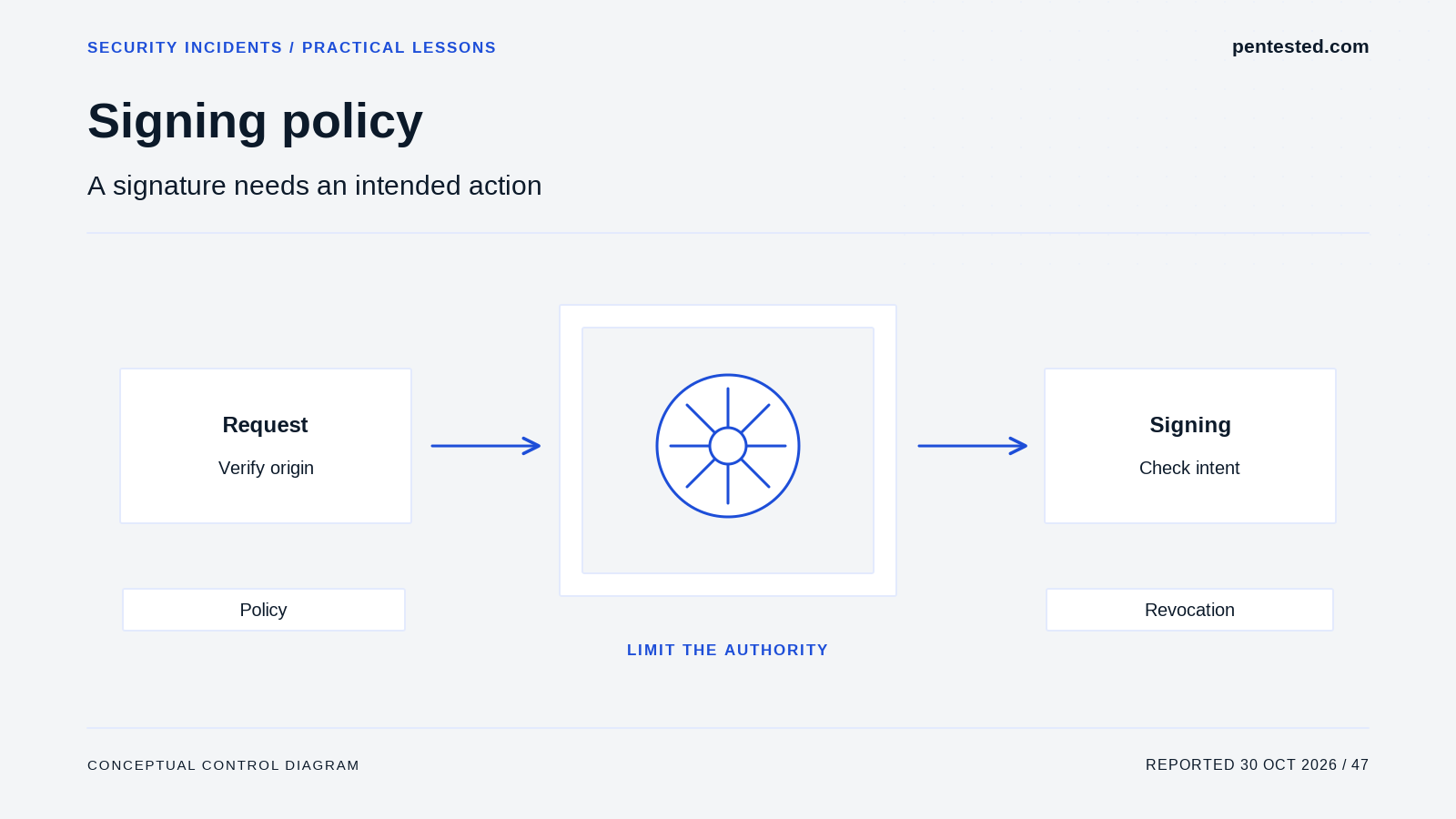
Wallet signing-service policy should establish which actions are acceptable, not merely whether a request comes from an authenticated internal service. A compromised requester may still present a valid identity. The independent policy needs to consider the intended operation and the authority it creates.
That distinction matters for both ordinary transfers and operations that delegate future rights. An action may look like one transaction while changing what another identity can do afterwards. The approval and monitoring process should understand that continuing effect.
Delegated transaction revocation is therefore a separate recovery capability. Stopping the normal application can be useful containment while leaving authority created elsewhere active. The organisation needs a way to identify and remove that authority using trusted tools and the appropriate approvals.
These are architectural questions for comparable services, not an instruction to change a live wallet configuration. The correct design depends on the platform and signing arrangement, and active testing should use isolated systems and assets without real financial value.
Why developer access belongs in the review
Developer and operations environments can hold credentials for deployment, diagnostics and production services. A convenience tool or compromised session in that environment may therefore reach beyond the immediate workstation. The access model should separate ordinary development from the most consequential transaction authority.
The review needs to consider service containers and automation as identities with effective permissions. A short-lived container is not automatically a low-risk environment if it can obtain a powerful token or request a signature. Its authority and reachable systems matter more than its expected lifetime.
Changes to those environments also need traceability. An investigator should be able to identify who deployed a workload, which source and configuration it used and what production operations it performed. A familiar container name is not evidence that its current contents are authorised.
The response should follow credentials and delegated authority outward. Rebuilding an affected workstation may remove one foothold, but a copied service credential or previously authorised transaction can require additional action. The recovery plan needs to account for each form of persistence separately.
How penetration testers assess comparable controls
An authorised assessment should map every route that can request a consequential signature or transaction. Include production services, administrative tools, emergency operations and developer support paths. Use a representative test environment rather than live customer assets.
Testers can assess whether an authenticated but compromised service can request an action outside its intended purpose. Synthetic transactions and valueless assets can demonstrate policy boundaries without financial risk. Findings should identify the missing independent decision rather than treating valid authentication as sufficient approval.
Review operations that create continuing authority. In a controlled environment, establish how the system records, monitors and revokes that authority. The response exercise should distinguish stopping normal application activity from removing permissions already created elsewhere.
Assess developer and deployment identities for unnecessary reach into signing infrastructure. Use synthetic credentials and agreed test services to demonstrate access paths safely. The report should connect each credential with its effective transaction capability and the controls that constrain it.
How to reduce the risk
Separate transaction policy from the identity of the requesting service. Define permitted operations and appropriate independent limits, then test them against unexpected requests from a normally trusted component. Protect the authority to change that policy with equivalent care.
Reduce production access from developer environments and general-purpose tooling. Use narrowly scoped identities and deliberate privileged workflows. Avoid making a useful diagnostic or deployment account an unreviewed route to the full signing service.
Maintain an inventory of continuing and delegated permissions relevant to the platform. Record how they are created, which monitoring detects changes and how they can be revoked during an emergency. Test the revocation route independently of the application most likely to be affected.
Retain protected evidence of deployments, policy changes and signed operations. The records should support reconstruction of the authority used and the intended business action. Review unexpected changes promptly rather than relying solely on a later reconciliation of asset movement.
Practise containment using a scenario in which stopping ordinary withdrawals is insufficient. The team should demonstrate the additional authority that must be removed, the trusted tools required and the evidence supporting completion. Keep the exercise isolated from real assets.
Transaction controls should be assessed against a specific business policy. Define which destinations are expected, how a new destination becomes trusted and what conditions require an independent review. A valid signature proves the use of signing authority; it does not by itself establish that the instruction matched the organisation's intent.
Connect that policy to developer and operational access. Identify which identities can change the transaction service, its configuration or the policy it enforces. Then verify where approval is required and which records remain outside those identities' control. A controlled test can use harmless instructions in a dedicated environment to establish whether an unauthorised policy change is rejected or detected before a transaction is released.
Reporting impact accurately
Maintain separate measures for gross assets transferred, assets frozen, assets recovered and remaining loss. Identify the valuation time and publisher of each estimate. A large frozen amount does not automatically mean it has already been returned to the owner, and a replenishment commitment is a separate business action.
That precision supports technical decisions as well as communication. The objective is to understand which authority remains active and which consequences remain unresolved, so the organisation can demonstrate containment rather than infer it from a paused application or an improving financial headline.
References
<https://www.binance.com/en/blog/community/3229153443759566763>
<https://www.binance.com/en-GB/support/announcement/security-incident-update-2026-10-30-c5a8729a97ac486d963784d96c5642d7>
Related issues
- What the Bitget security incident teaches about wallet-environment trust
- What the Drift Protocol theft teaches about transaction authority
- What the KelpDAO exploit teaches about independent verification
Read about our methodology or contact pentested.com to discuss security testing for your organisation.


