What the Drift Protocol theft teaches about transaction authority
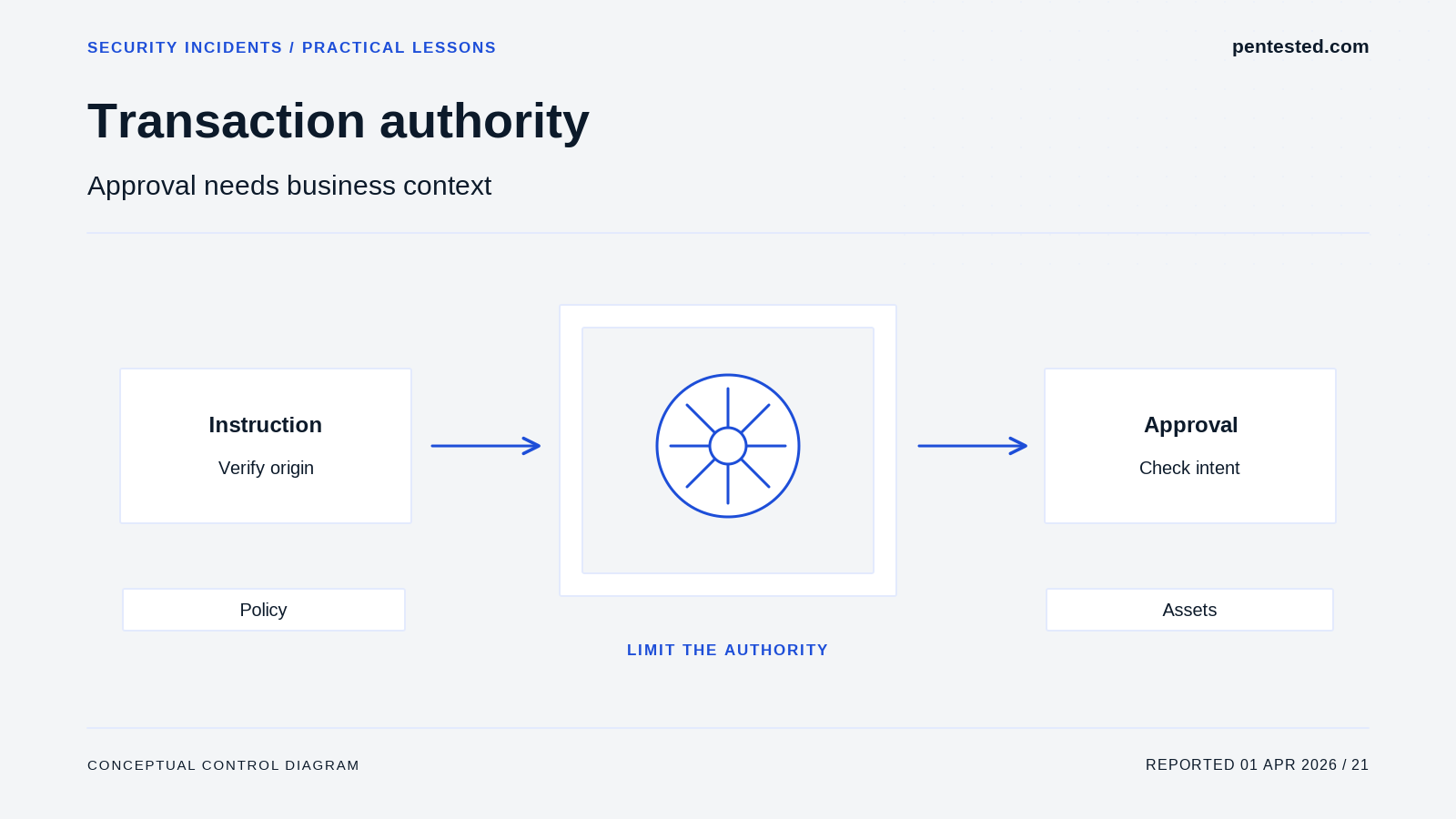
Public report: 1 April 2026. Updated: 17 November 2026.
The Drift Protocol theft illustrates why digital-asset security must examine the authority behind a transaction, not just the correctness of the smart-contract code processing it. A system can execute a validly authorised instruction that produces a disastrous business outcome. The review needs to ask who can authorise the action, what they can see and which independent limits remain in place.
What happened
Drift publicly warned of an active incident on 1 April 2026. Its later recovery plan identifies approximately US$295 million in exploit losses. Early estimates varied, so the figure should be attributed to that later plan rather than presented as a final amount known during the first alert.
TRM Labs' investigation describes an operation involving social engineering of signers, privileged changes and manipulation of collateral assumptions. These findings make the case broader than an isolated coding defect. They are the researchers' account of the operation; this article does not claim to have independently reconstructed every transaction or endpoint involved.
Incident reporting and recovery are different stages
The article date follows the public warning on 1 April. Subsequent technical analysis, attribution and recovery proposals belong later in the timeline. A proposal to fund recovery should not be confused with evidence that all affected users have already been repaid.
Loss estimates can also differ according to valuation time, assets included and investigative scope. Comparisons should use a consistent definition rather than selecting the largest figure from several reports without explanation.
Transaction authority is a layered problem
Privileged trading operations can include changing market parameters, accepting new collateral, moving assets or altering governance. Each capability should have a defined purpose and a clear limit. A single role that can change several of these assumptions may be more powerful than a casual description of an administrator suggests.
Multiple signatures can improve assurance, but the signers need independent, trustworthy information. If several people approve the same misleading representation or use compromised endpoints, a numeric threshold may provide less independence than expected. The design should examine the evidence behind each approval.
Timing is another boundary. Delays, review windows and emergency controls can give an organisation an opportunity to identify an unexpected change before its full consequences occur. Whether such mechanisms are appropriate depends on the service, but any ability to remove or bypass them deserves particular scrutiny.
The trust placed in external evidence also matters. A protocol may use price or state information to decide whether an operation is acceptable. The business should understand the assumptions behind that information, including concentration, liquidity and the consequences of an unusual asset or market condition.
Why ordinary application testing is insufficient
A conventional test can show that a user cannot call an administrative function directly. That is useful, but it may not address how a legitimate administrator is persuaded to approve an action or whether a privileged change defeats another control.
The review therefore needs business-logic scenarios. What happens if a permitted actor proposes an economically unreasonable configuration? Which independent checks remain? Who can see the full effect of the proposed change before approving it? These questions connect technical permissions to financial consequences without assuming that every authorised action is safe.
Digital-asset recovery design should be considered before an incident. The operator needs a way to stop or constrain dangerous activity where the architecture permits it, identify affected accounts and preserve evidence. An improvised recovery decision can create further uncertainty for users and investigators.
Communications must also separate technical containment from financial recovery. Stopping further theft, identifying the loss and arranging restitution are distinct milestones. A clear update tells users which milestone has been reached and which remains dependent on further work.
How penetration testers assess comparable systems
An authorised assessment should map every identity and workflow capable of changing important protocol assumptions. Include governance, emergency and administrative paths, not just the public trading interface. Use a test deployment and assets with no real financial value for active scenarios.
Testers can assess whether approvals are independent and whether the displayed information accurately reflects the action being authorised. This should include the relationship between an approval interface, the signed operation and its effective permissions. The objective is to reveal a misleading or overly broad approval boundary safely.
Business-logic testing should cover exceptional but permitted sequences. For example, a staged exercise can examine a parameter change followed by a dependent operation, with explicit limits on what is executed. Findings should explain the economic assumption being tested rather than presenting a generic list of smart-contract issues.
Response testing can simulate an unexpected privileged event and measure detection, escalation and use of available emergency controls. The team should know who can act, which evidence is needed and how the decision will be communicated to users. Exercises must avoid broadcasting harmful transactions to live systems.
How to reduce the risk
Separate powers that can jointly create an unacceptable outcome. Review whether the same identity or closely coupled group can change validation assumptions, approve transactions and disable protective controls. Independence should be architectural and operational, not merely a count of accounts.
Make approval information complete and understandable to the people responsible. A signer should be able to verify the intended action through a trusted route and identify changes in destination, authority or configuration. Signing from a familiar interface should not replace that verification.
Use suitable limits, staged changes and review periods for consequential operations. Assess any emergency bypass with the same care as the ordinary path. A recovery feature that can remove the last effective restriction becomes part of the critical security boundary.
Monitor privileged changes and the activity that follows them. The response team needs context about the affected market, identity and effective authority. A log showing that a signature was valid does not explain whether the approved action matched the business intention.
Preserve independent transaction and administrative records. Agree how losses, frozen assets and recoveries will be measured and reported. Those definitions help prevent confusion when early estimates evolve during investigation.
Document the business meaning of a transaction as well as its technical validity. An authorised signer should be able to determine the intended recipient, asset, amount and policy exception using a view they can trust. A screen that displays a long encoded request without useful context does little to support an informed approval.
For a controlled exercise, introduce a transaction that is technically well formed but outside the agreed business policy. Verify that approval is stopped or escalated before signing authority is used. Keep the test in a dedicated environment with harmless assets. The objective is to demonstrate that the decision process recognises an inappropriate instruction, rather than only rejecting a malformed request.
A useful review objective
Ask the system's owners to demonstrate one consequential change from proposal through independent approval, execution, monitoring and possible reversal. Each stage should have a clear decision maker and evidence that can be examined afterwards.
That exercise can reveal weaknesses that a code-only review misses. Secure execution matters, but so does ensuring that the authority reaching the code represents a legitimate and appropriately limited business decision.
References
<https://www.drift.trade/updates/recovery-plan-for-affected-users>
<https://www.trmlabs.com/resources/blog/north-korean-hackers-attack-drift-protocol-in-285-million-heist>
Related issues
- What the KelpDAO exploit teaches about independent verification
- What the Bitget security incident teaches about wallet-environment trust
- What the Binance security incident reveals about transaction controls
Read about our methodology or contact pentested.com to discuss security testing for your organisation.


