What the KelpDAO exploit teaches about independent verification
Public report: 18 April 2026. Updated: 17 November 2026.
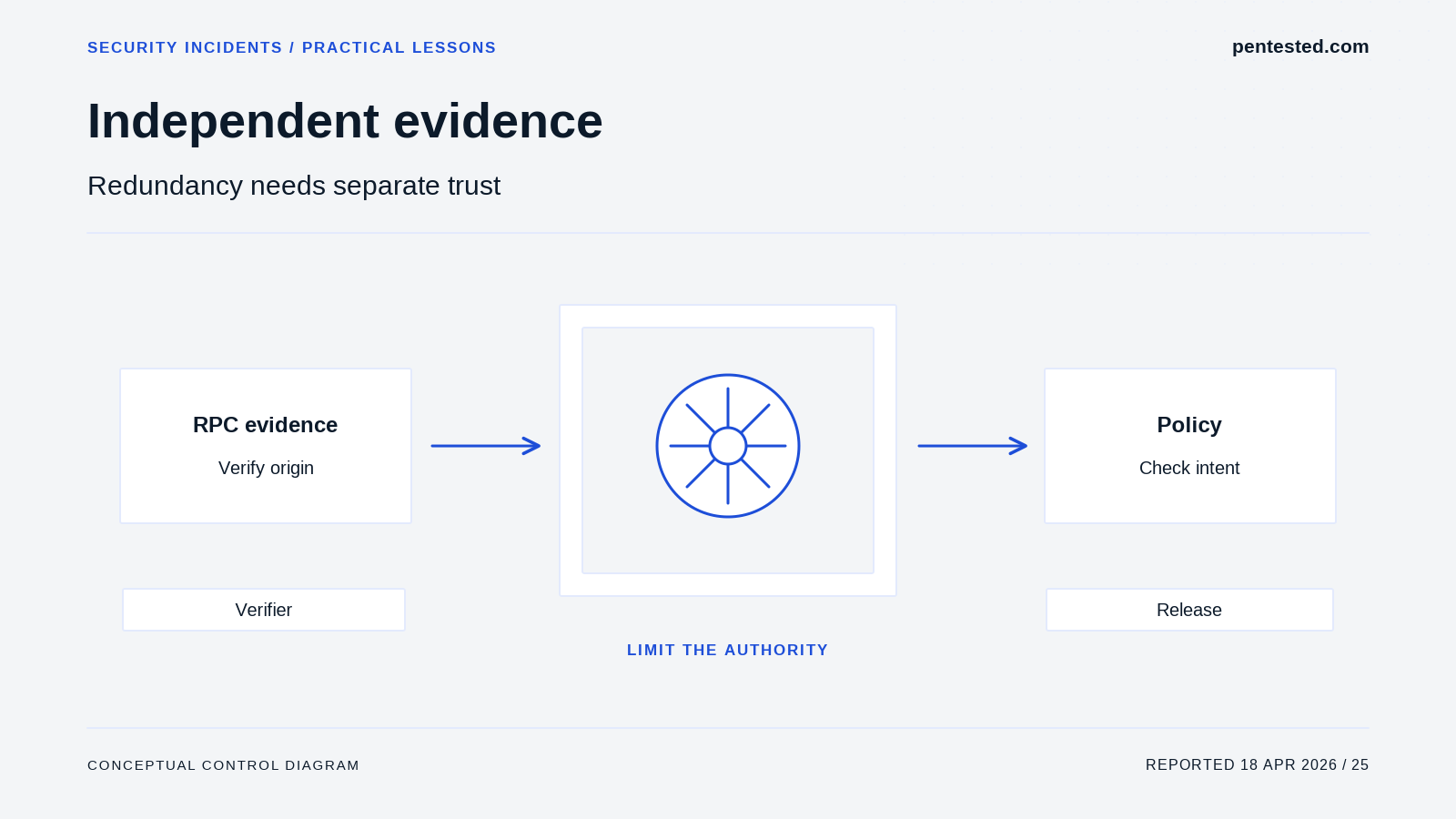
The KelpDAO exploit demonstrates why agreement between several technical components is not necessarily independent verification. If the components depend on the same compromised infrastructure or accept the same poisoned evidence, an attacker may obtain a valid-looking decision about an event that did not occur. The design needs to examine where its evidence really comes from.
What happened
KelpDAO's rsETH bridge was attacked on 18 April 2026. LayerZero initially reported an approximately US$290 million exploit. Its later incident report describes compromise of internal RPC infrastructure and a denial-of-service attack against an external provider, affecting the evidence used by a verifier. The later report valued the loss at approximately US$292 million at the time of attack.
LayerZero's account also identifies a configuration relying on a single Decentralised Verifier Network. These are the supplier's published findings, not an independent adjudication of responsibility between the organisations. The technical lesson concerns both the trustworthiness of evidence and the configuration deciding how much independent verification is required.
Public warning and subsequent investigation
The article date follows public reporting of the April incident. The supplier's initial statement and later completed report provide different levels of detail. The earlier approximate loss estimate should not be presented as a contradiction of a later valuation using a more specific asset amount.
The subsequent report also describes preparation preceding the final transaction. That distinction matters because the visible exploit can be brief while the access and configuration conditions enabling it develop over a longer period.
Redundancy needs genuine independence
RPC evidence integrity concerns the answers a system receives when it asks about blockchain state. If a security decision depends on those answers, the origin and integrity of the responses become part of the authorisation boundary. A correct decision algorithm cannot compensate for entirely untrustworthy evidence.
Verifier trust diversity therefore needs more analysis than counting servers. Two nodes administered through the same account or relying on the same infrastructure may share a failure mode. A design should identify which compromises can affect several apparently separate sources together.
Availability assumptions also influence integrity. If the system loses access to an independent source, it may fall back to the remaining ones. The security review needs to establish whether that fallback preserves the intended level of assurance or silently lowers it at the point an attacker most benefits.
The consumer's configuration is another boundary. A platform may support several independent verifiers while an application chooses a narrower arrangement. Assurance must examine the deployed configuration, including changes over time, rather than relying on the range of options the underlying protocol makes available.
Why monitoring needs a separate perspective
A monitor can report normal behaviour if it asks a different question or uses a different route from the component making the security decision. Selective responses are therefore an important scenario to consider. The organisation needs assurance about the actual evidence used in the consequential operation.
Independent observation should be designed deliberately. A second dashboard using the same identity, network path and data source may reproduce the same misleading view. The review should identify where a separate source of truth exists and when disagreement produces a safe outcome.
Configuration changes deserve equivalent attention. A reduction in a verification threshold can be a highly consequential administrative event even if no exploit is visible at the time. The owner should be able to explain why the change was made, who approved it and what assurance remained afterwards.
For other businesses, the pattern extends beyond digital assets. Payment validation, identity checks and high-value workflow approvals can all depend on external evidence. The same question applies: which independent fact would stop the operation if one trusted source were wrong or unavailable?
How penetration testers assess comparable designs
An authorised assessment should map the evidence sources, administrative ownership and decision thresholds behind important operations. Identify shared credentials, hosting dependencies and fallback behaviour. The diagram should show real independence, not just separate component names.
Use an isolated test deployment to simulate disagreement or unavailability among sources. The exercise can establish whether the system stops, requests additional evidence or proceeds with reduced assurance. No real asset transfer is needed to demonstrate that a threshold or fallback behaves differently from the intended policy.
Review the configuration-change workflow. Testers can assess whether reducing the verification requirement needs independent approval and whether the change is visible to monitoring. The evidence should identify the effective configuration that governed a specific test transaction.
Detection testing should compare the monitoring path with the execution path. A controlled inconsistent-response scenario can establish whether the organisation notices a divergence or receives a reassuring signal from a view that does not represent the decision being made.
How to reduce the risk
Define the minimum independent evidence required for a consequential action. Document the failure modes that can affect several sources together and avoid treating correlated infrastructure as equivalent to independent verification. Review those assumptions when providers or deployment arrangements change.
Make degraded behaviour explicit. If the required evidence is unavailable or inconsistent, the system should follow a defined safe policy appropriate to the service. Operational pressure to preserve availability should not silently remove the integrity requirement.
Protect the infrastructure supplying verification data. Separate administrative authority, minimise standing credentials and monitor changes affecting the responses used by security decisions. A data provider inside an authorisation process is part of the critical system.
Control changes to verification thresholds and trusted sources. Require a clear reason, appropriate approval and a record of the effective state. Monitor emergency changes and review them afterwards rather than allowing them to become an unexplained permanent reduction in assurance.
Retain evidence connecting each important operation to the configuration and data sources used. That makes both incident investigation and routine assurance more meaningful. A later statement that the system generally supports redundancy cannot establish what protected a particular operation.
Independence should be checked at the administrative level as well as the network level. Two endpoints can share an operator, cloud account, credential store or release process. An attacker who controls that common dependency may influence both responses, leaving the consumer with two matching answers from one compromised source.
For a design review, draw the administrative ownership of each verification path and identify every shared dependency. Then ask which evidence remains available if one administrator or hosting environment is compromised. This is a more demanding question than whether two servers are running. It tests whether disagreement can still be detected when the failure affects the organisation operating those servers, rather than an individual machine.
A practical architecture test
Ask the design owner to identify one action that should never proceed on a single source's assertion. Then remove or contradict one source in a test environment and observe the actual result.
The outcome should be understandable to both engineers and the business owner. Genuine independence is a property of the full decision process, including administration, evidence and degraded operation. It cannot be established merely by counting the boxes in an architecture diagram.
References
<https://layerzero.network/blog/kelpdao-incident-statement>
<https://layerzero.network/blog/layerzero-labs-kelpdao-incident-report>
Related issues
- What the Drift Protocol theft teaches about transaction authority
- What the Binance security incident reveals about transaction controls
- What the Bitget security incident teaches about wallet-environment trust
Read about our methodology or contact pentested.com to discuss security testing for your organisation.


