Oracle PeopleSoft exploitation and the limits of perimeter rules
Public report: 11 June 2026. Updated: 17 November 2026.
Oracle PeopleSoft exploitation illustrates the difference between blocking a known request pattern and correcting the vulnerability that makes the request dangerous. A perimeter rule can be a useful temporary measure, but its protection depends on how the rule and the application interpret the same traffic. An attacker can benefit when those interpretations differ.
What happened
Mandiant and Google Threat Intelligence publicly described a PeopleSoft compromise and extortion campaign in June 2026 involving CVE-2026-35273. Their account dates activity before Oracle's June advisory and identifies initial concentration in higher education.
In September, the researchers documented renewed exploitation and broader targeting. They said attackers changed request encoding to bypass path-based web application firewall rules, while the application still resolved the requests to the vulnerable component. The reports describe web shells and further activity on compromised systems. These observations concern the investigated campaign, not every organisation running PeopleSoft.
Why the two reporting periods matter
The article is dated to the initial June public analysis and incorporates the September findings. The later wave demonstrates adaptation to defensive measures rather than a separate reason to ignore the original vulnerability. Organisations needed to assess the software condition and their own evidence of exposure.
Notifications to potentially exposed organisations should not be counted as an equivalent number of confirmed compromises. A reachable vulnerable endpoint, an exploitation attempt and established attacker execution are different findings that require different evidence.
The interpretation boundary is the issue
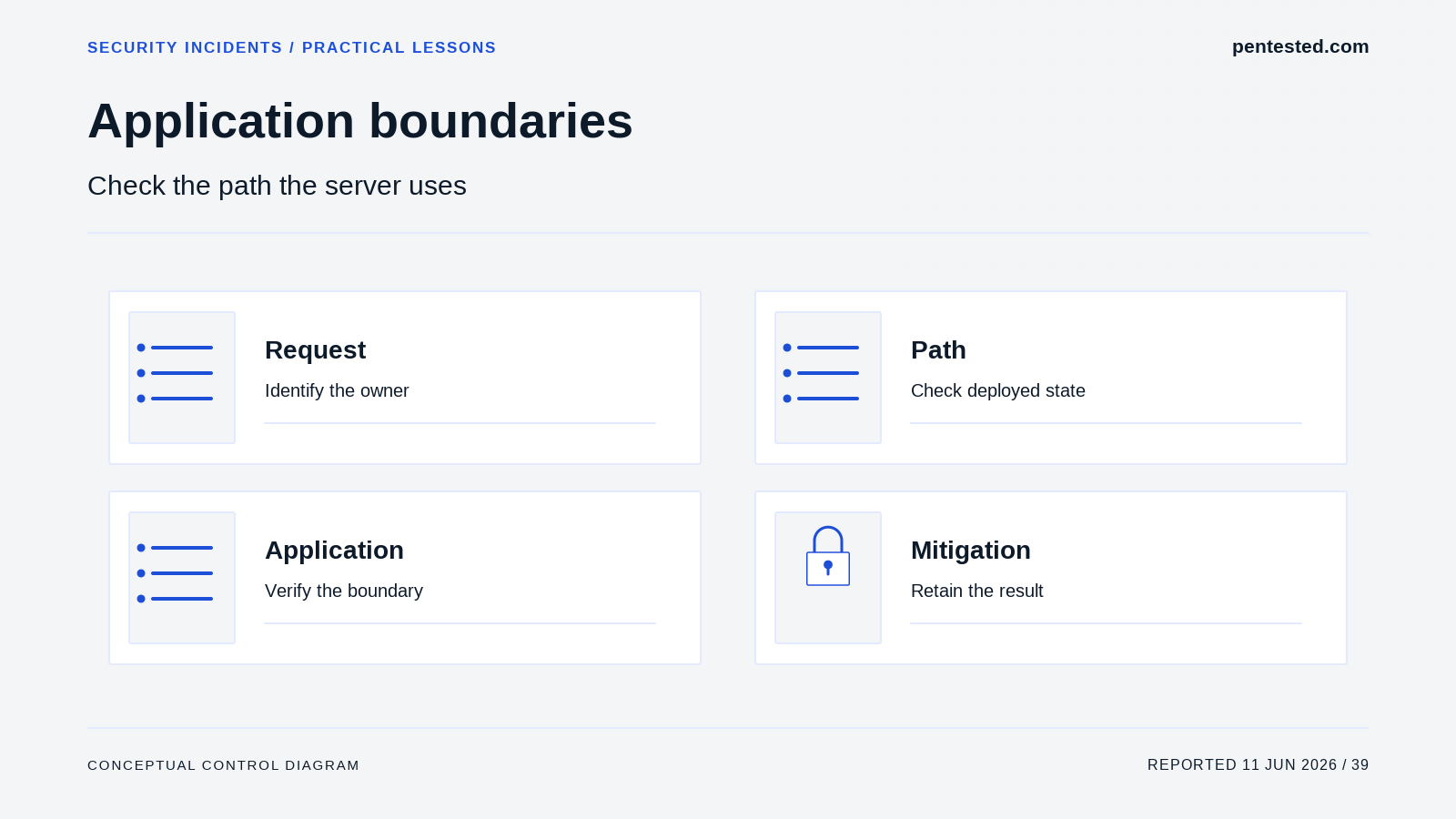
Normalised-path security checks concern the resource an application ultimately understands, rather than only the characters visible in the incoming request. Proxies, firewalls and application servers may transform or interpret a path at different stages. Protection can fail if a restrictive decision is made against one representation while execution uses another.
The practical lesson is broader than one encoded request. A review should identify where canonical interpretation occurs and whether the security decision applies to the same effective operation. Blocking a few observed strings can leave equivalent routes open without changing the vulnerable application at all.
Enterprise application web shells create another boundary after initial access. They can provide an attacker with an application-hosted execution route independent of the original request. Removing external exposure to the initial endpoint may not remove that established access.
The supporting service identity then determines reach. Enterprise applications may connect to databases, shared files and administrative services. A vulnerability in the web tier can therefore become a larger incident if the runtime identity holds more authority than it needs.
Why a temporary mitigation needs an exit plan
Perimeter restrictions can buy time when a business cannot immediately deploy a correction. That can be a reasonable operational decision, but it should have an owner, a defined scope and a deadline for permanent remediation. Otherwise a temporary measure can become an undocumented long-term assumption.
Validation should examine the intended security property. If the goal is to make an administrative component unreachable externally, the test should assess the effective component across representative routing behaviour. A single rejected example does not establish that the entire boundary is closed.
Investigation also needs to consider all relevant application nodes. A distributed deployment can contain different versions, files or local changes. Checking one front-end instance may leave an incomplete picture of both remediation and compromise.
Leadership needs those distinctions in plain language. A report should say whether the organisation has patched the vulnerability, restricted a route, found evidence of compromise or completed recovery. Treating those as interchangeable states makes an urgent decision harder to assess.
How penetration testers assess comparable exposure
An authorised assessment should map the proxy, firewall and application interpretation of relevant requests. Use a controlled environment or agreed safe checks to establish whether the restriction applies to the intended resource. The engagement should avoid an uncontrolled exploit walkthrough against production.
Review the need for internet access to management and system-to-system components. Testers can compare documented business routes with actual exposure and identify unnecessary administrative services. A reachable component should be assessed according to its purpose and effective privileges.
An assumed-compromise review can examine the application identity's access to files, databases and other systems using synthetic credentials or approved test resources. The finding should explain the boundary beyond initial code execution, without collecting unrelated business data.
Recovery testing should verify the state of each relevant node and the removal of unauthorised artefacts or access. A retest should distinguish a corrected vulnerability from a clean environment. Both may be necessary before the service can be considered recovered.
How to reduce the risk
Apply the vendor's current correction and review whether affected management components need to remain available. Reduce external access according to legitimate business requirements. Record temporary restrictions and ensure they lead to a verified permanent state.
Align security decisions with the application's effective interpretation of requests. Review normalisation and routing across the deployed layers rather than relying only on literal path patterns. Test changes using representative safe cases that establish the intended boundary.
Constrain the runtime identity and separate it from administration. Protect credentials available to the web tier and restrict unnecessary network reach. This limits the consequence if an application vulnerability still results in execution.
Collect application, host and identity evidence that can support investigation of code execution and persistence. Ensure the records cover the relevant nodes and exposure period. A clean current directory is not a complete account of earlier credential access or activity.
If compromise is identified, preserve evidence and rebuild or remediate through a trusted process. Review reachable credentials and investigate their use elsewhere. Do not assume a perimeter rule removes access already established inside the environment.
A temporary mitigation needs an owner, a verification method and an end condition. Record exactly which route it blocks and which supported update is expected to replace it. If a deployment changes, retest the mitigation rather than assuming a restriction applied to the previous configuration still has the same effect.
Track exceptions at application level. A business owner may need time to validate a vendor update, but the resulting delay should have a defined exposure decision and compensating controls that can be demonstrated. When the permanent fix is deployed, check the running service and remove obsolete temporary changes through the normal change process. This prevents a response from ending with a patched package, an uncertain deployment and a forgotten set of workarounds whose effects nobody owns.
A useful remediation check
Ask the application owner to demonstrate the difference between the temporary mitigation and the permanent correction. The evidence should identify what each prevents, what remains exposed and how every relevant instance has been checked.
That exercise makes the status understandable to both technical and business decision makers. The objective is a verified security boundary and a trustworthy recovered service, rather than a growing collection of rules matching the last request an attacker happened to use.
References
<https://cloud.google.com/blog/topics/threat-intelligence/shinyhunters-renewed-mass-exploitation-campaign-targeting-oracle-peoplesoft>
<https://cloud.google.com/blog/topics/threat-intelligence/shinyhunters-targets-education-sector-oracle-exploit>
Related issues
- React2Shell exploitation and the race to secure exposed applications
- Cisco SD-WAN exploitation and the security of the management plane
- What the IDC Frontier ransomware attack reveals about cloud control planes
Read about our methodology or contact pentested.com to discuss security testing for your organisation.


