What the Poland energy-sector attack reveals about industrial resilience
Public report: 13 January 2026. Updated: 17 November 2026.
The Poland energy-sector attack demonstrates that cyber incidents can target the integrity of physical control equipment, rather than simply encrypt office files. An organisation may preserve electricity or heat production while still losing visibility, remote control or confidence in individual devices. Resilience needs to account for those partial failures as well as a complete outage.
What happened
CERT Polska's technical report describes coordinated destructive attacks on 29 December 2025 against more than 30 wind and solar installations, a combined heat and power plant and a manufacturer. At renewable-energy sites, attackers damaged industrial devices and disrupted communications with the distribution operator. Electricity generation continued. The attempted disruption of heat supply also failed.
The report describes interference with controller firmware, deleted system files and destructive malware. It also records endpoint protection blocking the attempted wiper execution at the heat and power plant. These outcomes show why an incident should be assessed by each affected function rather than summarised as either a complete blackout or a harmless failed attempt.
Attack date and reporting date
The December attacks were publicly discussed in January 2026, with CERT Polska publishing its detailed technical report on 30 January. The article's date follows public reporting, while the later technical findings are included as an update. The date of the destructive activity remains separate.
Public attribution involves assessments by the relevant authorities. The practical review below focuses on the reported methods and consequences, without requiring a business to resolve the identity of the operator before improving its own controls.
Why industrial resilience is different
An industrial installation can contain controllers, remote terminal units, gateways and communication devices with different owners and replacement lifecycles. Some devices may be easy to rebuild; others require specialist configuration, supplier support or physical attendance. Treating them all as ordinary servers can produce an unrealistic recovery plan.
Controller firmware destruction also changes the meaning of a backup. Restoring a database does not necessarily restore the logic, configuration or communication settings needed by a field device. The organisation needs to know which components can be recovered remotely and which require equipment, engineers or spare parts on site.
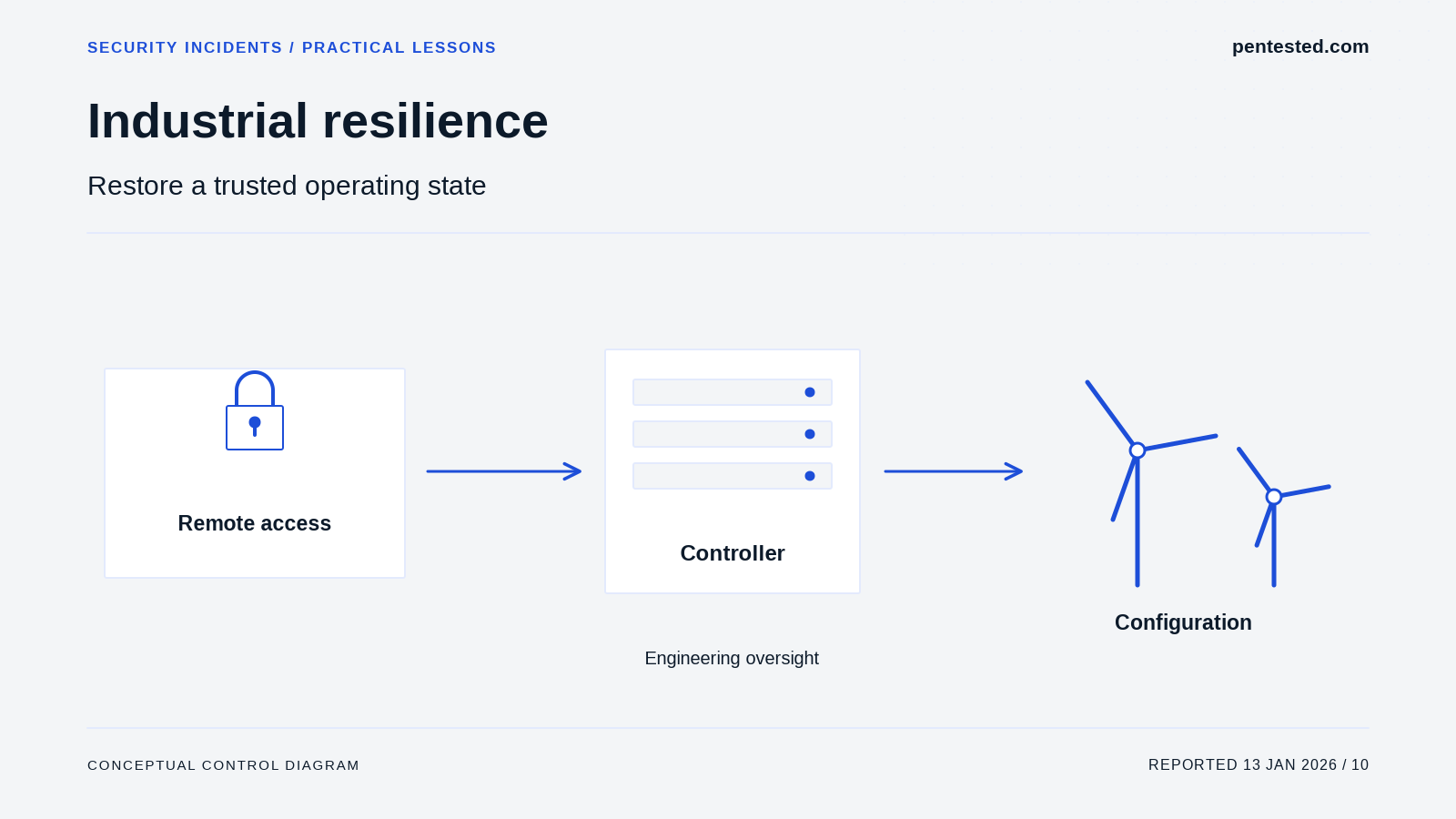
Renewable-energy remote access is useful for maintenance and supervision, but its authority needs to be explicit. The systems that support convenient access may also bridge operational sites, central management and supplier environments. A review should trace those routes and the credentials that enable them.
Loss of visibility deserves attention even when production continues. Operators may be unable to confirm the state of equipment or make a necessary change promptly. The resilience objective should include trustworthy monitoring and safe control, not just an output figure recorded during the incident.
Interpreting successful defensive outcomes
The continued delivery of a physical service can reflect several controls working together. It should not be assumed to prove that the initial access was insignificant. Conversely, damage to some equipment does not establish that every installation or safety mechanism was compromised.
For a comparable business, this suggests measuring several outcomes separately: access to the site, ability to alter devices, continuity of the process and the time required to restore confidence. Those measurements help identify where a control prevented a worse consequence and where recovery remained difficult.
Safety decisions must stay with qualified operational personnel. A cybersecurity team may identify suspicious access, but disconnecting equipment or resetting a controller can itself affect a physical process. The response plan needs a joint decision process rather than an assumption that standard IT containment is always safe.
An investigation also needs evidence from several layers. Network records, remote-access logs, configuration histories and operator observations may each explain part of the event. Without a common timeline, teams can struggle to distinguish a cyber-induced fault from a separate equipment problem.
How penetration testers assess comparable environments
Industrial testing should begin with a safety review and explicit operating constraints. The engagement should identify prohibited actions, fragile equipment, maintenance windows and the person authorised to stop work. Uncontrolled exploitation of production controllers is not required to demonstrate a meaningful risk.
Architecture and configuration review can establish whether remote access has unnecessary reach. Testers can examine approved accounts, network routes and management interfaces, using passive evidence or a representative laboratory where active checks could affect the process. The report should distinguish verified access from consequences assessed through engineering review.
An assumed-compromise exercise can assess how a support identity might move between management functions, again within agreed limits. Synthetic systems or staged scenarios can demonstrate credential reuse and excessive administration rights without changing live process settings.
Recovery assurance should include a practical restoration exercise for representative equipment. The team should verify the availability of configuration records, trusted firmware, spare hardware and the people able to carry out the work. A backup file that nobody has restored onto a suitable device is incomplete evidence.
How to reduce the risk
Maintain an operational asset register that includes communication equipment and field devices as well as servers. Record ownership, approved firmware and configuration, recovery requirements and the consequences of losing each function. Validate the register with the engineers who maintain the installation.
Constrain remote administration to necessary identities and destinations. Separate supplier maintenance from routine monitoring, and review any route that can reach several sites with the same authority. Retain an independent ability to disable access when a supplier or central management system is suspected.
Protect configuration and recovery material separately from the managed environment. Verify that the organisation can obtain trusted device software and restore a known configuration without using a compromised account. Include access to specialist support and replacement hardware in the plan.
Monitor changes that alter device behaviour or management access. The useful signal may be an unexpected firmware operation, a new administrator or a changed communication setting. Relate the alert to the operating context so engineers can decide whether it represents authorised maintenance.
Exercise the transition to local or manual operation where that is part of the design. Confirm the staffing, communications and safety checks required to sustain it. A fallback arrangement that works briefly may not be suitable for a prolonged period.
A restoration decision in an industrial environment should combine technical and engineering evidence. A controller that responds to a management request may still contain an altered configuration. A communication link may be restored while a process remains outside its authorised operating state. Agree which qualified person verifies each condition and how the decision is recorded.
Include spare equipment and configuration material in the exercise. A replacement device is useful only if the organisation can identify the correct configuration, install it through a trusted route and validate the resulting behaviour safely. Keep these activities within the site's approved engineering procedures. Security testing should improve confidence in that process without introducing unplanned changes to operating equipment.
A practical leadership question
Ask the operational owner what evidence would be required to declare one affected site trustworthy again. The answer should cover the process state, equipment configuration, remote access and monitoring, rather than ending with network connectivity.
That question helps align security and engineering around a useful outcome. The objective is not merely to remove an attacker from a network; it is to restore a physical service whose behaviour, visibility and control can be relied upon.
References
<https://cert.pl/en/posts/2026/01/incident-report-energy-sector-2025/>
<https://www.gov.pl/web/primeminister/poland-stops-cyberattacks-on-energy-infrastructure>
Related issues
- What the Minnesota water-system attacks teach about exposed controllers
- What French refrigeration sabotage reveals about connected equipment
- What the IDC Frontier ransomware attack reveals about cloud control planes
Read about our methodology or contact pentested.com to discuss security testing for your organisation.


