What French refrigeration sabotage reveals about connected equipment
Public report: 12 October 2026. Updated: 17 November 2026.
French refrigeration sabotage demonstrates that connected building and retail equipment can create physical consequences beyond the normal scope of a website breach. A remotely managed controller may look like a supporting facility component, yet its settings can affect stock, safety and continued trading. Cybersecurity review needs to include that operational authority.
What happened
French authorities described attacks on refrigeration controllers during the night of 11 to 12 October 2026. In November, the foreign ministry attributed the campaign to an Iranian unit and said more than 700 retail sites had been affected, with material damage including fires and food losses.
CERT-FR had issued an initial controller-security alert on 12 October. The public attribution and fuller impact assessment followed on 9 November. Those stages should remain separate: the early warning did not itself establish every later finding about scale or responsibility.
Why the reporting date is October
The article is dated to the initial official public warning, rather than to the later attribution. It includes the November findings as subsequent information. The attack date, technical alert and attribution statement each have their own place in the chronology.
The public account should not be expanded into a claim that every connected refrigeration product or every retail site using those products was compromised. The relevant lesson is to examine the actual remote-management design and its consequences in a comparable environment.
Facility technology is part of the business system
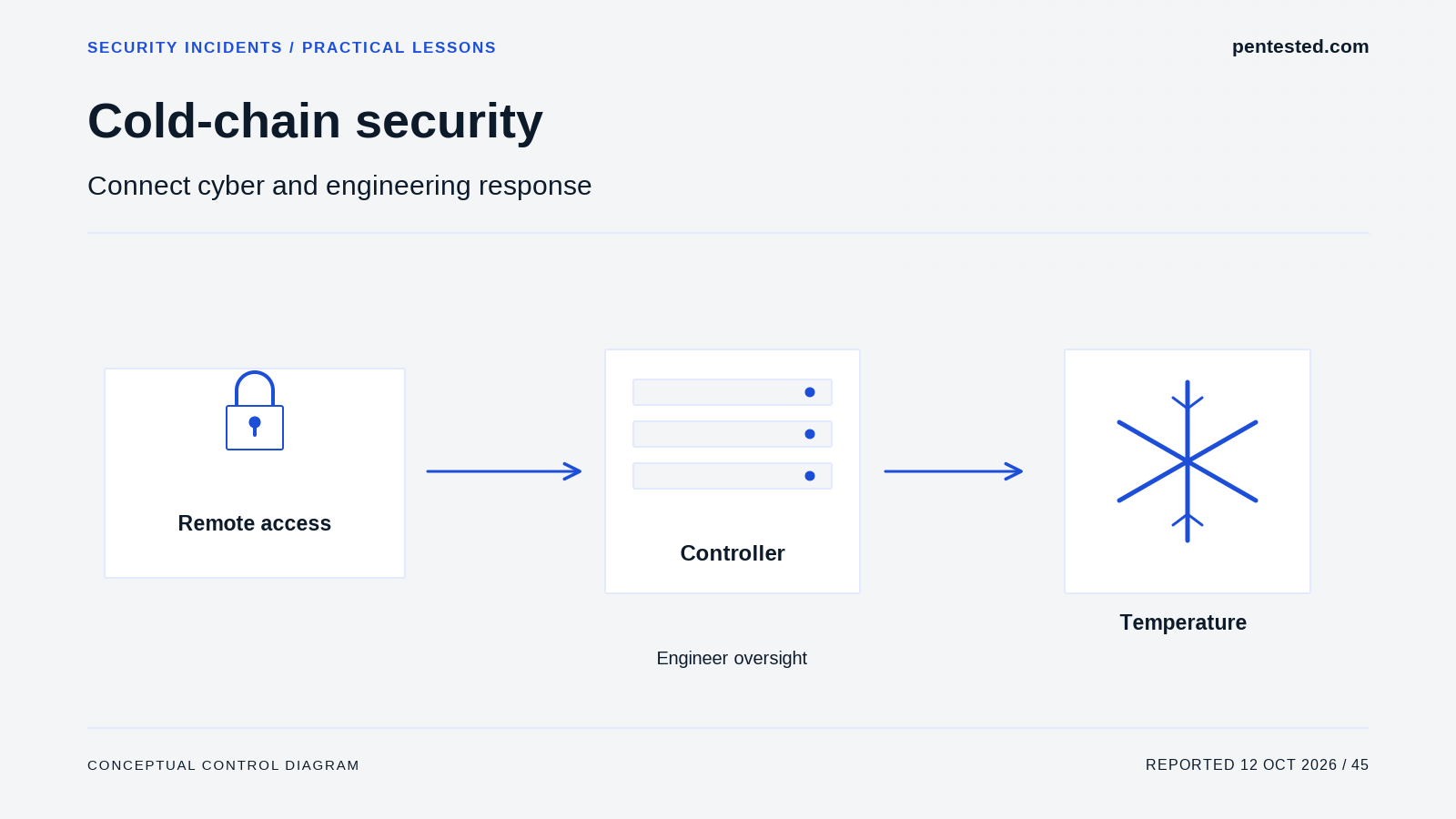
Cold-chain controller security can sit between facilities, maintenance suppliers and IT teams. Each may understand a different part of the arrangement. That division can leave an important remote-access route outside the organisation's usual application and network reviews.
The inventory should identify the physical function and who can change it. A controller, gateway and supplier portal may each hold part of the management path. Knowing the brand of the equipment is not enough to establish who has effective authority over its behaviour.
Remote equipment safety limits are another design question. A business should understand which protections remain independent if a management account or remote service is misused. That review belongs with qualified engineers and the equipment supplier, because changing or testing process settings can create its own hazard.
Shared supplier access can also concentrate risk across sites. A maintenance company may legitimately manage many installations, but the resulting authority should be limited, attributable and recoverable. A compromise at one point should not be assumed harmless merely because each site has a separate physical controller.
Cyber and physical response need coordination
An IT team may identify suspicious access while local staff observe an equipment alarm or stock problem. Those signals need a common escalation route. Otherwise teams can investigate the digital and physical symptoms separately while the incident continues.
Containment must preserve safe operation. Disconnecting equipment, resetting a controller or changing a setting can affect the physical process. The response plan should identify the qualified person who can authorise those actions and the independent observations needed to confirm the result.
Recovery also requires more than restoring connectivity. The organisation needs confidence in the equipment configuration, management accounts and relevant operational state. A device that is reachable again may still hold an unauthorised setting or trust a suspect remote administrator.
Business impact should include damaged stock, site disruption, inspection and recovery work where supported by evidence. A cyber incident with physical effects cannot be measured adequately by the length of a network outage alone. At the same time, hypothetical consequences should not be reported as observed damage at every site.
How penetration testers assess comparable equipment
An authorised assessment should begin with a safety review involving facilities staff, IT and the relevant supplier. Define prohibited actions, operating constraints and an immediate stop process. Production refrigeration equipment is not an appropriate target for uncontrolled exploitation or unapproved setting changes.
Much can be established through architecture, account and configuration review. Map the remote-management route, identify exposed interfaces and establish which identities can reach which sites. Use passive evidence or a representative laboratory where active validation could affect the process.
An assumed-compromise exercise can examine a supplier account's administrative reach using controlled test equipment. The finding should describe unnecessary authority and its operational significance without demonstrating harm to live stock or facilities.
Recovery testing should verify the documented return-to-service process with qualified personnel. Include trusted configuration, local access, supplier support and the checks needed to confirm safe operation. A generic server-rebuild runbook does not answer those equipment-specific questions.
How to reduce the risk
Include connected facility equipment in the organisation's security inventory. Record its purpose, owner, management path and the consequence of losing control. Reconcile the inventory with maintenance contracts and actual network access rather than relying only on equipment purchase records.
Constrain remote administration to necessary identities, sites and time periods. Remove obsolete supplier accounts and avoid shared credentials that prevent attribution. Retain a practical independent method for suspending remote access when the supplier route is under investigation.
Review independent operational protections with qualified engineers. Establish what prevents an unacceptable equipment state if the remote-management layer is compromised. Any change to those protections should follow the appropriate engineering and safety process.
Collect useful administrative and equipment-change evidence. Join cyber alerts with operational observations and establish who receives them outside ordinary hours. A record should identify the affected site and function clearly enough for the right local team to act.
Prepare and exercise a coordinated response. Include local attendance, trusted configuration, supplier escalation and the checks required before normal management resumes. Review temporary access and configuration changes after the incident so recovery does not leave an unnecessary exposure.
Facilities inventories should record the network route to a controller, the person authorised to maintain it and the operating process it supports. A device described merely as a small building-management component can still affect valuable stock or a service that depends on a stable environment. Let the facilities owner explain the consequence of an unauthorised change before deciding its security priority.
Agree an escalation procedure for a discrepancy between the displayed state and physical observations. Qualified engineers should determine how to verify the equipment safely and preserve relevant settings or logs. Security staff should understand which remote actions could interfere with that work. A useful exercise tests the communication and approval process with a fictional event, without changing live temperature settings or introducing an uncontrolled operational condition.
A practical facilities-security exercise
Choose one remotely managed equipment group and ask facilities, IT and the supplier to explain who can change its behaviour. Then agree how that authority would be removed and how safe local operation would be verified.
Differences between those answers identify a useful starting point. The objective is an equipment service whose remote access, physical consequences and recovery responsibilities are understood together, rather than a controller that falls between several teams' security boundaries.
References
<https://www.diplomatie.gouv.fr/fr/presse-et-ressources/decouvrir-et-informer/actualites/declaration-d-attribution-a-l-iran-de-cyberattaques-visant-la-france>
<https://cert.cyber.gouv.fr/alerte/CERTFR-2026-ALE-012>
Related issues
- What the Minnesota water-system attacks teach about exposed controllers
- What the Poland energy-sector attack reveals about industrial resilience
- What the IDC Frontier ransomware attack reveals about cloud control planes
Read about our methodology or contact pentested.com to discuss security testing for your organisation.


