What the Minnesota water-system attacks teach about exposed controllers
Public report: 28 July 2026. Updated: 17 November 2026.
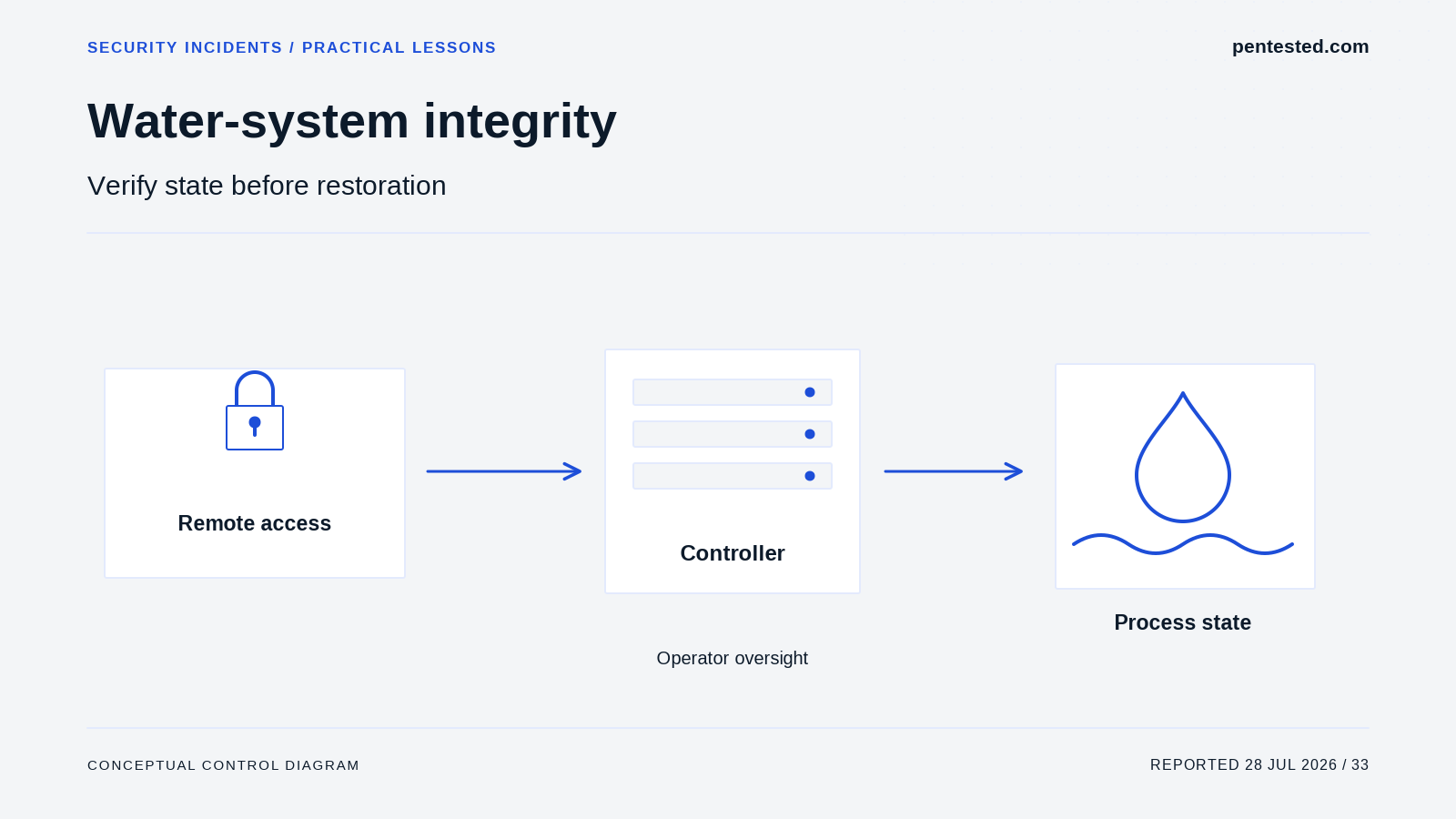
The Minnesota water-system attacks show how a small internet-facing controller can become a significant operational dependency. Its normal role may be limited, but losing access to it can remove visibility or control at an important point in the process. The security review needs to connect the exposed device with the physical function it supports.
What happened
Minnesota IT Services reported that a coordinated attack targeted operational technology at more than 30 community water systems on 26 and 27 July 2026. It activated a statewide response and worked with other authorities and affected organisations.
A subsequent FBI and EPA advisory described related water-sector incidents across at least seven states. It said attackers remotely accessed internet-facing controllers and changed addresses or passwords, causing loss of monitoring and control. The advisory distinguished impacts according to the device's function and the ability to move to manual operation. Those wider observations should not be attributed automatically to every Minnesota utility.
Public reporting and broader sector findings
The article is dated to Minnesota's public statement on 28 July. The later federal advisory provides additional sector context. The attack dates, state announcement and wider advisory therefore belong at separate points in the timeline.
The public evidence does not establish that every targeted system suffered the same physical outcome or that a named state actor conducted the Minnesota campaign. The control lessons can be applied without adding unsupported attribution.
A controller is part of a physical service
Water-utility remote control can support monitoring, pumping or other process functions. Two devices with the same model number may therefore have very different consequences if unavailable. An asset register needs to identify the function and operational owner, not just the manufacturer and network address.
Remote connectivity may have been introduced for a practical reason, such as reducing travel to a dispersed site or allowing a supplier to provide support. The review should preserve the necessary function through a controlled design rather than assuming that convenience justifies unrestricted exposure.
The communication equipment is part of that boundary. A modem, gateway or maintenance workstation can provide access to a controller even when the controller itself is not listed in the main corporate inventory. Ownership should follow the complete route from the remote user to the process device.
Manual process restoration is also a capability with limits. It may require trained staff, physical attendance and independent observations. An arrangement suitable for a short interruption may not be sustainable across several sites or several days.
Why recovery must establish integrity
Returning a controller to its previous address or restoring a password does not establish that all relevant settings are correct. Qualified operators and engineers need a trusted basis for validating the device's configuration and its relationship with the process.
Cybersecurity and operational teams should agree who makes those decisions. A standard IT response such as disconnecting or rebooting a device can affect monitoring or control. The incident plan needs a safe decision route rather than leaving responders to improvise with incomplete process knowledge.
Evidence should include both digital records and operational observations. A changed device setting, a lost connection and an operator's report may each explain part of the incident. Joining them on one timeline helps distinguish an attacker action from an unrelated fault or a recovery change.
The response should also examine similar deployments. A supplier may have used a common remote-access arrangement across several sites. That is a reason to review the shared design, not proof that every site is compromised. The distinction supports proportionate action and accurate communication.
How penetration testers assess comparable systems
An authorised operational-technology review should begin with safety constraints and the service owner's approval. Identify fragile devices, prohibited actions and the person able to stop testing. Production equipment should not be treated as a routine target for unrestricted vulnerability checks.
Configuration and connectivity review can establish unnecessary external exposure without altering the process. Testers can assess the remote-access route, permitted identities and network restrictions using approved evidence or a representative laboratory. Findings should explain the operational function at risk.
An assumed-compromise exercise can review the reach of a supplier or maintenance identity. Use controlled systems to establish whether that identity can administer unrelated sites or functions. A small safe demonstration is preferable to changing live controller settings to prove a broad point.
Recovery assurance should ask qualified personnel to demonstrate the approved return-to-service procedure for representative equipment. Verify access to trusted configuration, required tools and the necessary operational checks. A backup's existence is not the same as a tested restoration capability.
How to reduce the risk
Maintain an inventory linking controllers and communication equipment to their physical functions and responsible owners. Include remote sites and supplier-managed connections. Review whether the documented exposure matches the actual route available from outside the operational environment.
Mediate remote administration through an appropriately controlled access service rather than leaving process devices directly reachable. Give each user or supplier only the destinations and functions required for their task. Retain a practical way to suspend that access independently.
Protect configuration and recovery material and test it with the people responsible for the process. Identify which equipment needs physical attendance, specialist support or replacement hardware. Include those requirements in recovery time estimates rather than assuming every device can be restored like a virtual server.
Monitor unexpected access and changes to management settings. Connect alerts to authorised maintenance so an operator can determine whether the event is expected. Keep useful evidence outside a device that may be unavailable or under investigation.
Exercise fallback operation under realistic staffing conditions. Confirm how long it can be sustained, which sites require attendance and how the organisation will communicate service restrictions. Safety and process validation must remain with the qualified operational team.
A small utility needs a recovery procedure that matches its staffing and equipment. A plan that assumes a large on-call security team may be unusable during an overnight incident. Identify the qualified operator, the technical support route and the decision-maker who can authorise a safe change. Keep their contact details available through a channel independent of the affected system.
Exercise the handover between those roles with a fictional controller-integrity concern. Ask what evidence the operator needs before trusting the displayed state and what can be checked safely without altering the process. The aim is a shared decision with clear limits. Technical responders should understand when an engineering judgement is required, and operators should know how to preserve evidence while protecting the service.
A practical utility-level check
Choose one remotely managed controller and trace its access path, process function and recovery procedure. Ask what the operator would do if the device became unreachable while its physical state was uncertain.
That exercise turns a general warning about exposed industrial equipment into a concrete improvement. The goal is a service that can retain safe visibility and control, and recover a trustworthy configuration, even when one remote-management component is compromised.
References
<https://mn.gov/mnit/media/blog/?id=38-761869>
<https://www.ic3.gov/PSA/2026/PSA260730.pdf>
Related issues
- What the Poland energy-sector attack reveals about industrial resilience
- What French refrigeration sabotage reveals about connected equipment
- What the IDC Frontier ransomware attack reveals about cloud control planes
Read about our methodology or contact pentested.com to discuss security testing for your organisation.


