How the Odido data breach exposed the risks of voice phishing
Public report: 12 February 2026. Updated: 17 November 2026.
The Odido data breach demonstrates why customer-service security must include conversations as well as software. A person claiming to be an internal colleague can create a convincing reason to act quickly. The organisation needs a verification process that remains usable when the request sounds plausible, urgent and technically informed.
What happened
Odido publicly announced the incident on 12 February 2026. Its later account says attackers contacted customer-service staff on 5 and 6 February while impersonating the company's IT team. The company attributes the operation to ShinyHunters and says approximately 6.39 million people were affected.
Odido described exposure of customer information while stating that its communications services remained available. The attack dates, public notification and later completed analysis therefore represent different stages. A functioning telephone or internet service does not establish that the customer-contact information supporting that service remained secure.
What the public record establishes
The account identifies voice phishing as part of the route to unauthorised access. It does not provide a complete public description of every verification step or technical control encountered. The analysis below concerns the controls a comparable organisation should assess, rather than an invented reconstruction of a staff member's actions.
The company also describes notifying additional affected people as its analysis progressed. That is a reminder that an early estimate and a later confirmed notification population can differ without representing a separate intrusion.
Why an internal identity claim is persuasive
Customer-service impersonation exploits the fact that staff routinely cooperate with legitimate support teams. Real IT colleagues may contact them about access, faults or configuration. A blanket instruction to distrust every internal request would make normal work difficult and is unlikely to be followed consistently.
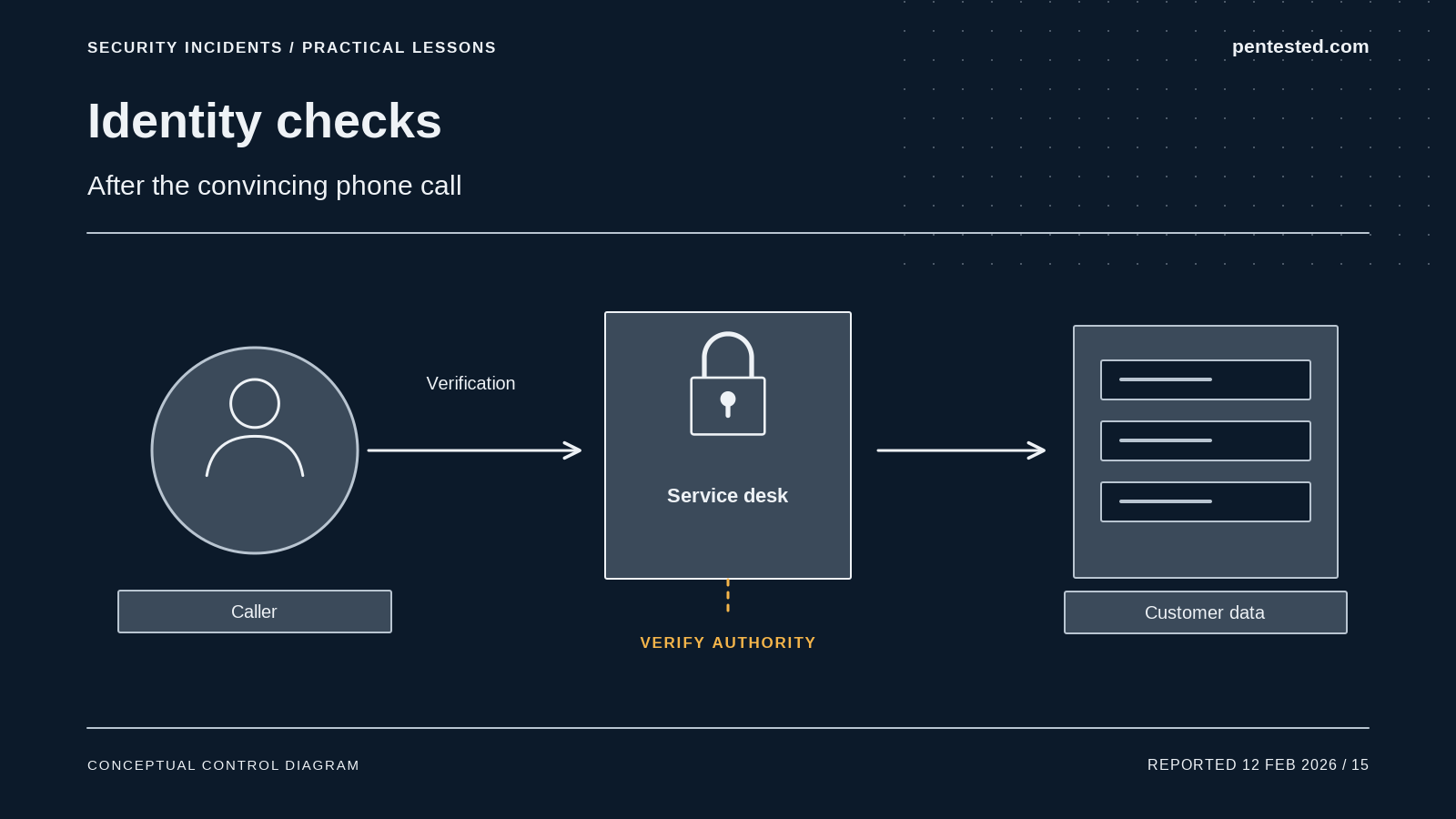
The useful distinction is between accepting the conversation and authorising the requested action. Staff can acknowledge a request while verifying it through a channel that the caller does not control. A telephone number displayed on a screen, a familiar name or knowledge of an internal system should not be the sole basis for that decision.
Vishing identity checks should also match the action's consequence. A routine question about a service status has a different risk from approving access, changing authentication or sharing a verification code. Processes should make the higher-risk actions clear and give staff a practical escalation route.
The surrounding environment can either support or undermine that process. If staff are penalised for slowing a call or cannot reach an authorised verifier promptly, a written policy may have little practical effect. Security assurance needs to examine the workflow people actually use under ordinary time pressure.
Data access after the conversation
Even where an attacker obtains a valid session, the amount of customer information available should remain constrained by the role's purpose. A service agent may need enough information to resolve one customer's enquiry without having unrestricted access to bulk records.
This creates a second line of assessment. The organisation should understand which tasks require broad access, which exports are exceptional and which events would reveal misuse. Training is useful, but it should sit alongside technical limits on what a compromised identity can obtain.
Historical records can complicate scope. Current and former customers may appear in the same system, and different brands may share supporting services. Investigators need an accurate data map to identify affected people and explain why information remained available.
Support data itself can be sensitive. Case notes and interaction history may contain details that make future impersonation more convincing. Classification should examine those contents rather than treating every customer-contact system as a simple address book.
How penetration testers assess comparable processes
An authorised social-engineering assessment should define the permitted pretexts, staff groups, contact channels and stop conditions. The objective should be a controlled action involving a test identity or synthetic information, not collection of real passwords or customer records.
Testers can assess whether staff use an independently verified callback or escalation route when a caller requests a sensitive action. A useful report explains the process that enabled or stopped the request. It should avoid reducing the outcome to blame directed at an individual employee.
The engagement should also review the technical authority available after an agreed test login. Using synthetic records, assess whether the role can reach data outside its assigned work or perform unnecessary bulk operations. This connects the human verification boundary with the application authorisation boundary.
Detection can be tested through controlled unusual access to test data. The team should measure whether the activity is attributable to a specific identity and whether responders can distinguish suspicious behaviour from a genuine busy shift. An alert without enough context to investigate is a limited control.
How to reduce the risk
Define sensitive support actions and give each a clear verification requirement. Provide staff with an internal directory or trusted workflow that does not depend on contact details supplied by the caller. Make the process usable across shifts and remote-working arrangements.
Design escalation so a cautious employee can obtain a timely decision. A staff member who pauses a suspicious request should have a clear next step and managerial support. Exercises should test that support mechanism as well as the employee's initial reaction.
Limit access within customer-contact applications. Separate individual-case handling from bulk export, restrict unnecessary historical data and review the permissions of integrations. A compromised routine identity should not automatically become a route to every customer record.
Protect administrative recovery and authentication-change workflows. Review whether one support conversation can both establish an identity and approve a consequential access change. Additional approval should provide an independent decision rather than repeating the caller's own claim.
Retain useful authentication and data-access records. During an incident, the team needs to connect the suspicious conversation with the resulting session and information obtained. Agree in advance which supplier records can support that investigation and how quickly they can be provided.
A realistic service-desk exercise should test the point at which an employee is asked to depart from the normal process. Use an agreed scenario, avoid collecting real passwords and measure whether the employee has a workable way to verify the caller. Staff need an approved route that remains usable when the caller claims an urgent technical fault.
Then follow the access granted after the conversation. Identify the records available to that account and whether a bulk export needs an independent check. Training helps protect the first boundary; limited permissions and useful monitoring reduce the consequences when a convincing request crosses it. Both parts belong in the exercise, with improvements assigned to the teams able to change the process.
What a meaningful exercise should change
The strongest outcome is a process improvement staff can explain and use, supported by appropriate limits in the application. Training statistics alone do not establish that an urgent impersonation request will be verified correctly.
Ask a service-team leader to demonstrate the approved response to one fictional IT-support call requesting a sensitive action. Then verify the available permissions and logs. That small joined-up review can reveal a more useful set of improvements than treating voice phishing as an awareness problem in isolation.
References
<https://www.odido.nl/veiligheid-eng>
<https://newsroom.odido.nl/odido-informeert-klanten-over-cyberaanval/>
Related issues
- What the Coupang data breach teaches about former-employee access
- What the Crédit Mutuel Arkéa attack teaches about supplier payment access
- What the ConnectWise Cloud Backup breach teaches about tenant trust
Read about our methodology or contact pentested.com to discuss security testing for your organisation.


