What the ConnectWise Cloud Backup breach teaches about tenant trust
Public report: 16 October 2026. Updated: 17 November 2026.
The ConnectWise Cloud Backup breach shows why backup software belongs in the review of privileged cloud identities. A service trusted to protect business information may hold broad, persistent authority across a tenant. If its application credentials are stolen, an attacker can attempt to use the trust already granted rather than persuade each customer to approve a new connection.
What happened
ConnectWise disclosed activity involving its Cloud Backup product, formerly SkyKick, in October 2026. Microsoft's subsequent report attributes the campaign to Storm-0940 and describes use of stolen application credentials to attempt access to more than 2,250 downstream tenants, with ARTEX-assisted automation.
Microsoft also described follow-on directory and identity activity in some environments. The attempted-tenant count is not a count of confirmed compromises. Its report distinguishes a separate high-volume password-spray sequence without observed successful authentication from later activity using compromised application trust. Those stages should not be combined into a misleading success total.
Disclosure and later investigation
The article date follows ConnectWise's initial public advisory on 16 October. Microsoft's 21 October analysis provides additional technical context. The later actor assessment and automation detail should be identified as subsequent findings, not facts known by every customer at the initial notice.
The case concerns a specific product and application-credential incident. It should not be merged with the separate November ScreenConnect activity simply because both products share a company name.
Backup applications hold consequential trust
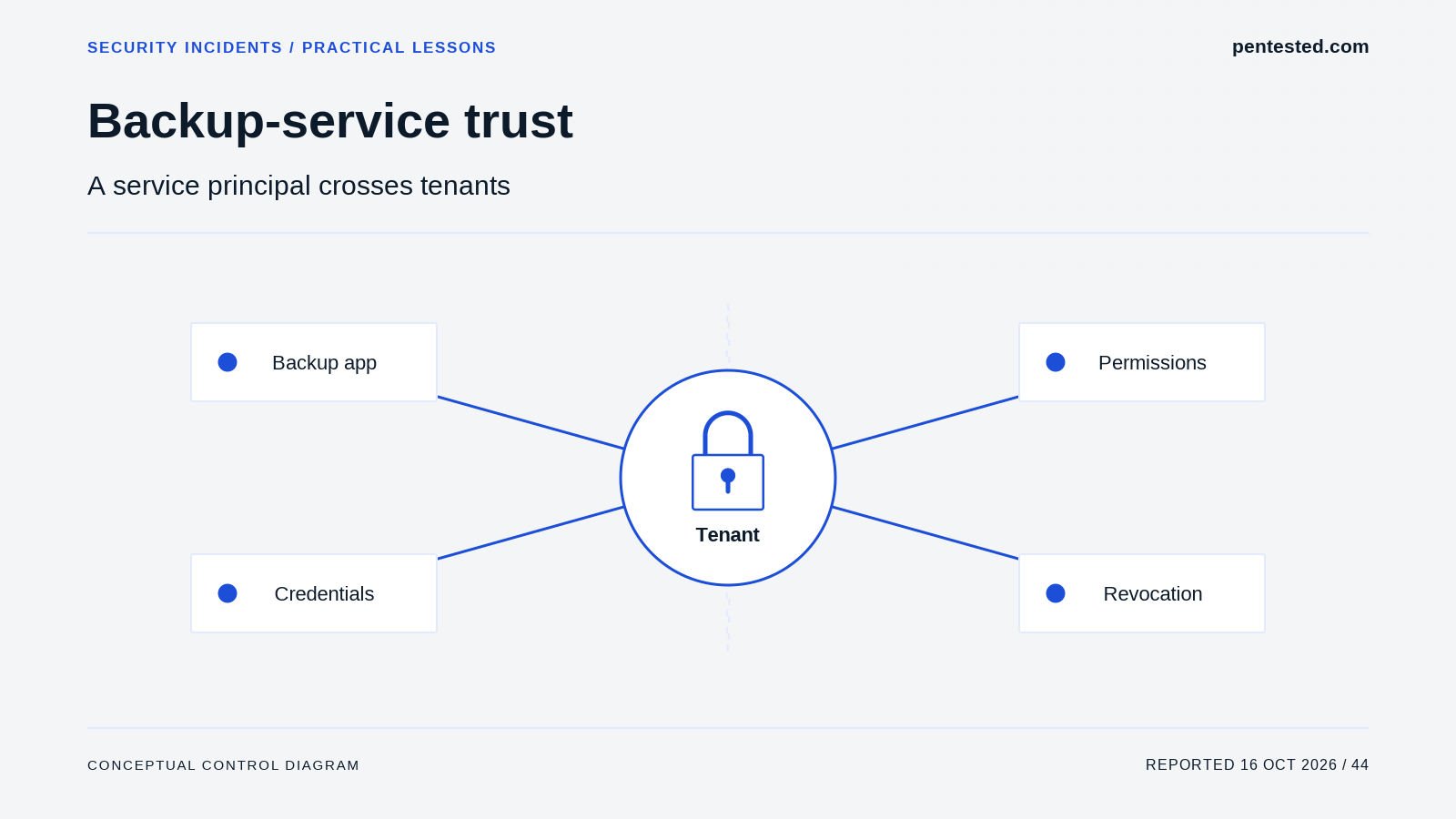
Backup service principals can have permissions necessary to read or manage information across a cloud environment. The exact capabilities depend on the product and customer configuration. A security review needs to establish those effective permissions rather than treating backup as inherently low-risk because its purpose is protective.
Cross-tenant application trust can amplify a supplier incident. Customers may have independently approved the same supplier application, creating many separate environments in which its identity is recognised. Compromise of the supplier's credentials can therefore have a broader reach than compromise of one ordinary customer account.
The distinction between a person and an application identity matters. Strong authentication for employees does not automatically constrain an already trusted machine credential. The organisation needs separate governance for application permissions, credential changes and consent relationships.
The backup function also creates a recovery dependency. If the service protecting information is under investigation, the customer needs to know whether it can still rely on its stored copies, administrative portal and restoration identities. Those questions should be answered before the product becomes the only recovery route.
Automation changes response requirements
An automated operator can attempt many actions quickly, but speed does not remove the need to distinguish attempts from outcomes. Responders should identify which credentials were accepted, which operations succeeded and which changes persisted. A large failed-sign-in count can distract from a smaller number of consequential successful actions.
Application credential modifications are particularly relevant because they can create a new access route independent of the original stolen secret. Recovery should examine the authorised state of the application and related identities, not only replace a password in one place.
The customer also needs context from the supplier. A broad indicator list can help investigation, but the organisation must connect it with its own app permissions, activity and changes. Neither a clean employee sign-in review nor a vendor statement alone answers every tenant-specific question.
Operational pressure can complicate containment. Removing the application's access may pause backup or restoration functions. The decision should include both the security consequence and the approved alternative, with a clear owner for reinstating the service safely.
How penetration testers assess comparable services
An authorised cloud assessment should inventory backup applications, service principals and their effective permissions. Identify the owners, consent history and credentials or trust mechanisms involved. Use a dedicated test tenant or explicitly authorised customer environment.
Testers can assess what a representative application identity can read or change using synthetic data. The result should distinguish permissions required for backup from unnecessary administration or unrelated access. A list of permission names is less useful than a demonstrated business consequence.
Review credential and consent lifecycle processes. A controlled exercise can add and revoke a synthetic credential, then verify the activity records and the response. Assess whether the organisation would recognise an unexpected change to an already approved application.
Recovery testing should remove the normal supplier connection in a tabletop or isolated scenario. Ask the team to demonstrate access to a trusted backup and an approved restoration route. This establishes whether the recovery design remains useful when the backup provider itself is the incident source.
How to reduce the risk
Treat backup application permissions as privileged access requiring ownership and periodic review. Understand what the product needs, remove obsolete grants and document any broad permissions that remain. Reassess the model when product capabilities or deployment arrangements change.
Monitor application credentials, consent and directory changes as well as human sign-ins. Retain records that can establish the identity, operation and outcome. Alerting should identify the application and affected tenant context so responders can act on the useful events.
Prepare a supplier-connection shutdown and restoration process. Identify who can revoke access, what business functions will pause and which evidence supports reconnection. Validate the current app and credential state before reinstating normal authority.
Maintain recovery arrangements that do not depend entirely on the same application identity. Review access separation and test restoration with the normal supplier route unavailable. A backup's value includes whether the organisation can use it safely under adverse conditions.
After suspected compromise, inspect changes and persistence as well as the original credential. Revoke unauthorised authority from a trusted environment and review successful operations during the exposure period. A high volume of failed activity should not obscure the actions that actually altered the tenant.
A backup integration needs a documented explanation of why each permission is required. Confirm whether it reads data, creates applications, manages accounts or changes configuration, and compare that authority with the service actually purchased. Broad permission granted during an old setup process should not be accepted as a permanent technical necessity without review.
Exercise revocation in a test tenant and observe both the security result and the operational effect. Verify that the application's old authority no longer works, then determine how backups are resumed through a clean, approved connection. Record which earlier backup data remains usable and how its integrity is established. This gives the team a prepared route to contain a supplier relationship without discovering the recovery consequences during a live emergency.
A useful tenant-level exercise
Choose one backup application and ask what it could do beyond reading the intended data. Then ask how the team would remove its authority and recover a representative service without using that same identity.
Those checks connect supplier assurance, cloud permissions and business recovery. A protective service is easier to trust when its authority is understood, its misuse is observable and the organisation can respond if that trust relationship becomes the route of attack.
References
<https://www.microsoft.com/en-us/security/blog/2026/10/21/storm-0940-uses-artex-agentic-ai-connectwise-supply-chain-compromise/>
Related issues
- What the Gainsight Salesforce breach teaches about connected apps
- What the ScreenConnect incident reveals about remote-management trust
- What the Vercel security incident teaches about AI-tool permissions
Read about our methodology or contact pentested.com to discuss security testing for your organisation.


