What the Gainsight Salesforce breach teaches about connected apps
Public report: 20 November 2025. Updated: 17 November 2026.
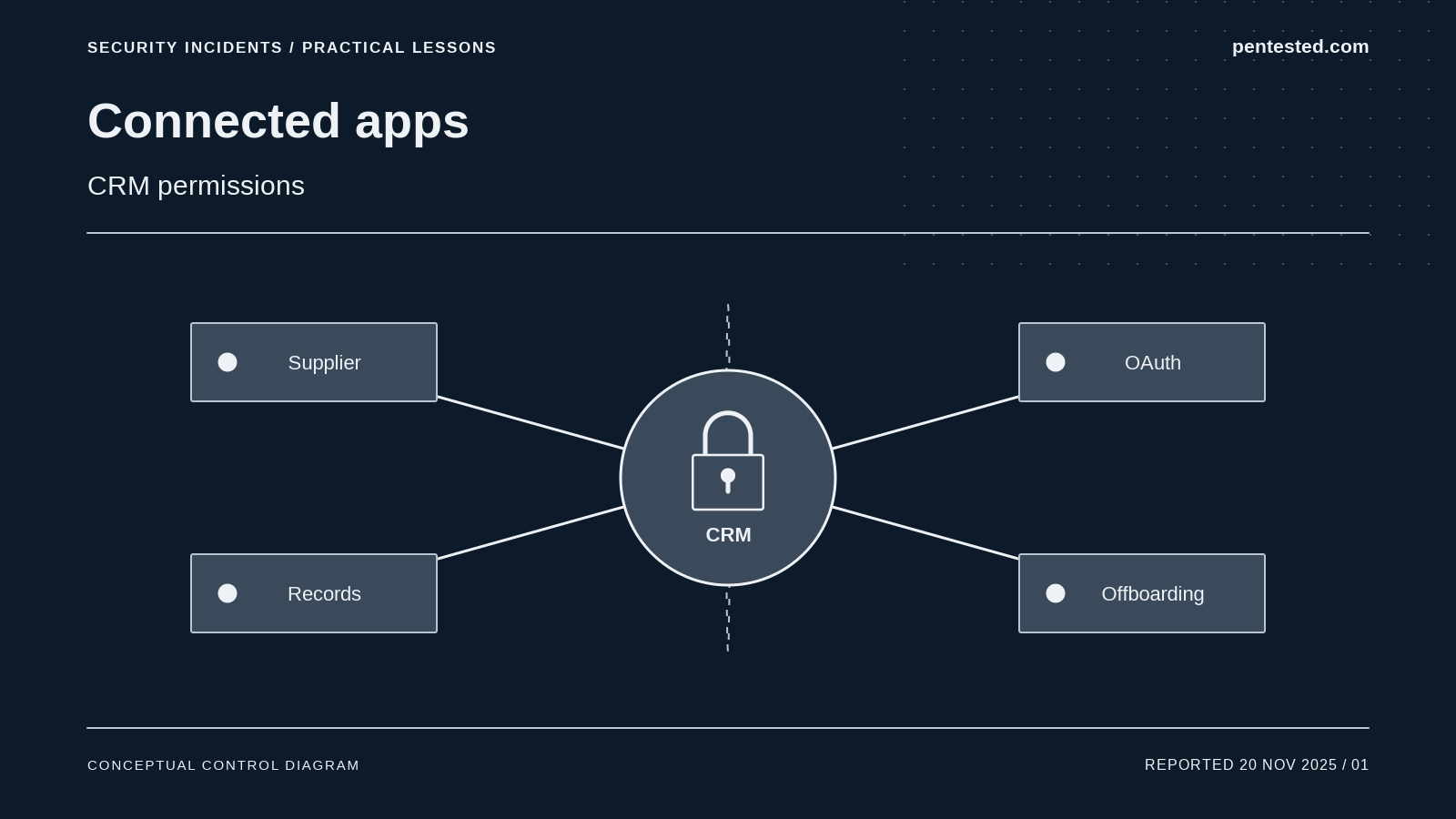
The Gainsight Salesforce breach shows why an application connected to your CRM belongs inside your security boundary. An integration can hold permission to read customer records long after the person who approved it has forgotten why it exists. If that permission is stolen or misused, the resulting activity may arrive through a familiar, authenticated route.
What happened
In November 2025, Salesforce reported unusual activity involving Gainsight-published applications connected to customer Salesforce environments. Its advisory said this may have allowed unauthorised access to some customers' data. Salesforce disabled the connections on 20 November and later restored them following remediation. It said there was no indication of a vulnerability in the Salesforce platform itself.
A separate customer account adds an important detail. Sentry said its Gainsight contract had ended in August, but the corresponding application remained active in Salesforce. Sentry reported unauthorised API calls using a compromised OAuth token, while stating that its investigation found no access to customer personal information or service data. That example demonstrates why supplier offboarding must include permissions in systems you operate.
Timeline and evidence
The public record distinguishes the suspicious activity, the revocation of integration access in November, and the re-enabling of integrations on 10 December 2025. This article uses the November public reporting date and incorporates subsequent updates. The references describe different organisations' findings; Sentry's outcome should not be assumed to describe every affected Salesforce customer.
Why connected applications change the risk
OAuth allows one application to act with permissions granted by another system. The arrangement is useful because a customer-success platform can synchronise account information without repeatedly asking a person to sign in. The security consequence is that a durable machine identity now has a route into business information.
CRM integration permissions should therefore be reviewed against business tasks. A tool that needs account names and renewal dates may not require unrestricted export of every contact, case note or attachment. Broad access makes implementation easier, but it also increases the amount of information available through one compromised connection.
Interactive sign-in protection is only part of the answer. Requiring staff to use strong authentication does not automatically limit what an already-authorised application can do. Security teams need to understand the application's permissions, credential lifetime, permitted access context and revocation behaviour separately from employee login policy.
The offboarding problem is particularly easy to miss. Procurement may close a contract, finance may stop payment and the supplier may delete its copy of the data. None of those actions necessarily removes the customer's connected application. Access persists until someone with responsibility for the receiving system removes it and verifies the result.
Business impact extends beyond a record count
For a CRM, the sensitivity of a dataset depends on its contents and relationships. Customer contacts, buying decisions, support concerns and contract discussions can make impersonation more convincing. An attacker does not need a password database to create a commercially damaging incident.
The integration may also support legitimate operational work. Disabling it can interrupt reporting, renewal workflows or customer communications. This creates a practical tension: responders need to remove suspect access while business teams need an alternative way to complete essential tasks. A documented dependency map helps both teams make that decision without guessing.
Evidence retention matters because the supplier and the customer see different parts of the activity. The supplier may hold application-side authentication records; the customer may hold API events and object-access logs. A useful investigation joins those views using timestamps, application identities and the affected organisations. A reassuring statement about one environment does not replace checks in another.
How penetration testers assess similar weaknesses
An authorised assessment begins with an inventory of connected applications, their owners and their effective permissions. The useful question is what a compromised integration could actually read, change or export. A screenshot of an approval screen rarely answers that fully.
Testers can use a dedicated integration account and synthetic customer records to assess the boundary safely. They should compare access through the integration with the business purpose recorded in the approval. Any permission that is broader than necessary should be demonstrated using controlled data and explained in operational terms.
Third-party OAuth access also needs lifecycle testing. The team should establish what happens when a contract is marked as ended, an application owner leaves or a credential is rotated. A successful test verifies that old access stops working and that monitoring records the attempted use; it does not simply confirm that someone clicked a revoke button.
Detection testing should include unusual record volumes, unexpected access times and new access locations where relevant. These are assessment scenarios, not claims about the controls present at Gainsight or Salesforce. The objective is to establish whether the customer's own team would recognise misuse of a legitimate connection.
How to reduce the risk
Give every integration a named business owner and a technical owner. Record the systems it connects, the information it needs, the privileges it holds and the conditions under which it should be removed. Review that record whenever the business use changes.
Reduce permissions before adding monitoring around excessive access. Separate integrations with different purposes, avoid shared administrator identities, and use the narrowest supported authorisation model. Where a product cannot support a suitable boundary, treat the limitation as a purchasing and architecture decision.
Make supplier termination a joint workflow across procurement, application administration and security. The closure record should include evidence that connected applications, service accounts and credentials have been removed or disabled. Reconcile it with the actual configuration rather than relying on a supplier's confirmation alone.
Prepare an integration shutdown procedure before an incident. It should identify who can revoke access, how evidence is preserved, which business functions will stop and how those functions can operate temporarily. Test the procedure in a non-production environment where possible.
Finally, agree a restoration threshold. Reconnection should follow a review of the supplier's remediation, the customer's own activity records and any credentials or data that may have been exposed. Restoring a connection is a new security decision, not an automatic consequence of a service becoming available again.
An integration owner should be able to explain the difference between the supplier's contract and the application's technical access. Ending one does not necessarily end the other. During a review, compare the procurement record with the connected-application inventory and resolve every mismatch. Where an integration is retained for an archive or a migration, give that exception an expiry date and an accountable owner. That creates a decision that can be checked later, rather than a permanent assumption that someone else has removed access.
A practical review for your organisation
Choose one CRM integration that has been in place for several years. Ask its owner to explain its current purpose without looking at the original purchase request. Then compare that explanation with its actual data access and with the teams that still depend on it.
If the answers differ, resolve the gap before conducting a wider exercise. A connection that has become unnecessary is usually easier to remove than to defend indefinitely. A connection that remains essential needs an appropriate owner, tested limits and reliable evidence about its use.
The most useful output is a small set of decisions: which permissions to reduce, which obsolete connections to remove, which logs to retain and who can authorise an emergency shutdown. Those decisions turn a widely reported supplier incident into a concrete improvement in your own environment.
References
<https://help.salesforce.com/s/articleView?id=005229029&language=en_US&type=1>
<https://www.sentry.help/en/articles/13964943-was-sentry-affected-by-the-gainsight-connected-app-incident>
Related issues
- What the Vercel security incident teaches about AI-tool permissions
- What the ConnectWise Cloud Backup breach teaches about tenant trust
- What the Crédit Mutuel Arkéa attack teaches about supplier payment access
Read about our methodology or contact pentested.com to discuss security testing for your organisation.


