What the Crédit Mutuel Arkéa attack teaches about supplier payment access
Public report: 4 November 2026. Updated: 17 November 2026.
The Crédit Mutuel Arkéa attack demonstrates why supplier access to payment infrastructure needs to be assessed according to the authority it can exercise. A bank can protect its customer-facing accounts while a separate service-provider route reaches its own treasury operations. The security boundary must follow the payment capability, not just the visible customer application.
What happened
On 4 November 2026, Crédit Mutuel Arkéa disclosed an attack involving fraudulent transfers. Its clarification said attackers entered through a service provider's platform and used the bank's own account to send transactions to other banks. It said customer holdings were unaffected and some operations had been delayed temporarily.
The bank did not confirm the widely reported loss amount as a final figure. It said only that the reported order of magnitude was consistent, while some funds had been blocked and recovery work continued. The article therefore does not present the press estimate as a settled net loss.
What the disclosure establishes
The article is dated to the bank's public statements on 4 November. The clarification provides a useful boundary between the provider route, the bank's own funds and customers' holdings. Those should remain distinct throughout the account.
The public notice does not disclose a complete technical initial-access mechanism. It would be misleading to identify a particular vulnerability, stolen employee password or payment protocol as the cause without further evidence. The analysis concerns the supplier authority and transaction-control questions the incident raises.
Supplier access can become payment authority
Supplier payment authority may be exercised through an application, an integration identity or a platform used for an operational task. The business needs to understand what that authority can initiate, approve or change. A contract describing a service does not establish the effective permissions of its technical connection.
Bank treasury transfer controls should consider compromise of a normally trusted provider. A request can arrive through the expected route while representing an unauthorised action. The design should identify the independent checks that remain after the provider's identity or platform is misused.
Separation of duties needs genuine independence. If one connected service can prepare a transaction, alter the relevant rules and approve execution, nominally separate stages may offer little protection. The review should trace who controls each stage and whether one compromise can influence several of them.
The same principle applies outside banking. A business may use suppliers for payroll, purchasing or payment processing. Its assurance should focus on the actions the supplier can cause and the limits that remain, rather than treating a successful supplier login as proof of a legitimate business instruction.
Why impact needs careful explanation
An incident involving the bank's own account is different from unauthorised access to individual customer balances. Accurate communication helps people understand whether they need to investigate their own activity or whether the immediate effect is a service delay managed by the bank.
The financial figures also need a defined basis. A gross transfer, an amount blocked at another institution and a final loss after recovery are separate measures. Early reporting can evolve as transactions are reconciled and cooperating parties confirm their actions.
Technical containment and financial recovery are different milestones. Disabling the provider connection may stop the initial route while funds remain elsewhere or other credentials require review. Conversely, recovering funds does not establish that the original access model has been corrected.
The response should also examine interrupted legitimate work. Temporary transfer restrictions can affect staff and customers even when their holdings are not exposed. A safe restart needs to address queued operations, duplicate requests and the status of any manual processing.
How penetration testers assess comparable access
An authorised assessment should map the supplier's technical connection to each payment-related capability. Include service identities, administrative roles and the people able to change the integration. The engagement should use test accounts and simulated or valueless transactions.
Testers can assess whether a compromised provider identity can initiate an operation outside its intended purpose. Review the independent checks on destination, authority, approval and exceptional changes according to the actual process. No real transfer is required to demonstrate a missing boundary.
Review changes to the payment policy and supporting identities. A system may restrict ordinary transfers while allowing an overpowered administrator to remove the restriction. The assessment should establish who controls the controls and how those changes are observed.
An incident exercise can suspend the supplier route and ask the team to complete one legitimate fictional payment through an approved alternative. Include evidence preservation, reconciliation and the checks required before reconnecting the provider. This measures continuity and recovery as well as access prevention.
How to reduce the risk
Inventory supplier connections according to their effective payment capabilities. Assign business and technical owners and review the authority when the service changes. Remove obsolete credentials and avoid broad permissions granted merely to simplify integration.
Maintain independent approval for consequential actions. Review whether one compromised identity or platform can influence several stages of the process. Emergency exceptions should be controlled and observable rather than becoming an undocumented route around normal checks.
Monitor changes in payment destinations, limits, approvals and integration credentials where relevant. The response team needs enough context to distinguish a legitimate operational change from an unexpected expansion of authority. A generic authentication alert rarely explains the business consequence by itself.
Prepare a provider shutdown and restoration process. Identify who can revoke access, what legitimate work will pause and how queued or manual operations will be reconciled. Reconnection should follow verification of both the provider's remediation and the customer's own effective permissions.
Keep a consistent incident accounting model. Track transfers, blocked funds, recoveries and unresolved amounts separately, with dates and evidence. That supports accurate leadership decisions without conflating a changing estimate with a completed investigation.
Review supplier access in terms of the decisions it can influence. A service used for communications, administration or payment preparation may sit outside the final authorisation step while still supplying information that staff rely on. Map that influence and identify which important details are verified through an independent route.
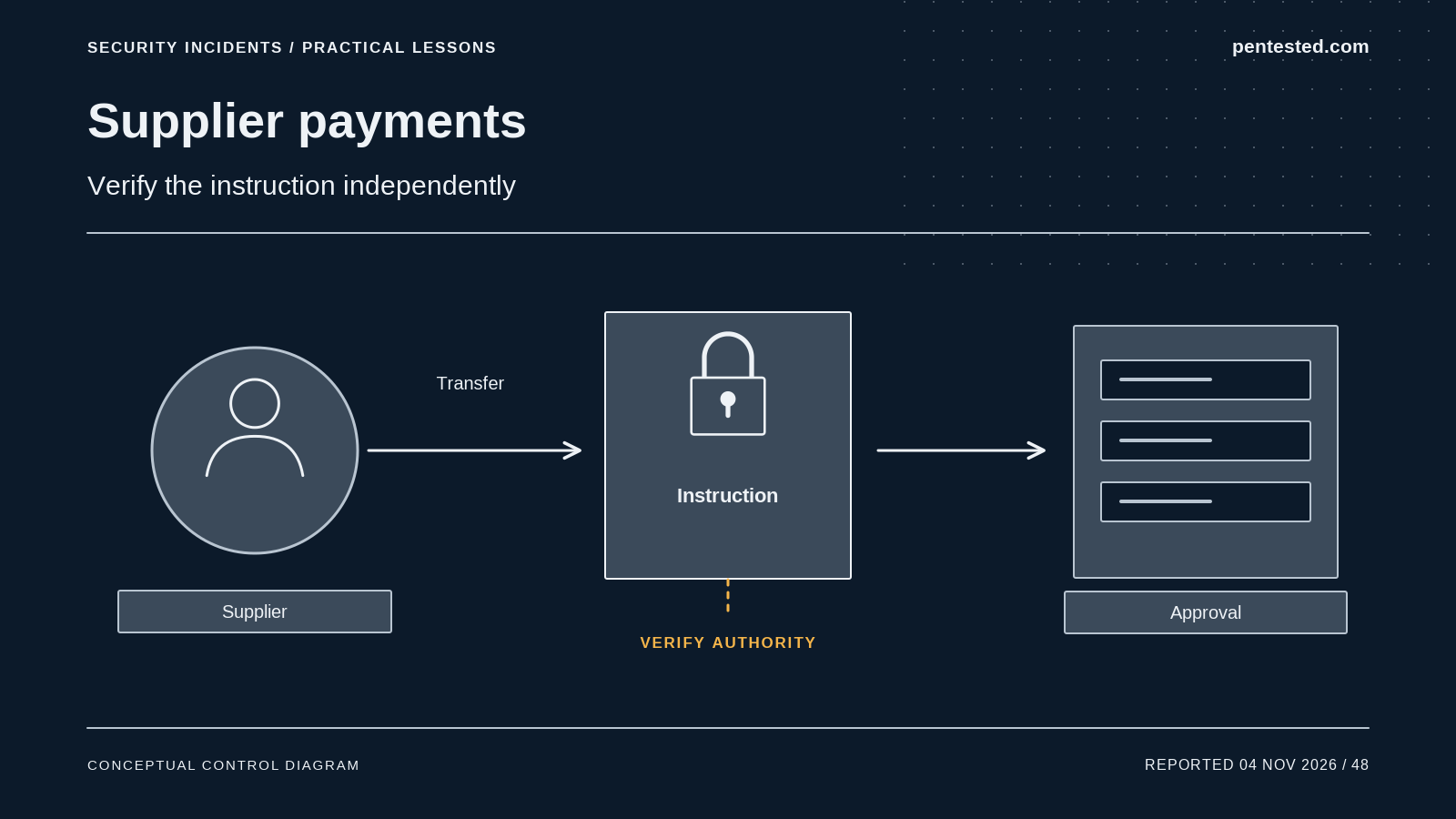
Use a fictional change of payment details to exercise the process with the relevant service owner. The test should demonstrate how the recipient, amount and approval are verified without relying entirely on the originating supplier session or message. Record the evidence available to investigate a disputed instruction. This makes supplier assurance part of the payment workflow itself rather than a separate questionnaire that says little about how a fraudulent change would be stopped.
A practical supplier-assurance question
Ask what one compromised payment supplier could cause without a second independent business decision. Then demonstrate the limiting control in a test environment and show the evidence an investigator would receive.
The answer should make the supplier's authority understandable in operational terms. A service-provider relationship is more defensible when its payment reach is limited, its changes are visible and the organisation can suspend and restore it without losing control of legitimate transactions.
References
<https://www.cm-arkea.com/arkea/banque/assurances/pa_38386/fr/informations-complementaires-suite-a-l-attaque-dont-le-credit-mutuel-arkea-a-ete-victime>
Related issues
- What the Gainsight Salesforce breach teaches about connected apps
- What the Bitget security incident teaches about wallet-environment trust
- How the Odido data breach exposed the risks of voice phishing
Read about our methodology or contact pentested.com to discuss security testing for your organisation.


