What the Coupang data breach teaches about former-employee access
Public report: 29 November 2025. Updated: 17 November 2026.
The Coupang data breach raises a question that every large application should be able to answer: what prevents an identity that once had legitimate access from continuing to obtain customer information? Removing a user account is only one part of that answer. Keys, sessions, service permissions and the volume of data a system will return all matter.
What happened
Coupang publicly disclosed a customer-information incident on 29 November 2025. Its subsequent statements describe improper access by a former employee to data associated with more than 33 million customer accounts. The company distinguishes the number of accounts accessed from the much smaller dataset it says the individual retained.
Those are the company's stated investigative findings, rather than an independent conclusion by this article. The distinction between access, retention, onward disclosure and demonstrated misuse is important: each describes a different part of an incident and requires different evidence. A statement about one does not automatically establish the others.
Discovery, disclosure and later findings
Coupang's regulatory filing dates discovery to 18 November 2025. The broader public disclosure followed on 29 November. Company updates in February 2026 provided further findings and described the access route as remediated. This article's reporting date follows the public disclosure, with the later findings identified as subsequent information.
The case should not be reduced to a single headline number. An investigation needs to establish which fields were accessible, which requests occurred and what the available evidence can say about copying or further distribution.
Why offboarding is an application-security issue
Former-employee access is often treated as an identity-administration task. Human resources records a departure, a directory account is disabled and a laptop is returned. That process can be necessary and still leave gaps in the applications or credentials the person previously used.
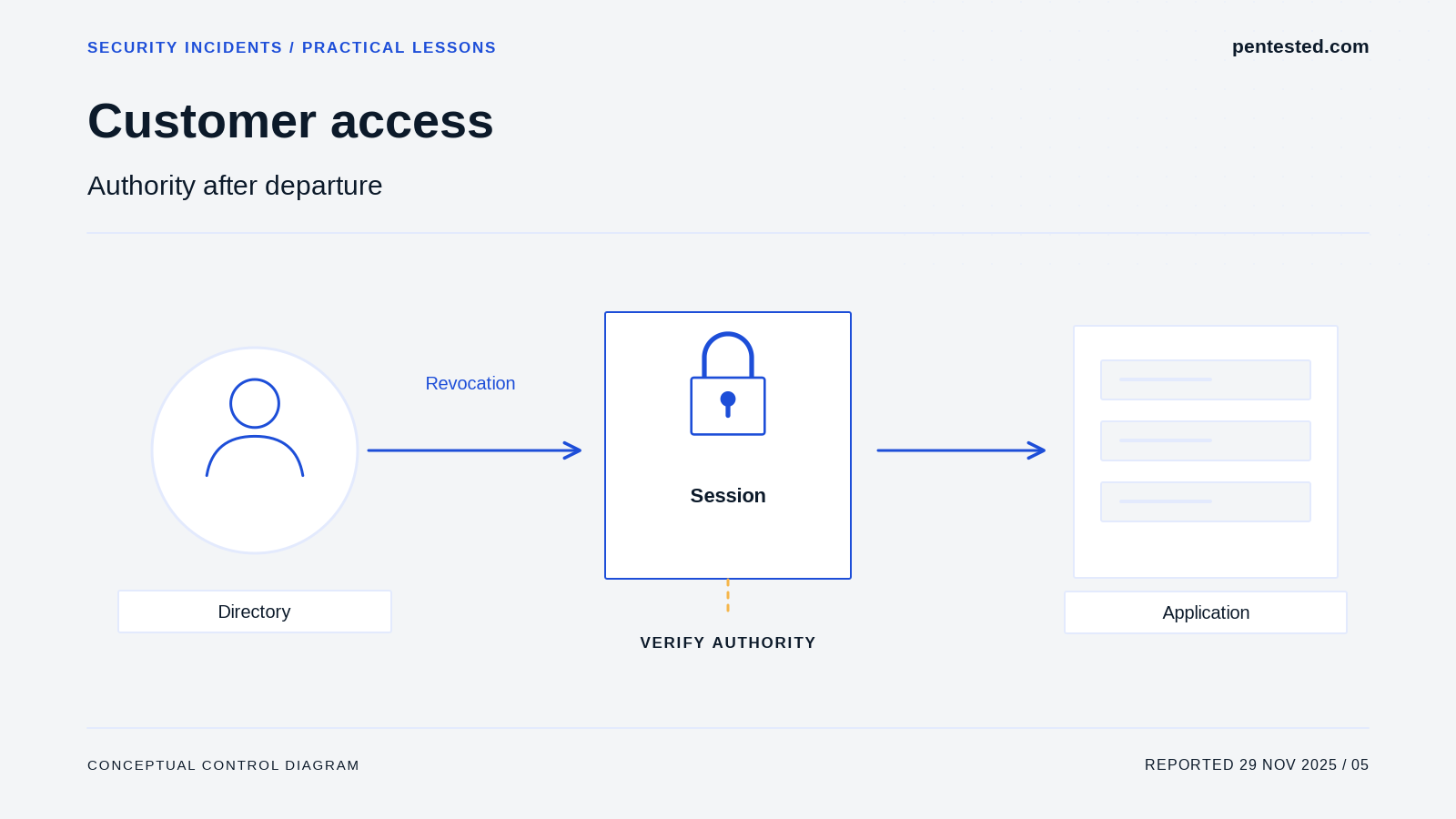
A meaningful review follows the person's authority into the systems that enforce it. A session may outlive the directory account that originally created it. A service credential may not be attached to the departing employee at all. A signing or administrative key may have a wider lifecycle than an individual login.
The application must also decide what an otherwise valid request is allowed to obtain. Authentication establishes an identity or verifies a credential; authorisation determines which records and operations that identity may access. Keeping those decisions separate helps prevent a powerful credential from becoming an unrestricted customer-data export mechanism.
Bulk customer queries make this especially significant. A single request may look ordinary, while a sequence of requests collects an entire population. Security controls need enough context to recognise the accumulated behaviour and enough operational ownership to decide whether it is justified.
Counting impact carefully
There are several legitimate measures of scope. An account may have been reachable, requested, returned by the server, stored on an endpoint or included in a dataset recovered by investigators. Those populations can overlap without being identical. Reporting should explain which population a number represents.
The information returned also changes the potential harm. Contact information, delivery addresses and purchase context can support different forms of impersonation or unwanted contact. An assessment should identify the actual fields rather than assuming that every customer record contains the same information.
Absence of observed misuse is relevant, but it does not make unauthorised access acceptable. Equally, unauthorised access does not justify asserting that every possible consequence has occurred. A mature incident account can explain both the established exposure and the limits of the evidence.
For another business, the practical value lies in testing those evidence limits before an incident. Can the application identify the records returned to an identity over time? Are logs retained long enough to cover an investigation? Can the team distinguish a failed request from a successful response containing personal information?
How penetration testers assess comparable weaknesses
An authorised review should start with representative roles and synthetic customer records. Testers can compare what a current employee, a departed employee's revoked credentials and a service identity are permitted to access. The purpose is to verify the organisation's controls, not to reproduce the reported incident against a live third-party service.
Offboarding tests should cover active sessions, API credentials and integrations in addition to the normal login screen. A useful result confirms that a revoked identity cannot continue using previously issued authority, or documents the remaining lifetime and the risk accepted by the business.
Authorisation testing should examine record boundaries. A customer-service role may need access to a specific case without needing every account in the system. Testers can demonstrate unnecessary reach using a small, agreed set of records and explain whether the weakness lies in role design, application enforcement or administrative practice.
Monitoring can be assessed through a controlled sequence of queries against test data. The team should agree safe limits, expected alerts and a contact able to stop the exercise. Success means an actionable investigation is triggered, with enough context to identify the identity and affected records.
How to reduce the risk
Treat departures and role changes as changes to effective application authority. Maintain an inventory of the applications, credentials and privileged groups associated with each role. Confirm removal against the actual systems, especially where accounts or service credentials are managed outside the central directory.
Use credential lifetimes and rotation processes appropriate to the authority granted. Where an exposed or no-longer-authorised credential could remain valid, the revocation process needs to remove that authority promptly. Creating a replacement credential without invalidating the old one does not complete the task.
Design application permissions around specific duties and data needs. Separate routine customer support from bulk export and administrative functions. Require additional approval for exceptional access where the business process supports it, and retain evidence of who authorised the operation.
Monitor the volume and pattern of data returned, not just whether authentication succeeded. Unusual access should be understandable to responders: the identity, records, time range and relevant business purpose should be available for investigation. Avoid relying on a raw event count with no service context.
Minimise the personal information returned by each endpoint. A workflow may need a customer's delivery status without needing every historical address or unrelated account detail. Smaller responses reduce the impact of both excessive permissions and accidental disclosure.
Offboarding verification should include a harmless action that the departed identity previously had permission to perform. Test the old application session, any separate API credential and access through delegated roles. A successful block in the employee directory is only one result. Record which systems required their own revocation and bring those steps into the standard departure process. Where a service identity must remain, transfer its ownership explicitly and replace credentials known to the departing person rather than merely renaming the account.
What a defensible review produces
A useful review should leave the organisation with evidence that a departure removes access, a role grants only necessary capabilities and abnormal extraction can be investigated. Those are separate outcomes; passing one should not conceal failure in another.
Ask the owners of one important customer application to demonstrate them using a test identity. If they cannot show the result, record a specific improvement with an owner and a completion check. The resulting work strengthens both prevention and the quality of the answers available if customer access is ever questioned.
References
<https://www.aboutcoupang.com/response-to-the-jit-report-regarding-the-november-2025-data-incident/>
<https://www.aboutcoupang.com/update-on-the-november-29-personal-information-incident/>
Related issues
- What the FICOBA breach teaches about access to national datasets
- How the Odido data breach exposed the risks of voice phishing
- What the Nottingham University breach teaches about student-record security
Read about our methodology or contact pentested.com to discuss security testing for your organisation.


