What the FICOBA breach teaches about access to national datasets
Public report: 18 February 2026. Updated: 17 November 2026.
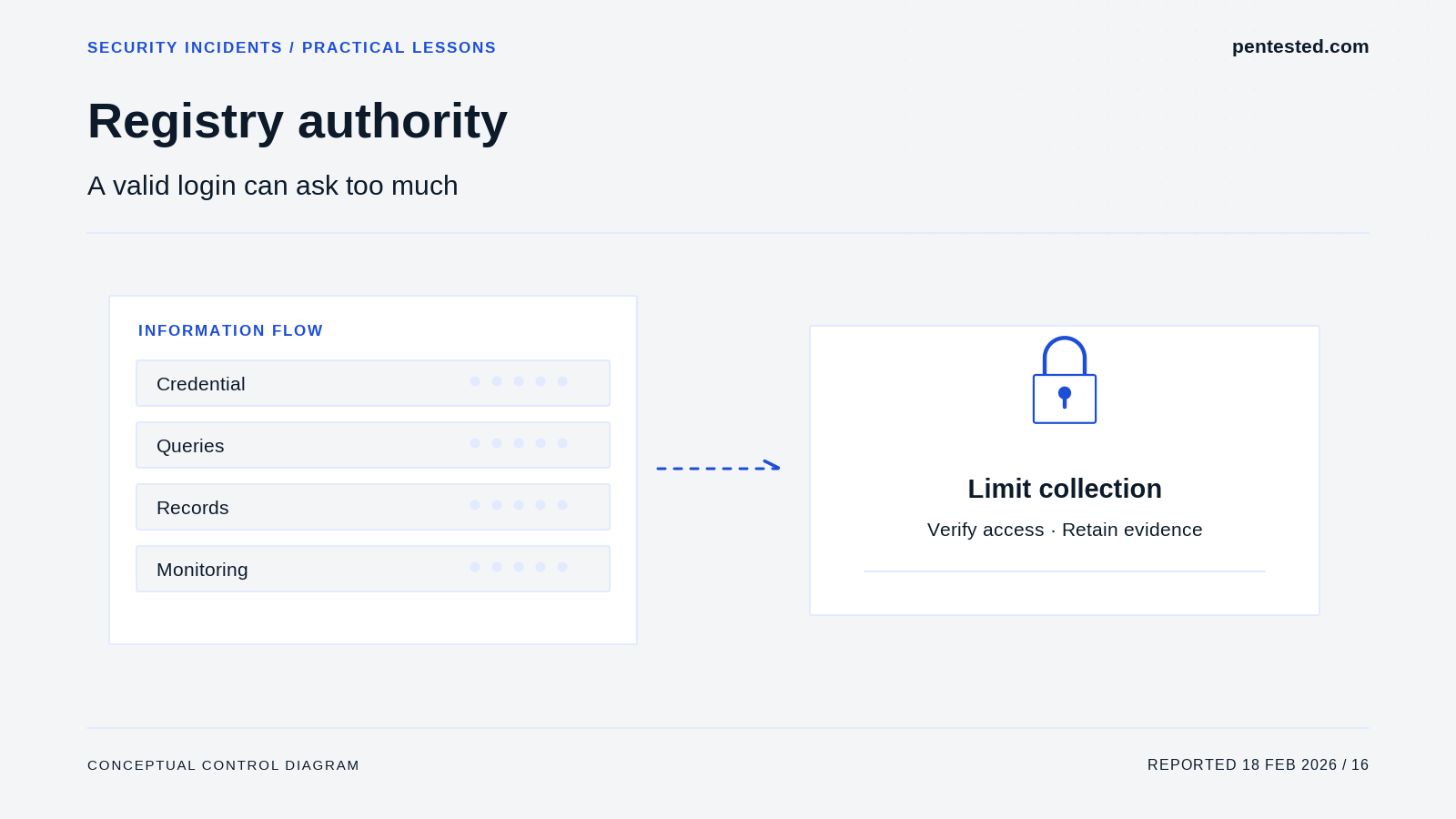
The FICOBA breach highlights the risks of legitimate access to a highly concentrated national dataset. A stolen credential may look different from a software exploit, but it can still give an attacker a direct route to sensitive information. The important questions concern the authority attached to the identity and how its use is monitored.
What happened
France's tax administration disclosed unauthorised access to the FICOBA national bank-account register on 18 February 2026. It said an attacker had used a civil servant's stolen credentials from late January to consult and extract information concerning approximately 1.2 million accounts. The described data included bank-account details, account-holder identity and addresses.
The administration restricted access and notified relevant authorities and affected users. A later clarification said users' tax identifiers had not been consulted. The account count should not be presented as an equivalent number of distinct people: a register can contain several accounts associated with the same person or organisation.
Reporting date and evidence limits
The public disclosure in February followed access that began in January. This article is dated to that disclosure and includes the subsequent clarification. It does not assume that the stolen credential was obtained through a particular phishing method, malware family or insider action when the notice does not establish that route.
The case concerns access to registry information. It should not be described as proof that the attacker controlled customers' bank accounts or could execute payments using the registry itself.
Why authorised access can still be excessive
Bank-registry credentials may exist to support legitimate work across public bodies. That business need does not necessarily justify the same access scope for every person, every task or every time of day. The design should connect authority to a defined purpose.
A central dataset concentrates the consequences of one identity's misuse. An application may correctly authenticate an official while lacking enough context to distinguish an ordinary enquiry from a broad extraction. Authentication is therefore necessary but insufficient assurance about the legitimacy of the work performed.
Abnormal account queries need to be understood in the context of the service. A high volume may be legitimate for some administrative tasks, while a much smaller unusual pattern could be suspicious for another role. Monitoring should combine the role, expected purpose and data returned rather than relying on one universal threshold.
Cross-organisational access complicates ownership. The organisation holding the data may not manage the official's employment, device or daily supervision. Both parties need a clear agreement about account provisioning, role changes, revocation and investigation of questionable activity.
The value of financial-context information
Bank details and identity information can support impersonation and targeted fraud attempts even where they do not themselves authorise a payment. An affected person may be more likely to trust a message that accurately names an account or address. That is a potential consequence to explain, not a reason to claim that misuse has already occurred.
The business handling the dataset should identify which fields each workflow genuinely needs. A search task may require confirmation that an account exists without needing every available detail in the response. Smaller responses reduce both accidental disclosure and the impact of a compromised identity.
Retention and audit design matter as well. Investigators need to establish which records were returned and to which account, while protecting the resulting logs from becoming another broadly accessible copy of financial information. Logging every sensitive field indiscriminately can create unnecessary secondary exposure.
Incident communication should preserve those distinctions. People need to know the information involved, the steps being taken and the channels through which genuine notifications will arrive. A clear explanation can help them recognise opportunistic impersonation without implying that their funds have necessarily been taken.
How penetration testers assess comparable datasets
An authorised review should begin with representative roles, documented purposes and synthetic records. Testers can compare the intended access model with what the application actually returns. This should include users from connected organisations where their access is within the agreed scope.
Assess separation between ordinary enquiries, bulk extraction and administrative functions. A useful demonstration shows that a routine role can perform an unnecessary operation or reach records outside its legitimate task, using a small controlled dataset. The finding should identify the failed boundary precisely.
Lifecycle tests should cover a role change or revoked external identity. The receiving organisation needs evidence that access stops when the source organisation removes authority. That test should include active sessions or application credentials relevant to the deployment, rather than only a new interactive login.
Monitoring exercises can simulate an unusual pattern of queries against synthetic records. The assessment should establish whether an alert reaches the right team and whether the team can identify the purpose, identity and records involved. Safe agreed limits are essential; a real bulk extraction is unnecessary.
How to reduce the risk
Tie access to documented duties and review it when roles change. Separate exceptional bulk work from routine enquiries, with additional approval and evidence where appropriate. Avoid permanent broad permissions granted merely because occasional exceptional work may be required.
Strengthen authentication and protect the devices used for sensitive access. Those controls reduce credential compromise, while application authorisation and monitoring limit its consequences. Treat them as complementary boundaries rather than assuming one removes the need for the others.
Minimise the information returned by each operation. Review whether a workflow can use a restricted view, masked field or narrower search result. The appropriate design depends on the legitimate task, so validate changes with operational users rather than removing information they need without an alternative.
Monitor cumulative access in a way that supports investigation. Retain the identity, purpose where available, record references and outcome, with protected access to the logs. Define who can challenge an unexplained operation and how that challenge reaches the employing organisation.
Agree lifecycle and incident responsibilities across organisational boundaries. Document who approves accounts, who removes them and who can suspend access urgently. Test the process with a fictional departing official or a synthetic suspicious-query scenario.
A registry review should distinguish the ability to find a record from the authority to retrieve it in bulk. An approved user may need a specific account result for a defined task without needing a complete extract. Check whether that distinction exists in both the interface and the underlying service, using synthetic records and an agreed query scope.
A meaningful access review also asks why a user retains a role. Compare account permissions with current duties, exceptional assignments and departure records. Where access is retained temporarily, record the reason and end date. High-value information deserves an approval trail that can explain an individual user's authority at the relevant time, rather than only their membership of a large authorised group.
A practical governance check
Select one external or cross-departmental role and ask both organisations to explain its purpose, maximum access and revocation route. Compare those answers with the live permissions and retained evidence.
Any disagreement identifies an actionable gap. A central register is more defensible when each identity's authority can be explained, constrained and removed, and when unusual access can be investigated without reconstructing responsibility during the incident itself.
References
<https://www.impots.gouv.fr/actualite/acces-illegitimes-au-fichier-national-des-comptes-bancaires-ficoba>
Related issues
- What the Coupang data breach teaches about former-employee access
- What the MyDr data breach teaches about historical medical records
- What the Nitori data incident teaches about uncertain breach scope
Read about our methodology or contact pentested.com to discuss security testing for your organisation.


