How Notepad++ update hijacking exploited trust in software delivery
Public report: 2 February 2026. Updated: 17 November 2026.
Notepad++ update hijacking illustrates a difficult supply-chain problem: software can be delivered through a familiar update process while an attacker controls part of the infrastructure behind it. Users may have chosen the correct product and followed its normal workflow. The integrity of the delivery path still needs independent protection.
What happened
The Notepad++ project disclosed an update-infrastructure incident in February 2026. Unit 42's investigation describes a compromise of the project's shared hosting environment between June and December 2025. Attackers selectively redirected update traffic and supplied malicious update information to targeted users.
The researchers documented more than one infection chain and activity affecting several sectors and regions. That does not mean every Notepad++ installation received a malicious update. Selective targeting is an important part of the account: the existence of the software in an organisation is a reason to assess exposure, not proof that all of its users were compromised.
Why February is the article date
The public disclosure followed the period of malicious activity. This article uses the reporting date in February, while keeping the June-to-December activity period in the timeline. Later research provides additional context without changing when users first received the fuller public warning.
The case concerns trust in update delivery. It should not be simplified into a claim that the application's entire source repository or every official release was malicious when the evidence describes a more specific infrastructure-level intervention.
An update is a chain of decisions
A typical updater asks where a new version is available, retrieves an artefact and decides whether to install it. Those stages may depend on different services and credentials. An attacker need not control every stage if one trusted response can redirect the user to code the updater will accept.
Selective update redirection also makes ordinary availability monitoring less useful. A site can return legitimate information to most visitors while behaving differently for a small set of requests. A successful routine check therefore does not establish that every user received the same update information.
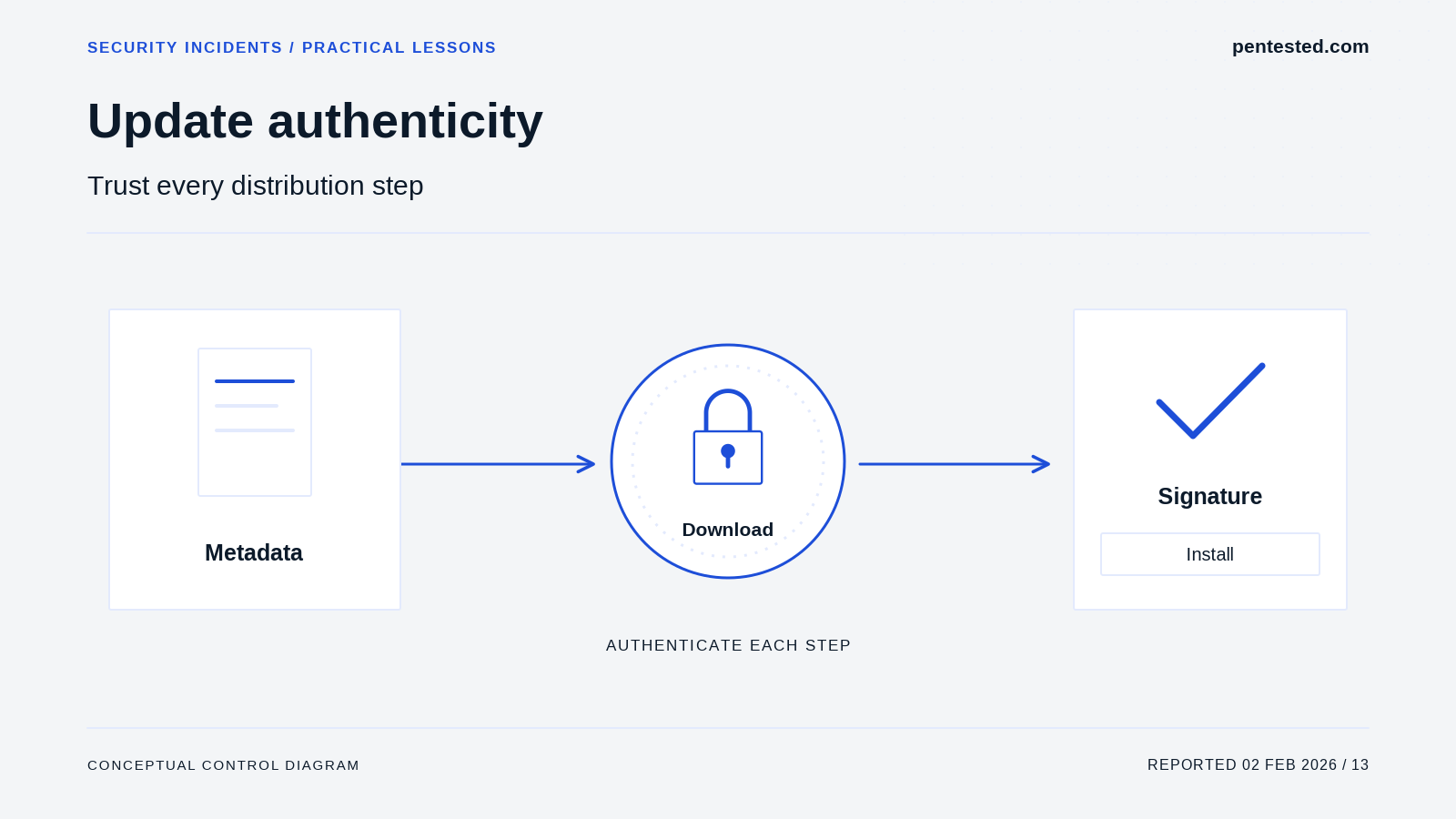
Signed update metadata can help bind the version and download decision to an authorised publisher. The verification needs to be enforced by the client, with a clear trust root and a defined response to invalid or missing signatures. A signature that is checked only in the normal case may leave an unintended fallback path.
Transport security remains important, but it answers a different question. A protected connection to a compromised service can faithfully deliver the attacker's response. Software-delivery assurance needs to establish both the origin of the connection and the authority behind the artefact and update instructions.
What selective targeting means for customers
An organisation needs evidence about what its users actually downloaded and executed. A current version inventory may not reveal a transient malicious update that was removed or replaced later. Installation history, endpoint records and network evidence may be needed to reconstruct the exposure period.
Developer and administrator workstations deserve particular attention because their credentials and tools can reach other systems. A utility update may appear peripheral to the business while the device receiving it has powerful access. The consequence follows the device's authority, not the apparent simplicity of the utility.
The investigation should also distinguish exposure from execution and execution from subsequent actions. Finding an affected update route does not prove every possible downstream compromise. Conversely, absence of the original malicious file does not establish that credentials or additional access were never obtained.
Supplier communications should make those distinctions usable. Customers need dates, affected components and clear investigation guidance. Broad reassurance about the current website cannot answer every question about historical installations on independent customer devices.
How penetration testers assess update mechanisms
An authorised review should map the update request, metadata, artefact retrieval and verification decision. Testers can use a controlled environment to assess whether altered metadata or an unauthorised artefact is rejected. The exercise must not redirect real users or distribute a malicious public update.
Review the client's failure behaviour as carefully as its successful path. The team should establish what happens when verification fails, a signature is missing or an update source is unavailable. Security should not depend on an undocumented fallback that relaxes the intended requirement.
The publishing environment needs a separate assessment. Identify the people and systems able to change update metadata, download locations and verification keys. A narrowly protected source repository does not compensate for unrestricted control of the delivery configuration.
Finally, an exposure exercise can ask the organisation to identify which test devices accepted a particular update during a defined interval. The answer should come from retained evidence, not a survey of which users remember clicking an update prompt.
How to reduce the risk
Bind update decisions to authenticated publisher authority and verify the resulting artefact before execution. Review how trust keys are distributed, changed and recovered. Make the rejection behaviour explicit so an invalid update cannot silently become an accepted one.
Separate update hosting from signing and release approval. A hosting provider should not automatically possess everything needed to create an update that clients trust. Limit credentials according to the role each service performs and review the effect of provider compromise.
Record release artefacts and approved metadata in a protected location. The publisher should be able to explain which update was authorised at a particular time and compare that record with observed delivery. Keep the evidence independent enough to survive compromise of the hosting account.
For customers, retain suitable software-installation and endpoint evidence. Apply least privilege to workstations and keep routine development separate from unnecessary production administration. These measures limit the consequences if a trusted utility becomes an entry point.
Prepare an incident process that covers historical exposure as well as correcting the live update service. Identify the time window, explain the affected paths and give customers a practical way to assess their own systems. Avoid relying on a clean current download to resolve questions about earlier execution.
An update check should establish what happens when a trusted network component supplies an unexpected destination or an invalid artefact. Use a controlled test service and harmless files to observe rejection and logging. Do not infer that a secure connection to the first hostname verifies every subsequent download. Each transition needs an appropriate authenticity check.
For selective campaigns, the absence of suspicious activity on most devices says little about a small group that received a different response. Retain enough update metadata to compare versions, download destinations and installation times across the estate. That evidence helps investigators identify a targeted exception without requiring them to assume that every successful update followed the same path.
A useful assurance question
Ask the software owner what would happen if its hosting account were controlled by an attacker for one day. Could the attacker publish code that existing clients would accept, or would an independent verification boundary stop it?
That question applies well beyond text editors. It helps distinguish a delivery service from a release authority and exposes hidden assumptions about infrastructure trust. The strongest answer is a demonstrated rejection of unauthorised software, supported by evidence about the publisher's actual release process.
References
<https://unit42.paloaltonetworks.com/notepad-infrastructure-compromise/>
Related issues
- How the Trust Wallet extension compromise bypassed release controls
- What the GitHub repository theft teaches about developer extensions
- How the Fireworks AI and Cursor incident exposed secrets in agent traces
Read about our methodology or contact pentested.com to discuss security testing for your organisation.


