What the GitHub repository theft teaches about developer extensions
Public report: 20 May 2026. Updated: 17 November 2026.
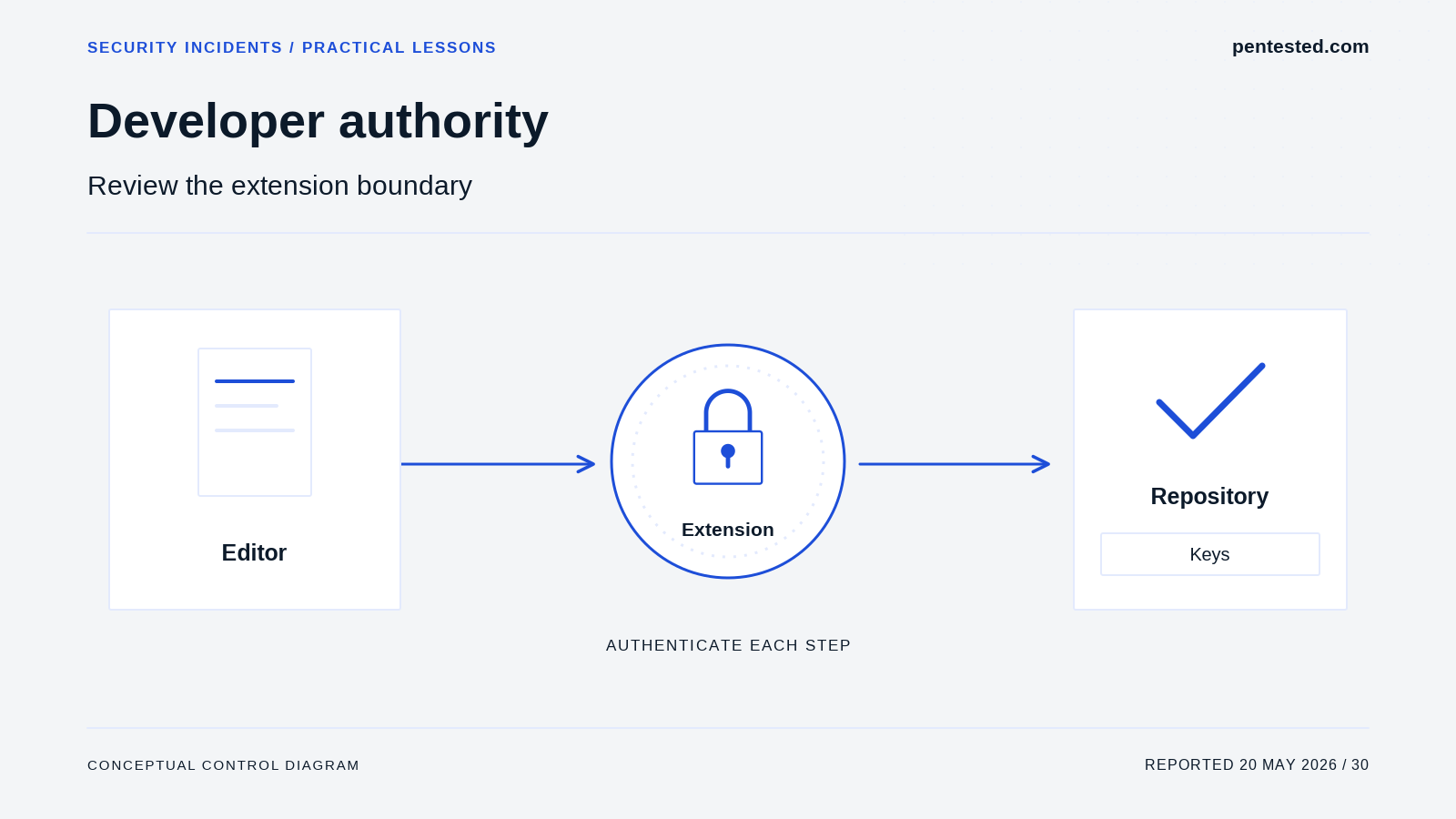
The GitHub repository theft shows how a developer tool can become a route into information and credentials beyond the code currently being edited. An extension runs within a working environment containing authenticated services and valuable project context. Its trustworthiness needs to be assessed according to that environment's authority, not just the feature the extension advertises.
What happened
GitHub disclosed that it detected and contained compromise of an employee device on 18 May 2026 involving a poisoned third-party VS Code extension. Its public account assessed that internal repositories had been exfiltrated, while stating that it had no evidence of impact to customers' own repositories outside that scope.
A later update announced precautionary rotation of the GitHub Enterprise Server signing key and said binaries hosted by GitHub were valid. Internal repository theft, possible information within those repositories and signing-key precautions are distinct parts of the account. They should not be collapsed into a claim that every GitHub customer repository or software binary was compromised.
Public reporting and later precautions
The article date follows GitHub's public disclosure on 20 May. The employee-device incident occurred earlier, and the signing-key update followed later in May. This chronology makes clear which actions were subsequent precautions rather than details established in the initial notice.
The public account identifies the extension route but does not disclose every endpoint or credential event. The review below addresses comparable developer environments without asserting a complete reconstruction of GitHub's internal infrastructure.
Extensions inherit useful context
Editor-extension trust should reflect the privileges and information available where the extension executes. A tool may need to read project files to provide its advertised feature, but the environment may also hold repository sessions, local configuration and access to external services.
That context can make developer workstations unusually valuable. A person may work across several projects, switch between organisational roles and retain authenticated command-line tools. Security review should consider the combined authority rather than treating each application as isolated from the others by default.
The distribution and update path matters too. An approved extension can change over time through new releases, transferred ownership or additional dependencies. An allowlist that records only a product name may miss important changes in the code actually installed.
Repository signing-key recovery introduces a separate trust question. When a supplier takes a precautionary key action, customers need clear instructions about the affected product and validation process. Precaution should be described accurately so it does not create an unsupported claim that previous signed artefacts were malicious.
Internal repositories can still contain customer information
The phrase internal code can sound narrower than the information actually present. Repositories may include support examples, operational configuration, test fixtures and historical files alongside application source. A review should inspect those categories through approved sampling rather than assuming source repositories hold no personal or business-sensitive data.
Secrets also have a lifecycle independent of the current file tree. A credential removed from the latest revision may remain in history or an earlier artefact. If repository access is exposed, the response should identify which authority remains valid and needs revocation.
The organisation must then assess onward use. A stolen repository token may allow access elsewhere, while an exposed signing credential presents different consequences. Grouping every secret into one rotation ticket can obscure the order in which important authority needs to be removed.
For customers, supplier communication should identify concrete required actions and scope. A request to rotate a validation key should come through established channels, with a safe way to verify the instruction. Incident urgency should not eliminate the customer's own change-control and authenticity checks.
How penetration testers assess developer environments
An authorised assessment should map the extensions, local tools and authenticated services used by representative developer roles. Include update mechanisms and the identities available to those processes. Use a controlled workstation and synthetic credentials where active testing is needed.
A harmless instrumented extension can demonstrate the access available within an agreed test environment. The purpose is to establish whether the development role holds unnecessary authority, not to distribute a covert extension or inspect unrelated personal information.
Review repositories for sensitive material with an agreed handling process. Findings should distinguish active credentials, historical secrets and business data, then explain the authority or confidentiality consequence. The assessment should avoid copying more repository contents than necessary to demonstrate the issue.
An incident exercise can simulate exposure of a developer identity and ask the team to identify its reachable repositories, publishing systems and signing operations. Measure the evidence available and the ability to revoke that authority from an independent trusted environment.
How to reduce the risk
Maintain an approved extension inventory with ownership and an update-review process appropriate to the environment. Review changes in publisher, permissions and dependencies. The objective is to understand the code being trusted, not merely to collect a list of familiar tool names.
Separate routine development from powerful production and release roles. Avoid keeping broad long-lived credentials available to every process on a workstation. Use narrowly scoped, short-lived authority where supported and make privileged work a deliberate action.
Reduce sensitive material in repositories. Remove unnecessary customer examples, protect operational configuration and revoke secrets that have been committed. Deleting a current file is not a substitute for invalidating a credential that may remain in history.
Protect signing and publication independently from ordinary repository access. Retain evidence connecting source, build and signature, and document how trust keys can be changed safely. A precautionary rotation process should be tested before it is needed urgently.
Keep endpoint, identity and repository evidence that can be joined during investigation. The team should be able to connect a compromised device with the accounts and repositories it could reach, then verify that replacement credentials are issued only to a trusted environment.
A developer environment review should include the authority available during ordinary work, not only credentials stored permanently on disk. A signed-in command-line tool, a forwarded agent or a short-lived session may still be accessible to a process running under the developer's identity. Record which actions each mechanism permits and whether sensitive operations require an additional decision.
Create a clean recovery procedure that developers can follow without improvising. It should establish how to preserve evidence, replace the workstation or working environment, invalidate old sessions and restore the minimum access needed for the next task. Verify the replacement environment before reintroducing release authority. This makes a security response compatible with continuing development without trusting the original environment simply because its visible symptoms have stopped.
A practical developer-security check
Choose one workstation role and ask what an untrusted extension could obtain if it ran with the permissions normally available there. Follow the answer into repositories, cloud services and release systems.
That exercise produces a realistic view of developer risk. Protecting the source platform remains important, but the identities and tools used to reach it are part of the same security boundary. A developer environment should support productive work without making every installed extension a potential administrator of the wider business.
References
<https://github.blog/security/investigating-unauthorized-access-to-githubs-internal-repositories/>
Related issues
- How Notepad++ update hijacking exploited trust in software delivery
- What the axios npm compromise teaches about maintainer security
- What the DigiCert support compromise reveals about code-signing trust
Read about our methodology or contact pentested.com to discuss security testing for your organisation.


