What the DigiCert support compromise reveals about code-signing trust
Public report: 18 April 2026. Updated: 17 November 2026.
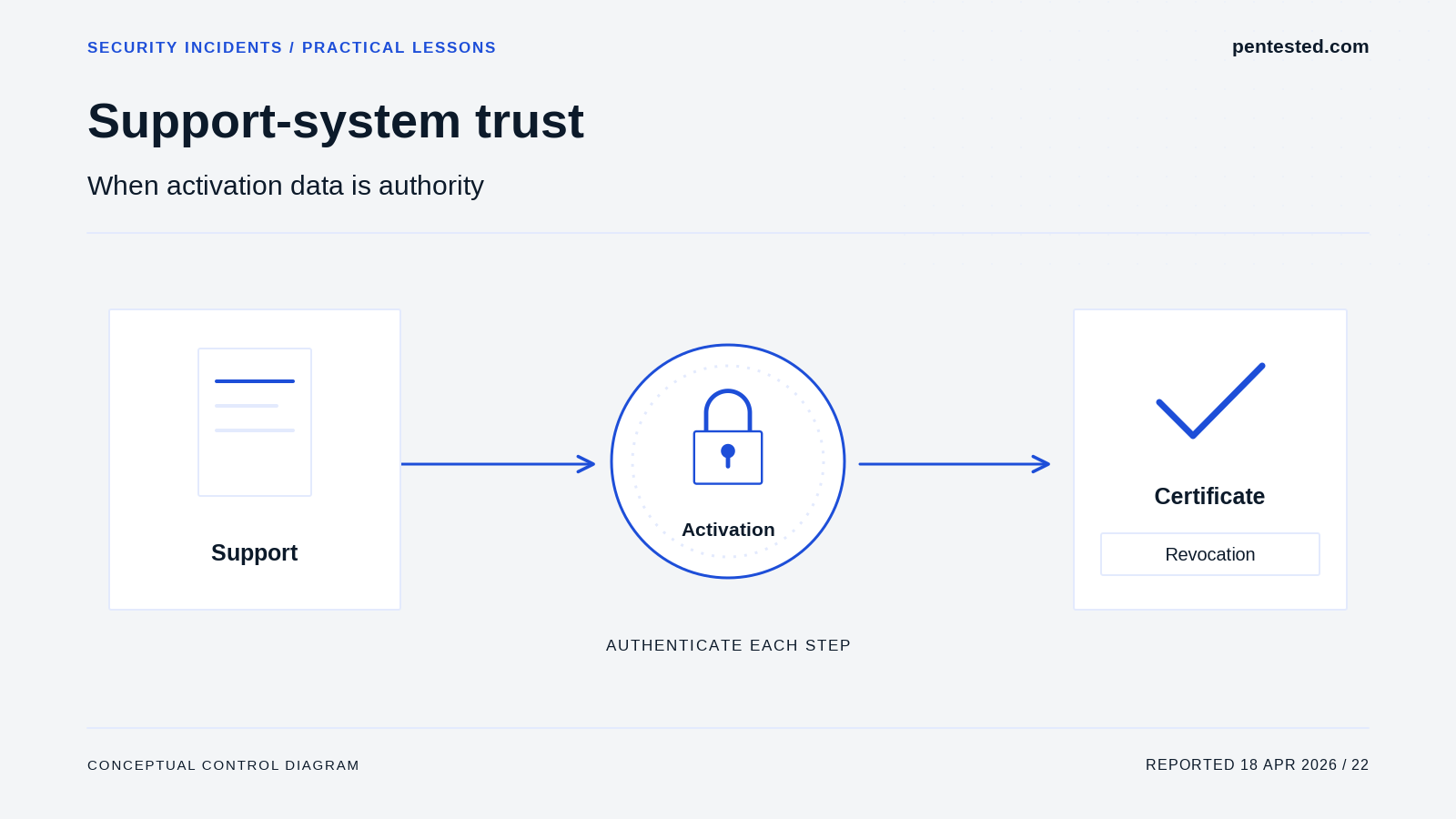
The DigiCert support compromise demonstrates how a limited support feature can become a route into a wider trust system. Staff may need to view a customer's account to resolve a genuine problem. The sensitive material visible through that view must still be treated according to what it authorises, rather than dismissed as ordinary support information.
What happened
DigiCert's public incident report describes malicious files delivered through a support chat in April 2026, compromising two analyst workstations. The attacker used a support-portal function to obtain initialisation codes for approved code-signing certificate orders. Some resulting certificates were used to sign malware.
The company revoked 60 certificates, including precautionary revocations, and cancelled relevant pending orders. Its report distinguishes the affected code-signing workflow from broader certificate-authority compromise. This was not evidence that every DigiCert certificate or every customer's private key had been exposed.
Why the report date follows the intrusion
The attacks began on 2 April. DigiCert opened its public incident report later in April and expanded it as investigation continued. The article is dated to public reporting, with the earlier attack and later findings kept in their proper places in the timeline.
The report also describes the second endpoint being identified after the initial response. That is a useful reminder that containment of the first observed machine does not establish that every related access path has been found.
Activation information can be a credential
Certificate activation secrets may not look like passwords, but their security importance depends on the action they enable. If possession allows someone to obtain a certificate associated with an approved order, the information represents useful authority and needs corresponding protection.
Support-portal privilege boundaries should reflect that consequence. A feature that allows an analyst to see a customer's view can expose more than the analyst needs for a particular support task. The application should distinguish viewing ordinary account details from obtaining material that enables a security-sensitive operation.
The approval status of the underlying order does not resolve this problem. Approval can establish that a certificate should be issued to a legitimate customer, while a separate delivery mechanism determines who actually obtains it. Both stages need an appropriate identity and authority check.
This pattern appears outside certificate services. Recovery codes, enrolment links and device-activation material can all carry authority without being labelled as a login credential. A review should classify them by their effect and avoid exposing them through broad diagnostic or support views.
Why signed malware creates wider consequences
Code signing can provide evidence about the identity associated with a signing certificate and whether a file has changed since signing. It does not make every signed program benign. If an attacker obtains useful signing authority, downstream users and systems may encounter software bearing an apparently legitimate signature.
An incident response therefore needs coordination across the issuer, affected customers and the parties relying on those certificates. The exact technical actions depend on the certificate and platform, but scope and communication must be precise. A limited revocation should not be described as invalidation of an entire trust infrastructure.
Endpoint coverage also matters. An organisation can have a strong central security policy while a particular workstation is absent from the intended controls. Assurance needs to examine the actual device population and whether missing or degraded protection is visible.
Support teams face a practical challenge because receiving customer material is part of their job. Restricting every attachment may break legitimate work, while allowing arbitrary files to execute on privileged workstations creates risk. The process needs a safe way to inspect relevant material without granting it the workstation's authority.
How penetration testers assess comparable systems
An authorised assessment should map support roles, account-viewing features and the sensitive operations reachable through them. Use test customers and synthetic activation material to examine whether routine support can obtain authority it does not need. The report should identify the exact capability, not merely label the role as too privileged.
Review bearer-like information separately from conventional passwords. Testers can establish whether a code or link remains usable outside the intended user context, whether it expires appropriately and whether support access is recorded. These checks should use isolated orders or a representative test environment.
The customer-material workflow also deserves testing. A harmless attachment can be used to assess where files are stored, which tools open them and whether risky execution is separated from support administration. There is no need to deliver live malware to demonstrate an architectural boundary.
Detection exercises should cover both endpoint anomalies and unusual support-portal activity. The team should be able to join an analyst identity, device and sensitive action in one investigation. A list of endpoint alerts without application context may miss the operation that matters most.
How to reduce the risk
Treat activation and recovery material as security credentials when possession enables a consequential action. Limit its visibility and avoid placing it in general diagnostic views. Where possible, require the legitimate customer to complete the sensitive step through a separate authenticated process.
Constrain support impersonation features to the information and actions required for the task. Make access time-limited, attributable and reviewable. A support role should not automatically inherit every capability available to the customer it is assisting.
Provide an isolated method for handling untrusted customer files. Define approved file types and inspection routes according to the genuine support need. Ensure that restrictions apply across the channels staff actually use, rather than only one visible upload form.
Verify endpoint-control coverage against the real asset inventory. Investigate devices that stop reporting or differ from the intended policy. A purchased control is useful only where it is deployed, functioning and connected to a response process.
Prepare an incident process for misuse of issued trust material. It should identify who can revoke or replace affected items, how relying parties are informed and which evidence establishes scope. Test the process using synthetic material before an urgent decision is required.
Support workflows should treat activation material according to the authority it provides. A value described as a recovery detail, enrolment code or troubleshooting attachment may still enable another person to act. Classify it by that effect and verify where it is displayed, retained and copied during a normal case.
Use a test support request to trace the information through the actual workflow. Include attachments, internal notes, exported case records and any connected system used by the team. Then demonstrate how the material can be invalidated if exposed. This connects preventive access restrictions with a recovery action that can remove the authority, rather than merely deleting one visible copy from a ticket.
A practical support-security review
Choose one routine support feature and ask what it would let an attacker do if the analyst's workstation were compromised. Follow the answer through to any activation codes, recovery links or customer actions exposed by that feature.
That exercise helps identify authority hidden inside apparently ordinary information. The strongest support design enables staff to solve the customer's problem while preventing a compromised support session from becoming a substitute for the customer's own security-sensitive approval.
References
<https://bugzilla.mozilla.org/show_bug.cgi?id=2033170>
Related issues
- What the GitHub repository theft teaches about developer extensions
- How the Trust Wallet extension compromise bypassed release controls
- What the Crédit Mutuel Arkéa attack teaches about supplier payment access
Read about our methodology or contact pentested.com to discuss security testing for your organisation.


