How the Trust Wallet extension compromise bypassed release controls
Public report: 25 December 2025. Updated: 17 November 2026.
The Trust Wallet extension compromise shows why release credentials can be as valuable as the software source itself. A legitimate distribution channel gives an update immediate credibility. If an attacker can publish through that channel without passing the owner's intended approvals, users may receive malicious code while believing they are following the normal update process.
What happened
Trust Wallet says an unauthorised version of its browser extension, version 2.68, was published to the Chrome Web Store on 24 December 2025. It affected users who opened and logged in to that extension during the specified exposure period. The company reported wallet theft and later identified 2,520 affected wallet addresses.
Its investigation linked the publishing access to secrets exposed during the November Shai-Hulud supply-chain incident. The company described use of a leaked Chrome Web Store API key to distribute a malicious build outside its normal internal approval process. It distinguished this incident from use of its mobile application and other extension versions.
From publication to public warning
The malicious release appeared on 24 December, with wallet-draining activity publicly reported on 25 December. Trust Wallet subsequently published a fuller community account and updated its investigation. This article is dated to the public incident reporting and includes those later findings.
An exposure window is not the same as a recovery deadline. A user who ran malicious software may still need to address consequences that survive removal of that release. The exact response should follow the vendor's current account-specific guidance.
The trust boundary was the release process
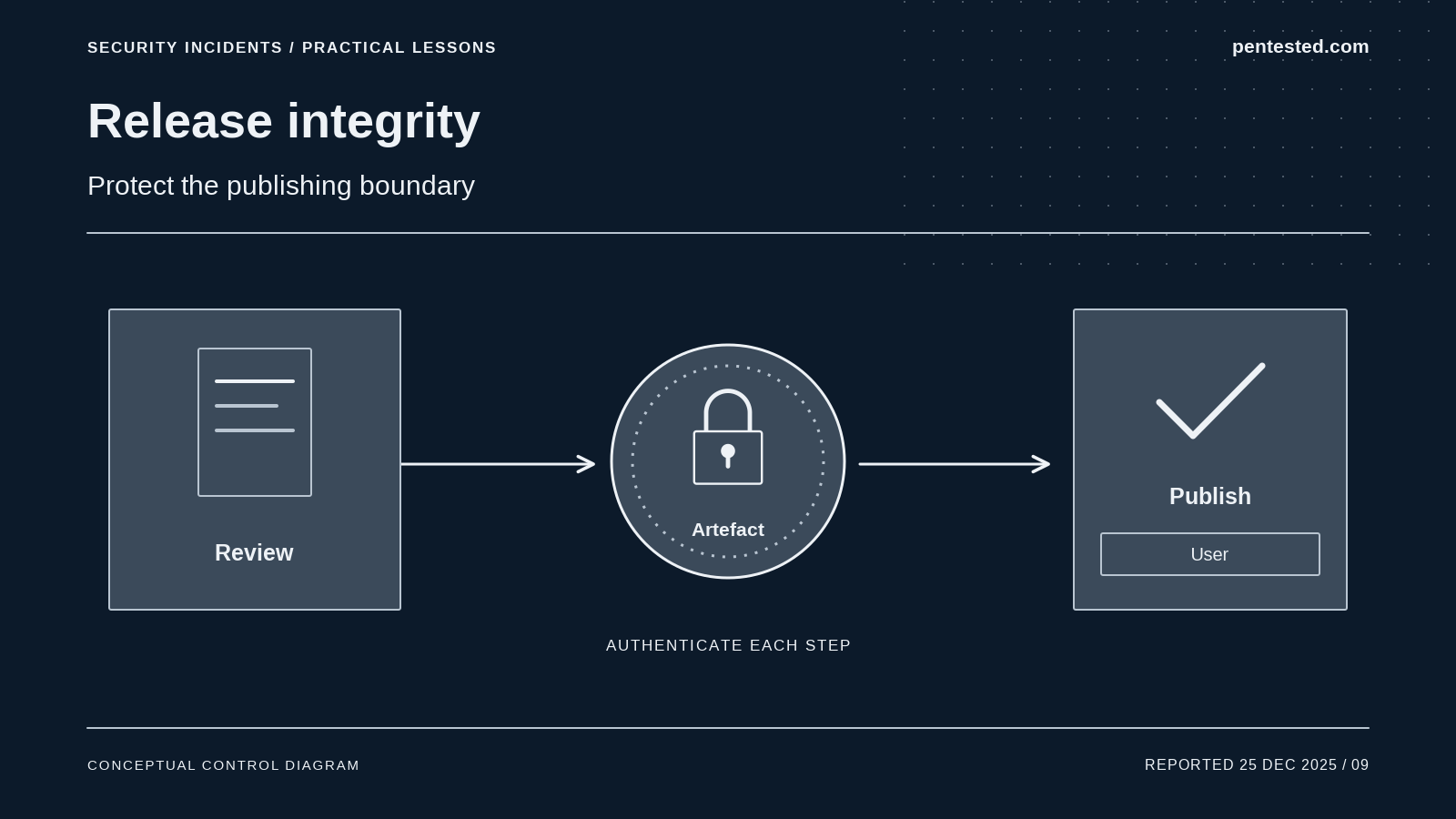
Wallet release integrity depends on more than reviewing a pull request. Source control, build systems, artefact storage, publishing APIs and store permissions form a chain. A control can appear strong at one point while another route bypasses it entirely.
The important architectural question is whether internal approval is enforced by the only available publishing route. If a separate credential can submit an artefact directly, a mandatory internal review may be mandatory only for the normal team workflow. The alternate route becomes the real boundary that needs attention.
Browser-extension publishing keys therefore need ownership, restricted use and a tested revocation process. They should not be treated as ordinary development configuration. Their authority can reach every user who trusts an update, including users with no direct relationship to the build infrastructure.
A store's review process and the developer's release approval also serve different purposes. An organisation should not assume an external review will establish that a submitted artefact was authorised by its own maintainers. Evidence about source, build identity and approval must remain connected to the published artefact.
Why financial applications raise the stakes
An extension handling financial authority operates near information and actions with immediate consequences. If malicious code gains access to that authority, reducing the distribution window may limit additional victims but cannot reverse every action already taken.
This makes recovery planning unusually important. Product teams need a way to identify affected versions and users, communicate through trustworthy channels and coordinate action on any credentials or authorities exposed. A generic instruction to uninstall software may leave important questions unanswered.
Incident communications also become a target for impersonation. A fraudulent compensation form can exploit people already worried about losses. The legitimate organisation should use established contact channels, publish clear verification information and explain which information support staff will never request.
Reimbursement and technical recovery are separate workstreams. One concerns compensating affected people; the other concerns removing access and preventing repetition. Both require reliable records, but a financial resolution does not demonstrate that publishing controls have been corrected.
How penetration testers assess release controls
A release-security assessment should map every identity and route capable of publishing the product. That includes automated workflows, emergency processes, vendor portals and credentials retained by former maintainers. The assessment should establish effective authority rather than relying on a diagram of the preferred route.
Use a test application or isolated distribution environment to verify approval enforcement. Testers can assess whether a build lacking the intended approval is rejected and whether a separate publishing credential can bypass that decision. No exercise should submit malicious code to a public store or expose real users.
Trace one approved artefact from source commit to published checksum or signature. The team should be able to identify who initiated the build, what dependencies were used and who authorised publication. An approval attached to a source change is not sufficient evidence if a different artefact can be uploaded afterwards.
An incident exercise can then simulate exposure of a publishing credential. Measure how quickly the organisation identifies every affected channel, disables the credential and establishes which artefacts it could have published. This tests the practical value of the inventory and access model.
How to reduce the risk
Ensure the release approval is enforced at the point where publication occurs. Remove unnecessary alternate routes and document any emergency exception. Where multiple routes are necessary, apply equivalent authorisation and monitoring to each.
Keep publishing credentials out of general development environments. Prefer narrowly scoped, short-lived authority where supported, and restrict the systems allowed to use it. Review whether a developer dependency or routine build job could obtain a credential with public release authority.
Maintain an independent record of release artefacts and approvals. The evidence should survive compromise of a maintainer account or deletion of a build log. It needs to identify the actual bytes distributed, not just the release name entered in a ticket.
Practise stopping distribution and issuing a corrected release. Agree who can make those decisions, how customers are informed and which evidence must be preserved first. A process that requires an unavailable individual can waste critical time.
For financial products, include a separate review of the authority exposed on a user device. Recovery guidance should address the consequences of execution, with clear scope and vendor-specific instructions. It should not rely on a software rollback to solve every downstream problem.
Release assurance should include a comparison between the reviewed artefact and the artefact users receive. A successful source review cannot establish that a subsequently uploaded browser extension contains the same code. Preserve the approved artefact identifier, the publishing identity and the distribution record so that the chain can be reconstructed during an incident.
Prepare the warning mechanism separately from the compromised distribution path. Users may need to identify a particular installed version without following a link inside an untrusted extension. Give support staff a verified procedure and clear escalation route. For any application handling valuable credentials or assets, an ambiguous update instruction can create an opportunity for impersonation at exactly the point users are looking for urgent help.
What other software businesses should take away
The same release problem can affect a desktop utility, mobile application or enterprise agent. The value of the product changes the consequences, but the architectural question remains: can the organisation prove that the artefact reaching users passed its intended controls?
Ask that question for one real release and for one emergency publishing route. If the answers differ, close the gap before a publishing credential is exposed. A release process is dependable only when its safeguards apply to every practical way the product can be distributed.
References
<https://trustwallet.com/blog/company/trust-wallet-browser-extension-v268-incident-community-update>
Related issues
- How the Shai-Hulud 2.0 attack spread through trusted npm packages
- What the axios npm compromise teaches about maintainer security
- What the GitHub repository theft teaches about developer extensions
Read about our methodology or contact pentested.com to discuss security testing for your organisation.


