What the axios npm compromise teaches about maintainer security
Public report: 31 March 2026. Updated: 17 November 2026.
The axios npm compromise demonstrates how the security of an open-source maintainer can affect organisations that never interact with that person directly. A widely used dependency sits inside many independent build processes. When publishing authority is stolen, a short malicious-release window can create a much longer investigation for downstream developers and security teams.
What happened
On 31 March 2026, two malicious axios versions were published through a compromised maintainer account. The maintainer's post-mortem says they introduced a dependency that installed a remote-access trojan on macOS, Windows and Linux. The releases remained available for approximately three hours before removal.
The maintainer described a targeted social-engineering campaign leading to compromise of a computer and npm credentials. The relevant scope is the malicious versions and environments that executed them, not every application using axios. A package's overall popularity is a measure of potential reach, rather than evidence that all of its users were affected.
Why the installation window is only the beginning
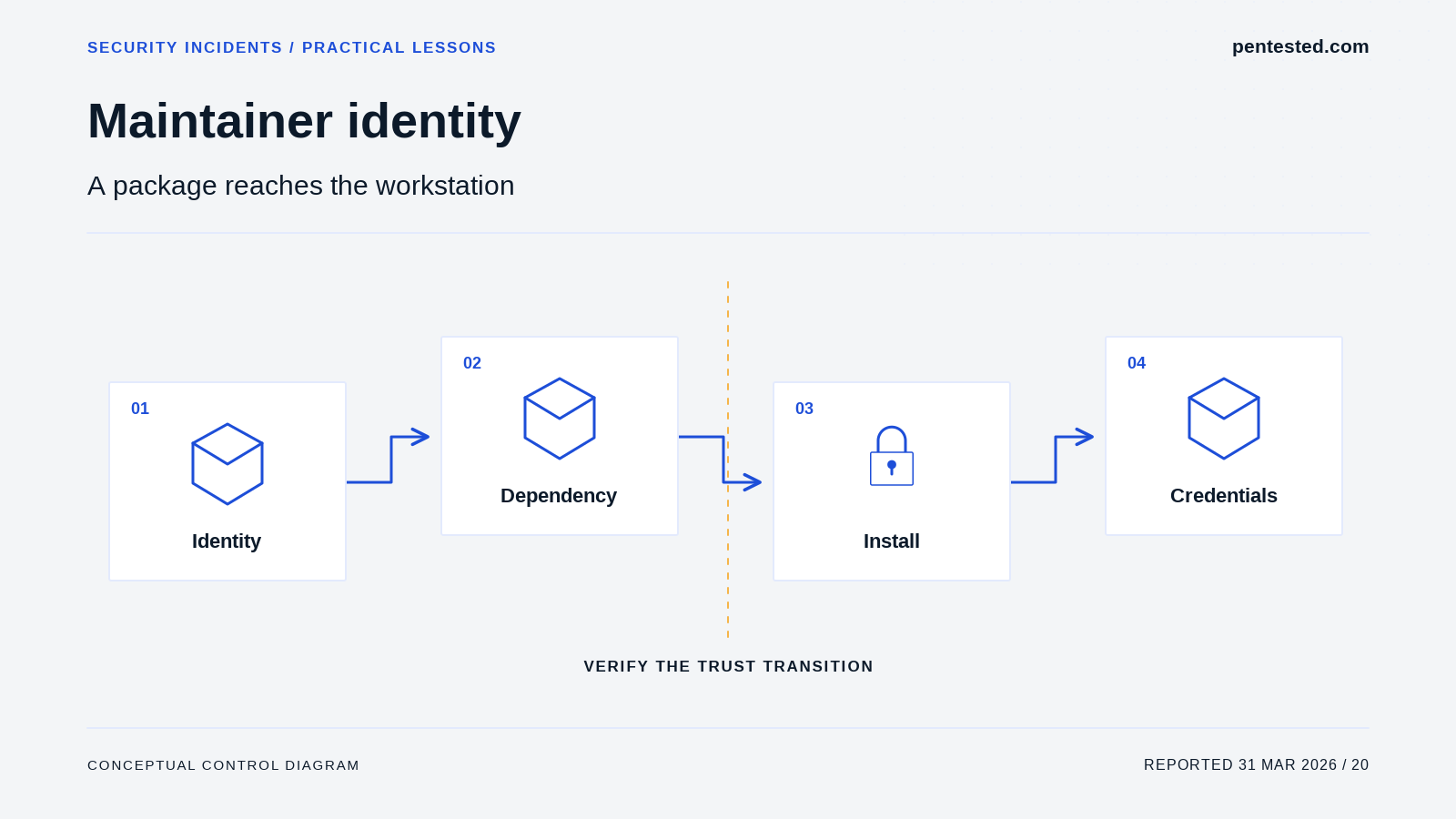
The article is dated to the public reporting on 31 March. For a consumer, the important local timeline starts with dependency resolution and installation. A build completed during the exposure window may deploy later, while a developer workstation may retain consequences after the package has been replaced.
Package removal therefore helps stop new distribution but does not complete customer recovery. The team needs to identify affected execution and then assess the authority available to the installed code.
Maintainer security is part of the supply chain
Maintainer social engineering targets people with useful authority rather than the source code alone. An attacker may seek access to a device, an authenticated session or a publishing credential. The route can bypass the expectation that a malicious change must first appear as a reviewable contribution.
For consumers, this makes release identity important. A familiar package name and a legitimate registry account may still publish a malicious artefact. The question is which version was obtained, how it was produced and whether the installation introduced unexpected behaviour or dependencies.
Transitive package execution can complicate the picture. A developer may approve an update to the library they recognise without noticing the additional package it introduces. Review needs to consider the resolved dependency tree and the execution behaviour of newly included components.
The environment running that code determines the business consequence. A personal development container, a shared build runner and a workstation with production access present different opportunities. An incident assessment should reflect those differences instead of assigning one identical outcome to every installation.
What downstream organisations need to establish
The first question is whether the malicious artefact was actually installed. Lockfiles, registry records, caches and build logs can each provide evidence. The current package version on a machine may not explain what ran earlier in the month.
The next question is whether code executed and what it could access. Installation-time activity, application execution and developer tooling can produce different evidence. Investigators should avoid treating absence of one file as proof that no code ran.
Reachable credentials then require attention. An affected worker may have had access to source repositories, cloud APIs or package registries. Those systems may need review even if they never directly depended on axios. The scope follows the compromised environment's authority.
The organisation should also examine its own releases. If a compromised worker built or published artefacts, the team needs to establish whether their integrity can still be trusted. This does not mean every resulting artefact is automatically malicious; it means the build evidence must support the conclusion.
How penetration testers assess comparable exposure
An authorised supply-chain review should trace dependency changes from proposal to installation and release. Testers can examine whether the review highlights new transitive dependencies, unusual install behaviour and changes in publishing provenance. The aim is to identify decisions that receive less scrutiny than their consequence warrants.
A controlled test package can assess the execution boundary in an isolated environment. Synthetic secrets can demonstrate whether dependency code can read credentials unrelated to its task. No live malware or public malicious publication is needed to establish the permission problem.
Review developer workstations and build workers separately. A consumer organisation may have strong pipeline controls while allowing everyday development sessions broad access to production services. The report should describe the resulting routes rather than assuming the same controls apply everywhere.
An incident-readiness exercise can name a fictional affected version and ask the team to find every installation during a defined interval. Measure the quality and speed of the evidence, including environments that have already been destroyed or rebuilt.
How to reduce the risk
Review resolved dependency changes rather than only top-level version numbers. Maintain lockfiles and artefact records that support later investigation. Where automated updates are used, ensure the approval process still considers meaningful changes in dependencies and execution.
Separate routine development from unnecessary production authority. Keep publishing credentials and high-privilege cloud access out of general-purpose environments wherever possible. A developer's ability to write code does not require every process on their machine to administer production.
Use isolated build workers with narrowly scoped, short-lived credentials. Restrict the authority of jobs that process untrusted inputs and separate artefact creation from publication approval. Review the practical effect of each permission rather than relying on the worker's temporary lifetime as a security control.
Preserve evidence about installed versions and build execution. The organisation should be able to identify the exact artefact and revision behind a release, including automatically rebuilt containers. That evidence can make a short-lived package incident much easier to scope.
If exposure is confirmed, isolate and rebuild affected environments, revoke reachable credentials and review their use. Carry out replacement from a trusted system. A simple dependency downgrade can correct future installations while leaving earlier access unresolved.
An installation record should identify whether package lifecycle behaviour was allowed and which identity ran it. The same dependency can execute under a developer's interactive session or inside a deliberately restricted build. Those contexts determine which credentials, local files and network destinations were reachable. Review them before reducing the investigation to a list of affected versions.
Dependency controls also need a workable emergency path. Establish who can pause automatic updates, approve a known-good dependency set and rebuild an application without bypassing release review. If the only practical response is an unrestricted manual installation on a privileged laptop, the response process itself recreates the conditions the organisation is trying to avoid.
What maintainers and consumers share
Maintainers need protected publishing authority and a release process that resists account compromise. Consumers need constrained execution environments and evidence about the artefacts they accept. Neither side can solve the entire supply-chain problem on its own.
For a business consuming open-source software, the most useful next step is to trace one dependency update through a real build. Identify who approved it, what executed and which permissions were available. That turns an abstract concern about open source into a specific, testable security boundary.
References
<https://github.com/axios/axios/issues/10636>
Related issues
- How the Shai-Hulud 2.0 attack spread through trusted npm packages
- What the GitHub repository theft teaches about developer extensions
- How the Trust Wallet extension compromise bypassed release controls
Read about our methodology or contact pentested.com to discuss security testing for your organisation.


