How the Fireworks AI and Cursor incident exposed secrets in agent traces
Public report: 9 October 2026. Updated: 17 November 2026.
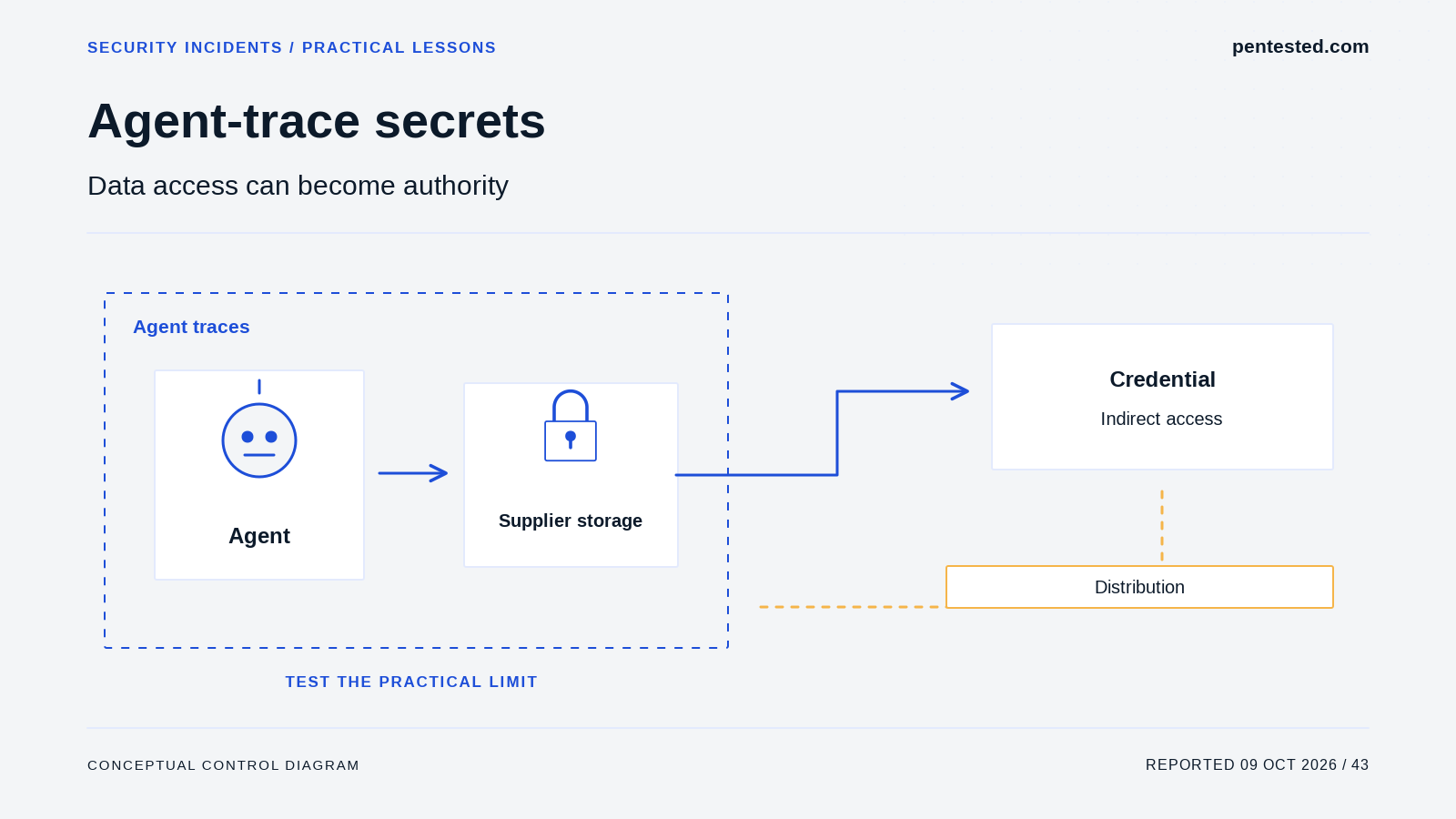
The Fireworks AI and Cursor incident demonstrates how information retained for model development can become a route into unrelated business systems. A supplier may receive a read-only dataset for a legitimate purpose, but secrets inside that dataset can represent live authority elsewhere. The security boundary needs to consider the contents and their consequences, not just the storage permission.
What happened
Fireworks published an October 2026 security bulletin and a later update describing broader affected information. Cursor's 13 November account traced its own incident to an access key exposed at Fireworks. The key allowed access to a storage bucket containing historical coding-agent traces; a small portion contained unredacted credentials.
Cursor said the attacker used exposed credentials to reach selected internal SaaS tools and later placed unauthorised copies of a Claude Code extension into its extension-marketplace cache. The company said up to 5,000 users could have received the malicious build during an approximately eleven-hour window. It distinguished the copies from Anthropic's own publication and from Cursor's official application updates.
The reporting dates need to stay separate
The article is dated to the first Fireworks bulletin in October. Cursor disclosed its own activity later that month and published the fuller supplier-to-marketplace account in November. The later chain should not be presented as something publicly established at the date of the initial supplier notice.
The companies also describe different affected populations and exclusions. A percentage relating to credentials in historical traces is not a measure of every customer dataset or every product function. Scope needs to remain attached to the specific statement and service.
Read-only data can contain writable authority
AI vendor storage access may be read-only at the bucket level while still exposing credentials that can change another service. The permission on the container of information does not limit the authority represented by its contents. A data review should therefore search for secrets and access material as well as personal information.
Historical agent-trace credentials are especially easy to underestimate. A trace can include terminal output, configuration, support context or other material encountered during a task. Some of that information may remain useful to an attacker long after the original session has ended.
The lifecycle of the trace and the lifecycle of the credential are separate. Deleting a current development secret from source does not necessarily remove it from an older trace, and replacing a dataset does not revoke a credential already copied. Recovery needs to address both the retained information and the authority it contains.
The supplier relationship adds another boundary. A key created for a narrow sharing purpose should have a limited audience, scope and lifetime. The owner also needs a way to identify the exact data accessible through it and remove access independently when the relationship changes.
A second distribution boundary expanded the incident
The marketplace-cache aspect illustrates a different trust problem. A customer can request a familiar extension while receiving content from a delivery layer controlled separately from the upstream project. The integrity of that layer needs to be verified as part of software distribution.
This should not be confused with a defect in the impersonated product. Accurate reporting names the place the unauthorised copy was distributed and the publisher whose systems were involved. Otherwise readers may investigate the wrong update source or misunderstand which installations require attention.
For affected developers, the consequences follow execution and reachable authority. Removing a malicious extension may stop one component while leaving copied credentials or additional access unresolved. The vendor's current exposure and response instructions are therefore more useful than a generic assumption that uninstalling completes recovery.
For other businesses, the combined case shows how one retained secret can connect data sharing, internal applications and public software delivery. Security review should follow that chain rather than treating each supplier or dataset as an isolated purchase.
How penetration testers assess comparable arrangements
An authorised assessment should map the datasets shared with AI suppliers, the credentials granting access and the information actually present. Use synthetic traces and test secrets to assess redaction, access limits and retention without exposing real customer code or confidential data.
Review whether a read-only dataset can contain values that grant authority elsewhere. The exercise should identify the owner and capability of each synthetic credential, then verify revocation. The goal is to demonstrate the cross-system relationship safely, not to collect or try live secrets found in production traces.
Assess extension or artefact delivery independently from upstream publication. In a test environment, verify that an unauthorised or altered cached artefact is rejected. Review who can write to the delivery layer and what evidence connects its contents to the approved publisher.
An incident exercise can simulate a supplier key exposure and ask the team to identify affected datasets, reachable credentials and downstream releases. Measure whether the owners can act without depending on the suspect supplier account or distribution system.
How to reduce the risk
Minimise retained traces and review their contents before sharing. Apply secret detection and suitable redaction, while recognising that detection can miss unfamiliar credential formats. Reduce the live authority present in development and support environments so traces have less valuable material to capture.
Constrain supplier keys by purpose and review their lifecycle. Keep a record of the accessible datasets and a tested route for immediate revocation. Remove access when the sharing purpose ends rather than relying on a later contract review to uncover obsolete keys.
Separate sensitive internal systems and publishing authority from general SaaS access. A credential obtained through one tool should not automatically provide a convenient route to public software distribution. Review the administrative identities and stored secrets connecting those systems.
Verify artefacts throughout the delivery chain, including caches and marketplace infrastructure. Retain independent evidence of approved contents and monitor unexpected changes. A trusted upstream project does not make every intermediary equally trustworthy.
During recovery, revoke exposed authority from a clean environment and review its use elsewhere. Rebuild affected execution or delivery components as required, then validate both data access and artefact integrity before normal operation resumes.
A data export used for analysis should be reviewed for embedded authority, not only for obvious personal information. Logs and support material can contain credentials, private endpoints or details that make another account easier to reach. Restricting the analyst to read-only access does not make those values read-only in the systems where they are valid.
Trace one representative data flow from collection to the external service and back into the development environment. Identify who can approve it, what values are removed and how exposed authority would be replaced. Where the workflow produces code or extension artefacts, review publishing permissions separately. The data boundary and the distribution boundary require different evidence even when the same supplier relationship connects them.
A practical review question
Ask what live access could be obtained from the oldest dataset currently shared with an AI supplier. Then trace who can change the software delivery mechanisms reachable from any related internal identity.
That exercise can reveal relationships invisible in a supplier questionnaire. The useful assurance is a limited, understood data-sharing arrangement whose contents and credentials cannot silently bridge into unrelated systems or customer-facing releases.
References
<https://fireworks.ai/security/bulletins/october-2026-security-incident-update>
<https://cursor.com/blog/security-incident-update>
<https://fireworks.ai/security/bulletins/october-2026-security-incident>
Related issues
- What the Vercel security incident teaches about AI-tool permissions
- What the GitHub repository theft teaches about developer extensions
- What the Mixpanel data breach reveals about analytics privacy
Read about our methodology or contact pentested.com to discuss security testing for your organisation.


