What the Mixpanel data breach reveals about analytics privacy
Public report: 26 November 2025. Updated: 17 November 2026.
The Mixpanel data breach is a useful case study in information that businesses often describe as harmless telemetry. Names, email addresses, account identifiers and product-use context may be less sensitive than passwords, but they can still make a person identifiable and make a fraudulent message unusually convincing. Analytics systems need a deliberate security boundary.
What happened
OpenAI disclosed a security incident at analytics supplier Mixpanel on 26 November 2025. Its notice described limited identifiable analytics information associated with some users, including names, email addresses, coarse location and browser or account metadata. OpenAI said its own systems were not breached and that chat content, API requests, passwords, API keys and payment information were not exposed.
Mixpanel separately described a smishing campaign and its incident response. OpenAI later clarified that a limited number of ChatGPT users were also within the affected group. These statements should be read together without expanding the incident into a claim that all OpenAI users or their conversations were exposed.
Reporting date and subsequent clarification
The article's date follows OpenAI's public disclosure about its affected users. The supplier's detection, notification to customers and later clarification occurred at different times. That distinction matters when comparing reports that describe different stages of the same incident.
The established lesson is about the information held by an analytics supplier. It does not require an assumption that the primary product's authentication or conversation storage was compromised.
Why telemetry becomes personal information
A product event can be technically simple and still carry substantial context. Knowing that an identifiable person belongs to a particular organisation and uses a particular service may help an attacker imitate a genuine account notification. Accuracy in the surrounding details can make an otherwise ordinary phishing request harder to dismiss.
Identifiable analytics data often accumulates through small implementation decisions. A developer adds an email address to simplify support, an account identifier to join reports, or a full page location to understand a failed journey. Each addition may appear reasonable in isolation. Together they can create a dataset that identifies both people and their behaviour.
The classification problem is therefore not solved by labelling a system as analytics. The useful questions concern the actual fields collected, whether they can be linked back to a person and who can export them. A supplier that never sees payment-card information may still hold information that warrants strong access controls.
Data minimisation reduces the consequence of failure. If an event can answer the business question using a pseudonymous identifier and a broad category, adding an email address or free-text value needs a separate justification. Removing unnecessary fields is often more reliable than attempting to predict every future misuse of them.
The risk of believable impersonation
Consider a hypothetical message claiming that an organisation's API account requires verification. A recipient may be more likely to trust it if it names the service, the employer and an apparently genuine account identifier. Those details do not prove the sender is authorised, but they can reduce the scepticism that a vague message would attract.
This is an illustrative risk scenario, not a claim that a particular affected person received such a message. Incident communications should explain the possibility without presenting hypothetical fraud as an observed outcome. That precision helps users take useful action without misunderstanding the scope of the breach.
The response should also distinguish exposed data from exposed authority. If a dataset contains contact information but no credentials, rotating every unrelated password may distract from the relevant measures. The organisation needs to examine what the attacker obtained and then provide advice matched to that information.
For a business using analytics suppliers, the harder question is whether anyone knows the complete event schema. Documentation may describe intended collection while production events include additional properties introduced by later releases. Security assurance needs to examine what is actually sent.
How penetration testers assess analytics exposure
Testing should trace a representative user journey from the browser or mobile application to the receiving analytics endpoint. The team can use synthetic accounts and inspect which identifiers, URLs and custom properties leave the application. The assessment should avoid capturing unrelated users' information.
Testers should compare the observed fields with the approved schema and the supplier agreement. Free-text inputs, query strings and error messages deserve particular attention because they can carry information the developer did not intend to collect. A technical finding should identify the field and the path by which it is transmitted.
The supplier's administrative access model is another useful boundary. An authorised review can establish which roles can query, export or join datasets, and whether access survives staff or supplier offboarding. An analyst who needs aggregate trends may not need unrestricted identifiable exports.
Detection exercises can use a controlled export of synthetic records to check whether an unusual download is visible and attributable. The test should assess the destination, the responsible identity and the response process, rather than treating the existence of an audit-log feature as sufficient assurance.
How to reduce the risk
Define the minimum event fields needed for each analytical purpose and enforce that definition in application code. Avoid sending secrets, session tokens, personal messages or unrestricted form contents. Review changes to event properties as part of the release process.
Separate operational support needs from product analytics. If support staff require identifiable account information, provide that through an appropriately controlled system rather than making every analytical dataset a convenient customer directory. This also makes retention decisions easier to explain.
Restrict access to exports and review the people and applications that can create them. Apply suitable authentication to supplier administration, remove obsolete accounts and investigate unusual access. Retain enough event history to identify the affected dataset when a supplier reports an incident.
Set retention periods that match the actual purpose. Historical telemetry can remain useful in aggregate even when individual-level records are no longer needed. Verify deletion behaviour, including exported copies and secondary reporting stores.
Prepare communications that name the data categories involved and the categories that the investigation has ruled out. Update those communications when the scope changes, with a clear explanation of what changed. Precision is more useful than broad reassurance.
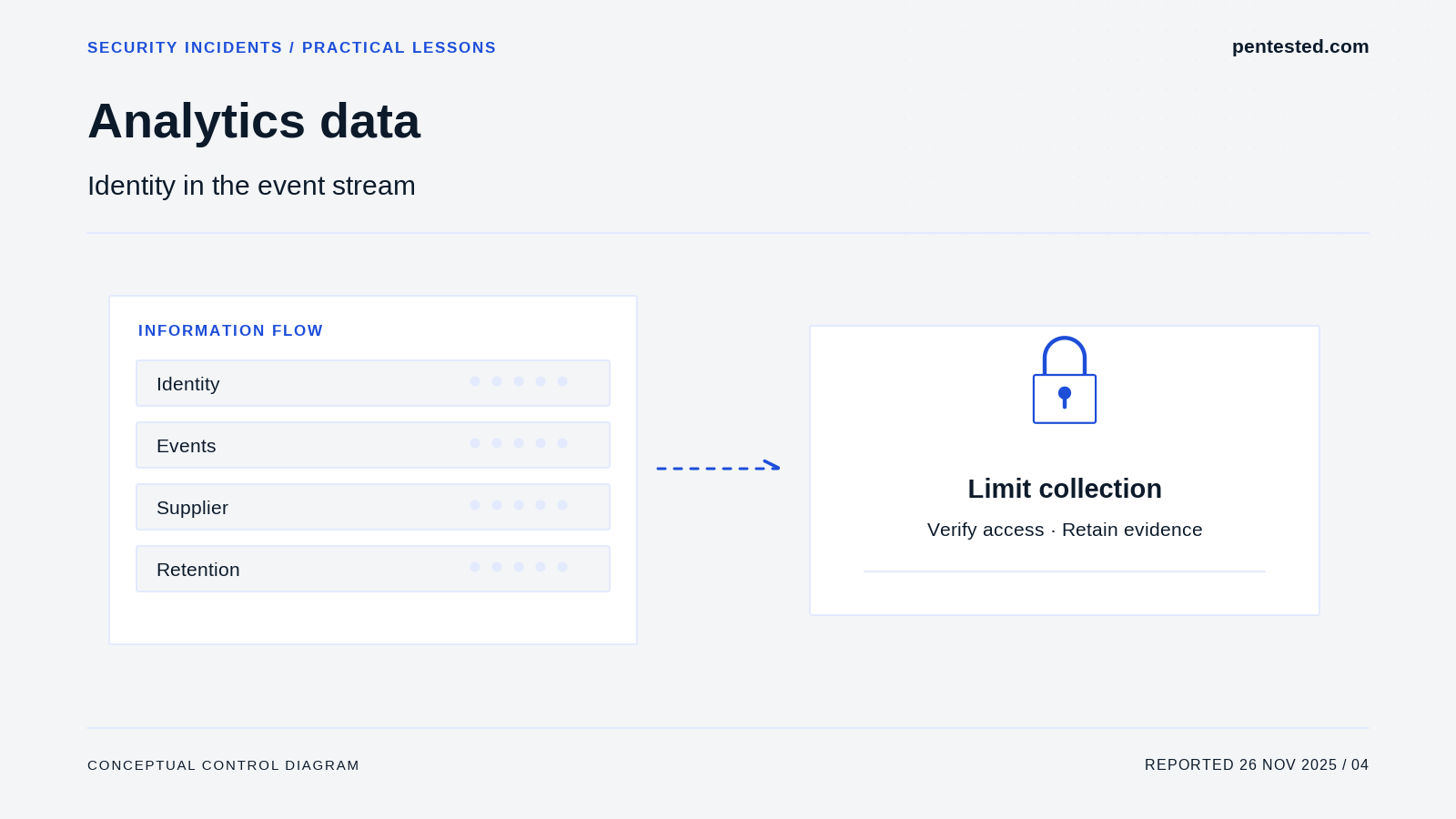
Analytics supplier exposure should be reviewed at the point where an application generates an event, as well as at the supplier account. A well-restricted dashboard cannot undo a decision to send unnecessary identity information in every event. Ask developers to demonstrate a representative event from collection through ingestion and retention, with sensitive values replaced by test data. That short trace often provides stronger evidence than a general statement that the organisation uses analytics responsibly. It also establishes which team can stop collection promptly when a supplier incident occurs.
Questions for the next analytics review
Ask a product owner to identify one decision made using each collected personal field. If no current decision depends on it, consider removing the field. Then compare the documented event with a synthetic event observed in production-like testing.
The resulting review should leave the organisation with a smaller, understood dataset and a clearer picture of supplier access. That improves privacy and makes a future incident easier to investigate, because the team can explain what the supplier held without first reverse-engineering years of event changes.
References
<https://openai.com/index/mixpanel-incident/>
<https://mixpanel.com/blog/sms-security-incident/>
Related issues
- How the Fireworks AI and Cursor incident exposed secrets in agent traces
- What the Manchester Airports Group breach reveals about passenger data
- What the Nitori data incident teaches about uncertain breach scope
Read about our methodology or contact pentested.com to discuss security testing for your organisation.


