What the Manchester Airports Group breach reveals about passenger data
Public report: 27 August 2026. Updated: 17 November 2026.
The Manchester Airports Group breach demonstrates why customer information collected around a core service deserves its own security review. Parking, lounges, Fast Track access and public Wi-Fi may appear secondary to running an airport, but they create identifiable records about customers and their use of services. Those datasets remain valuable even when aviation operations are unaffected.
What happened
Manchester Airports Group publicly disclosed the incident on 27 August 2026. It said an unauthorised party obtained information relating to bookings and Wi-Fi sign-ups at Manchester, London Stansted and East Midlands airports. The described information included email addresses, telephone numbers, vehicle registrations and postcodes.
MAG stated that bank and payment details were not held in the affected system and that passenger safety and aviation security had not been compromised. Those boundaries are important. A customer-data incident should not be transformed into an unsupported claim about flight-control or airport-safety systems.
What the reporting date establishes
The article is dated to the August public disclosure. Subsequent examination or publication of customer information belongs later in the timeline. The date a dataset appears in an independent breach service is not necessarily the date of initial access or the first supplier announcement.
The public statement identifies affected services and information categories, but does not provide a full technical initial-access account. The security review below therefore focuses on comparable ancillary services and the authority over their customer data.
Ancillary services create their own data estate
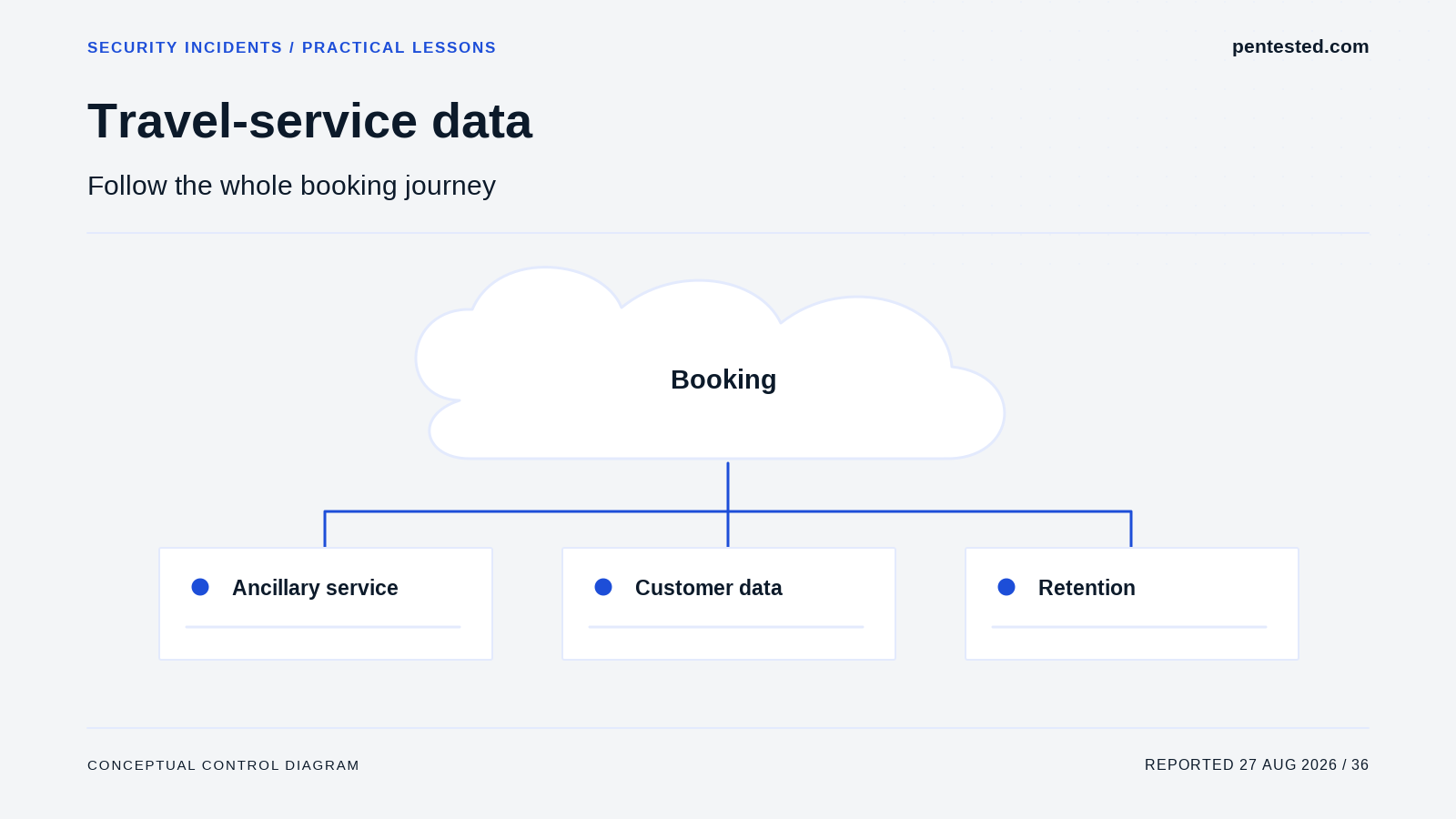
Airport ancillary services may be delivered through several applications, suppliers and commercial teams. A customer can interact with the same organisation through a parking booking, a lounge purchase and a Wi-Fi registration while those records follow different technical paths.
Travel information aggregation can make the joined record more revealing than any one field. Contact details combined with service history can establish relationships and context useful for impersonation or intrusive profiling. This is a general risk to assess, not a claim that every potential misuse occurred in this incident.
The inventory should therefore follow the information from collection through storage, support and reporting. A main customer website may be well understood while an older booking platform or marketing export receives less attention. Security ownership needs to remain clear across those systems.
The absence of payment-card information reduces one category of exposure but does not remove the need to protect the remaining records. A vehicle registration or booking context may still be personal information in the circumstances. The assessment should describe what the data reveals and who can use it.
Why retention and integration matter
Service information often remains after the immediate transaction has ended. Some retention may support legitimate administration, while other copies persist because an export or reporting process has never been reviewed. The organisation needs a purpose for each category and a way to apply that decision technically.
Integrations can widen access. A supplier providing a narrow service may receive more customer information than its function requires, or an internal reporting identity may join several datasets. Review should compare the actual fields and privileges with the business purpose.
Customer support can also become a route to sensitive context. Staff need enough information to resolve a booking query, but they may not need unrestricted access to every customer's history or bulk export. The application should enforce that distinction rather than leaving it entirely to staff discretion.
During an incident, these relationships affect notification. A person may have used several services, changed contact details or interacted with more than one airport. The organisation needs a reproducible method for identifying the affected information without confusing records, transactions and distinct people.
How penetration testers assess comparable services
An authorised assessment should map the customer journeys and supporting suppliers for each ancillary service. Use synthetic bookings and identities to trace which information is collected, where it is sent and which roles can retrieve it. The scope should identify the systems each party can authorise for testing.
Test record-level access in booking, support and administration interfaces. A customer or supplier role should not obtain another test customer's information outside its legitimate purpose. Include exports, search and mobile or API routes where they support the same workflow.
Review service identities and integrations separately from human users. A narrow customer-facing interface can coexist with a broad background credential. The finding should establish the effective dataset and operations available through that identity.
An incident exercise can identify a fictional affected service and ask the team to determine its customer population, data categories and notification route. Measure how duplicates and overlapping service use are handled. This is a practical test of the data map, not just a technical vulnerability check.
How to reduce the risk
Give each ancillary service a named owner responsible for its information and access model. Maintain an inventory of the applications, suppliers and secondary copies involved. Review older services and data flows rather than assuming they follow the controls of the main website.
Minimise collected and shared information according to the service purpose. A Wi-Fi registration or booking task should not automatically receive the fullest customer profile. Validate the fields in actual requests, exports and support views.
Separate routine support from exceptional bulk access. Limit integration credentials, review their owners and remove obsolete connections. Retain useful evidence about sensitive queries and exports so misuse can be investigated at the correct service boundary.
Apply retention decisions across the real data estate. Include reporting stores, marketing exports and supplier copies. A policy applied only to the primary application can leave the same information available elsewhere indefinitely.
Prepare clear communications identifying affected services, information categories and verified exclusions. Give customers a trusted route to ask about their specific exposure. Avoid implying that an unaffected core operation makes a customer-data breach insignificant.
Review the customer journey through ancillary services. A person may book parking, use a lounge or register for an offer through different interfaces while reasonably assuming they are dealing with one organisation. Map the identifiers passed between those services and establish which company controls each copy. The security review should follow the information rather than the visual consistency of the booking screens.
Test a small number of authorised customer accounts with different purchases. Confirm that booking references, account history and export functions preserve the intended separation. Include historical bookings and cancelled services, where retention rules can be less obvious. This provides a concrete view of both access control and the amount of customer information retained after a transaction is complete.
A useful first step
Choose one secondary service that collects customer information and trace a synthetic transaction from sign-up through support and reporting. Ask each owner why it receives the information and how access ends when the purpose is complete.
That exercise can reveal a forgotten integration or unnecessarily broad copy without requiring a dramatic technical exploit. The objective is consistent security ownership across the whole customer relationship, including the services that sit around the organisation's main operational function.
References
<https://www.manchesterairport.co.uk/help/data-security-incident/>
<https://haveibeenpwned.com/breach/manchesterairportsgroup>
Related issues
- What the Mixpanel data breach reveals about analytics privacy
- What the Nitori data incident teaches about uncertain breach scope
- What the Nottingham University breach teaches about student-record security
Read about our methodology or contact pentested.com to discuss security testing for your organisation.


