What the Gyazo data breach reveals about screenshot metadata
Public report: 16 September 2026. Updated: 17 November 2026.
The Gyazo data breach demonstrates why information about an image can be sensitive even when the image file itself is not disclosed. Screenshot services hold account records, sharing relationships and metadata that can reveal how people use the service. The security boundary needs to protect those relationships as carefully as the visible file.
What happened
Gyazo operator Helpfeel disclosed unauthorised access in September 2026. Its later update described approximately 23.62 million user records, including many anonymous accounts and approximately 5.62 million records with registered email addresses. It also described large volumes of image metadata, including metadata associated with previously deleted images.
The company explicitly distinguished metadata-record counts from image files disclosed. It said the contents varied by user and that payment information was not exposed. Those qualifications are central to the case: a count of account or metadata records cannot be converted automatically into the same number of identified people or stolen screenshots.
Initial notice and expanded findings
The article is dated to the initial public notice on 16 September. The 25 September update clarified account categories and added information about deleted-image metadata. Later service restrictions and restoration form separate operational milestones.
This chronology explains why a later scope statement can contain more categories than the first announcement. The account should preserve both the new findings and their limits, rather than treating every revised number as an equivalent measure of image-content exposure.
Metadata can reveal useful context
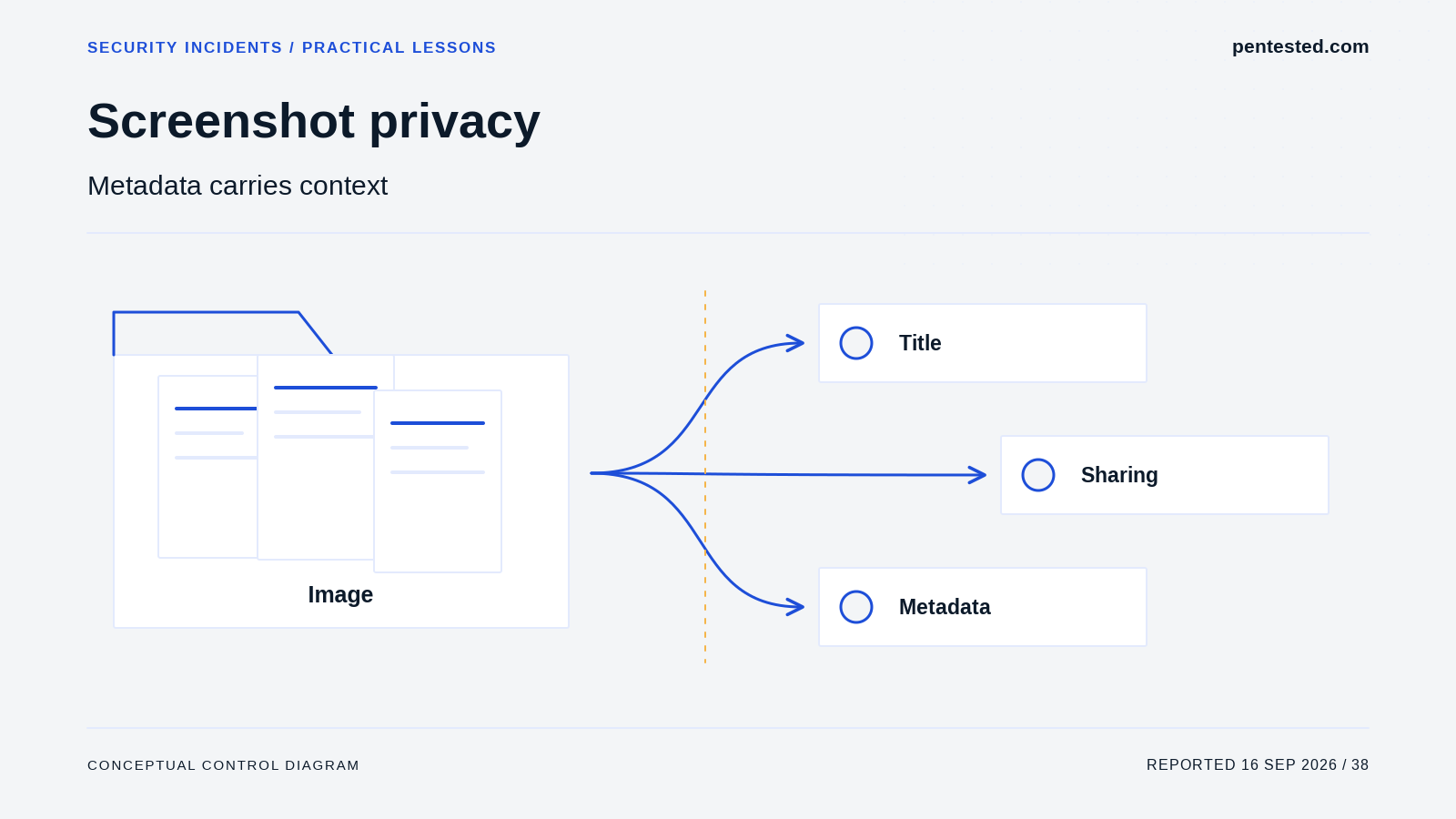
Private screenshot metadata may describe relationships between an account, an object and a sharing mechanism. Depending on the service design, those relationships can be sensitive even without the file contents. A review needs to identify what a field enables or reveals in combination with the surrounding system.
The distinction between anonymous and identified use also needs care. An account without a registered email address is not automatically meaningless. It may still have identifiers, access relationships or activity context. Conversely, the presence of an account record does not prove that the service knew the real-world identity of its user.
Deleted-image information retention creates another lifecycle question. A user may reasonably interpret deletion according to the product's published behaviour, while some metadata remains for a defined technical or business purpose. The service should understand and explain that remaining information rather than leaving it as accidental residue.
Authentication-related material needs separate classification. Some tokens or identifiers may represent authority, while others cannot be used alone to obtain access. Incident analysis should examine the actual capability of each item instead of treating every field called a token as equivalent.
File access and knowledge of a file are different
A service should not assume that obscurity of an image address is sufficient protection for private material. If metadata can help locate or construct a usable access route, the design needs an explicit decision about whether possession of that route grants access.
That is an architectural question for comparable services, not a claim that every Gyazo image became viewable. A robust assessment tests the relationship between object identification, sharing permission and server-side access enforcement using controlled files.
The same principle applies to thumbnails, previews and exports. A protected original file can coexist with a less protected derivative or metadata endpoint. The review should follow the complete object lifecycle and identify which representations retain sensitive context.
Recovery may require action on several boundaries: account sessions, sharing links, integration authority and the affected application. Removing the initial vulnerability does not automatically invalidate every previously exposed access mechanism. The response should identify which mechanisms actually require that action.
How penetration testers assess comparable services
An authorised assessment should create synthetic accounts and images with different sharing states. Test the main file, previews, metadata and relevant export routes. The objective is to establish whether each operation enforces the intended relationship between the user and the object.
Review the behaviour of sharing links deliberately. Testers can assess their audience, lifetime and revocation in an isolated environment. A finding should distinguish an intentionally public link from an unintended route to private content.
Deletion testing should trace the file and associated metadata through the service's documented lifecycle. Use test objects to establish what remains in active systems, secondary stores and user-visible functions. The result should be compared with the product's stated behaviour and legitimate retention purpose.
Detection exercises can simulate a small controlled sequence of unusual metadata requests. Measure whether the service records the identity, objects and outcome in a form responders can use. Avoid collecting real screenshots or generating a bulk extraction merely to demonstrate a rate or access-control issue.
How to reduce the risk
Classify metadata according to the relationships and authority it contains. Separate public object information from private account and sharing details. Minimise fields returned by interfaces that do not require the fullest record.
Enforce access controls across all file representations and related endpoints. Include previews, metadata, exports and direct storage routes. Review any design that makes possession of an address equivalent to permission, especially for material presented as private.
Make deletion behaviour intentional and understandable. Document what is removed, what may remain for a legitimate purpose and how that retained information is protected. Apply the decision to secondary systems rather than only the primary image file.
Inventory credentials, sessions and integration tokens according to their actual capability. During an incident, revoke authority where the evidence or prudent containment requires it, while explaining the scope accurately. A broad label should not replace analysis of what an exposed value can do.
Retain useful object-access evidence without logging unnecessary image contents. The service should be able to investigate relationships and retrievals while keeping the monitoring environment appropriately constrained.
A privacy review should ask what someone can infer from information that is not the main file. Titles, timestamps, sharing activity and identifiers can establish a relationship between a person and a subject even where the image itself remains inaccessible. Classify those fields according to their practical sensitivity rather than treating all metadata as harmless.
Use synthetic images and accounts to trace the ordinary sharing process. Observe which metadata appears in search, previews, notifications and exported account data. Check whether changing a sharing setting affects each of those routes. The intended privacy boundary should be consistent across the service, with any necessary exceptions explained to the user at the point the information is shared.
A practical privacy test
Upload a synthetic image, change its sharing state and then delete it. At each stage, ask which records, previews and access routes remain available to each test identity.
That simple lifecycle exercise can reveal a much richer security boundary than the upload screen suggests. The useful outcome is a service whose access and deletion behaviour matches its intended privacy model across both the image and the information surrounding it.
References
<https://corp.helpfeel.com/en/news/news-20260925>
Related issues
- What the Mixpanel data breach reveals about analytics privacy
- What the Manage My Health breach teaches about patient documents
- What the Nitori data incident teaches about uncertain breach scope
Read about our methodology or contact pentested.com to discuss security testing for your organisation.


