What the October LiteLLM compromise teaches about release provenance
Public report: 21 October 2026. Updated: 17 November 2026.
The October LiteLLM compromise demonstrates why removing a secret from a file is different from revoking its authority. It also shows how a release can pass apparently normal automation while the identities controlling that automation are compromised. The security boundary needs to cover the credentials, approvals and source of the artefact actually published.
What happened
On 21 October 2026, LiteLLM reported malicious version 1.107.0 in package and container registries. Its initial bulletin was followed by a canonical investigation on 23 October that corrected earlier assumptions about the route.
That investigation describes an administrative key committed publicly in May and removed from the current file shortly afterwards, but not revoked. The attacker used it in October to obtain a GitHub organisation owner's token from an internal agent platform, then acquired additional maintainer credentials. The report says the attacker changed release workflows, bypassed protection using owner authority and published a build from an attacker-controlled source.
Why this is a separate case
The article is dated to the October public notice. This incident is distinct from the March LiteLLM releases associated with the Trivy supply-chain compromise. Treating both as one continuous attack would obscure the specific cause and response described in the later report.
The canonical account is important because incident updates can change as evidence develops. The final narrative should follow the corrected findings, while keeping initial distribution and containment information attached to the appropriate bulletin.
Secret exposure has an authority lifecycle
A secret can remain useful after its visible copy disappears. Source history, caches and other records may preserve the value, while the receiving system continues to accept it. The decisive recovery action is to make the exposed authority unusable and verify that result.
Repeat release-pipeline compromise also raises a governance question. An organisation can improve one technical route while leaving a different credential or administrative exception unresolved. Assurance should track the underlying authority and verify completion of corrective actions rather than treating a removal commit as closure.
The internal agent platform is another useful boundary to examine. A service that performs repository work may need credentials, but the credential's scope should match that work. Giving it an organisation owner's authority can turn compromise of an experimental tool into control of the wider delivery environment.
This principle applies beyond AI tooling. Any automation that holds a broad personal or owner token should be assessed according to the token's effective authority, including the protections it can override. The convenience of an existing login does not make it an appropriate machine identity.
Approval independence needs to be real
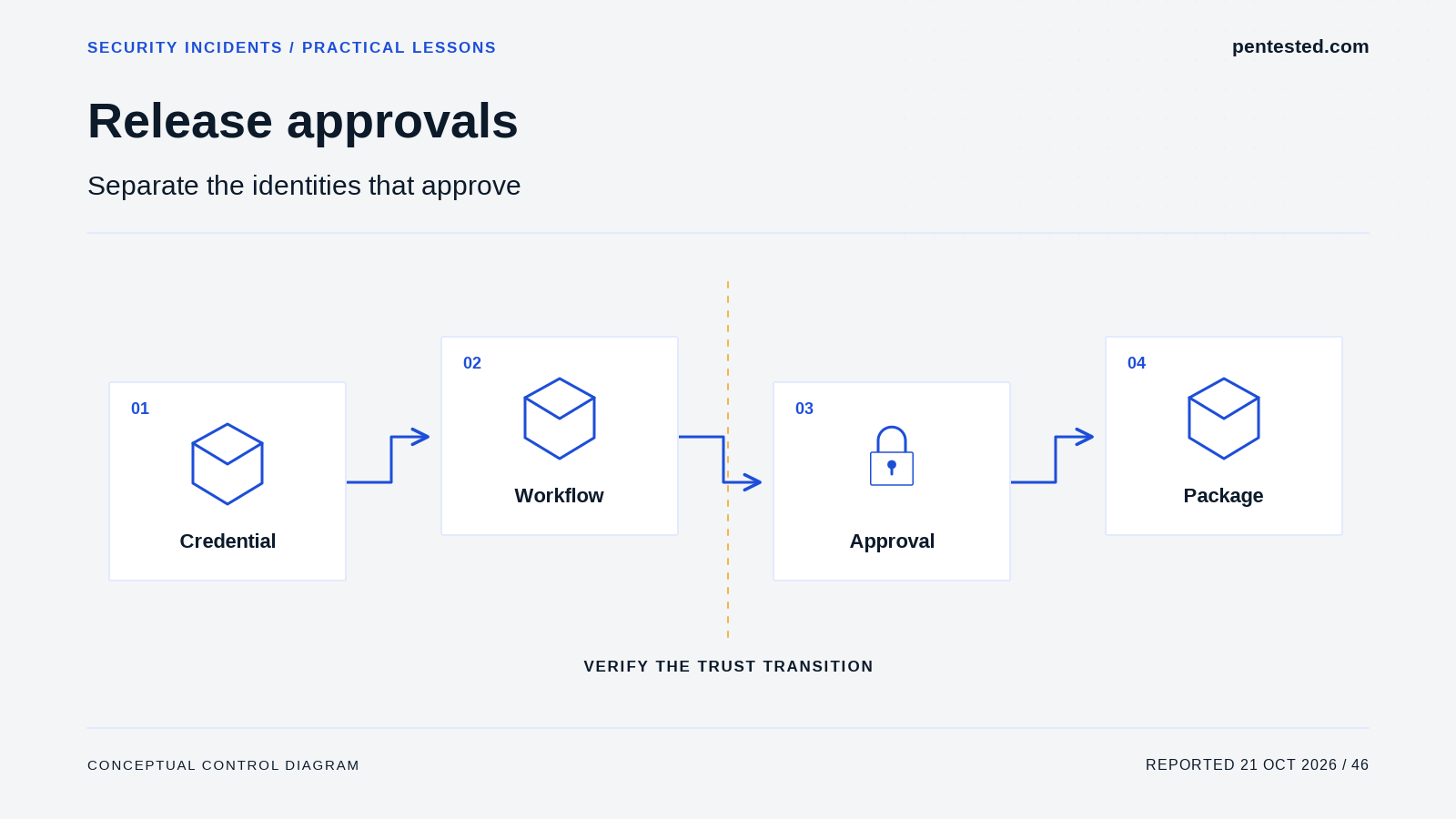
Two approvals provide limited protection if one attacker can obtain both identities or change the rule that requires them. The design should consider who can administer the approval process itself, not just who normally clicks approve.
An owner-level exception can be necessary for recovery, but it is also a consequential security capability. Its use needs protection and independent evidence. A branch rule that can be bypassed by a credential already available to ordinary automation may not provide the independence the business assumes.
Package-to-image provenance matters because the source repository can look correct while a distributed artefact comes from somewhere else. A review should connect the approved source, workflow version, build inputs and published artefact. Inspecting the current source tag alone cannot establish what users received earlier.
Incident evidence also needs protection from the publishing identities. If a compromised identity can delete runs or rewrite relevant history, responders need independent records to reconstruct the sequence. Logging should support recovery of the facts, not only routine troubleshooting.
How penetration testers assess comparable release systems
An authorised review should inventory the identities held by automation, including experimental and internal tools. Establish their effective repository, organisation and registry permissions. Use synthetic credentials or a test organisation for active validation.
Test credential revocation as an outcome. A controlled exposed test key can be removed from a file, revoked at its authority source and checked for continued use. The exercise should demonstrate why file cleanup and access removal are separate operations.
Review the administrators of branch rules, release gates and source selection. In an isolated pipeline, assess whether one compromised identity can change the approval boundary and publish an artefact that did not come from the intended source. No public malicious release is required.
Trace one release through its full provenance and evidence. Testers should identify the source revision, workflow, approvals and artefact digest, then establish which records survive compromise of a publishing identity. A useful report describes any missing link precisely.
How to reduce the risk
Make secret-exposure response include revocation, investigation and verification. Assign an owner and retain evidence that the old credential no longer works. Removing the value from the current file should be one task within that process, not the completion condition.
Replace broad personal and owner credentials in automation with identities scoped to the intended work. Review the ability of those identities to change rules, grant access or bypass approvals. Shorter credential lifetime helps only when the trust and permission model is also appropriate.
Protect the release policy independently from routine publishing. Review owner exceptions and emergency routes, and monitor their use. Independence should survive compromise of an ordinary maintainer or internal development tool.
Verify the relationship between source and distributed artefacts. Retain the workflow version, build inputs, approvals and artefact identity in protected evidence. Consumers should be able to identify what they installed even if a registry tag later changes or a build record disappears.
During recovery, assume reachable credentials may need review according to the evidence. Rebuild affected execution environments before supplying replacements, and verify that unauthorised administrative changes have been removed. A corrected package does not automatically restore trust in the process that published it.
A credential incident should end with an authority inventory, not merely a record that the exposed string was removed from view. Identify the services that accepted it, the actions it could perform and any replacement authority it could have created. A short exposure period does not establish that its later usefulness was short.
Verify the independence of release approval using two genuinely separate test identities. Confirm that one account cannot obtain the other's approval authority through a shared token, administrative role or common working environment. Where an owner can bypass a control, document that route and monitor its use. A workflow with two approval steps may still depend on one effective identity if the underlying administration allows the same person or compromised environment to control both.
A useful completion check
Choose one past secret-exposure ticket and ask the owner to demonstrate revocation, review of use and the resulting permission state. Then choose one release and trace it back to the exact approved source.
Those checks turn policy into evidence. The goal is a delivery process in which exposed authority is actually removed and a valid-looking approval cannot conceal an artefact produced from an unauthorised source.
References
<https://docs.litellm.ai/blog/security-incident-oct-21-2026>
<https://docs.litellm.ai/blog/security-incident-oct-21-2026-attack-chain>
Related issues
- How the Trivy supply-chain compromise reached downstream AI software
- How the TanStack supply-chain attack crossed build-pipeline boundaries
- What the Vercel security incident teaches about AI-tool permissions
Read about our methodology or contact pentested.com to discuss security testing for your organisation.


