Firmware vulnerability remediation and regression verification
A firmware fix needs evidence that the shipped release closes the original failure and related paths. Understanding firmware vulnerability remediation and regression verification helps establish which security property the feature needs and where that property is actually enforced.
What does this involve?
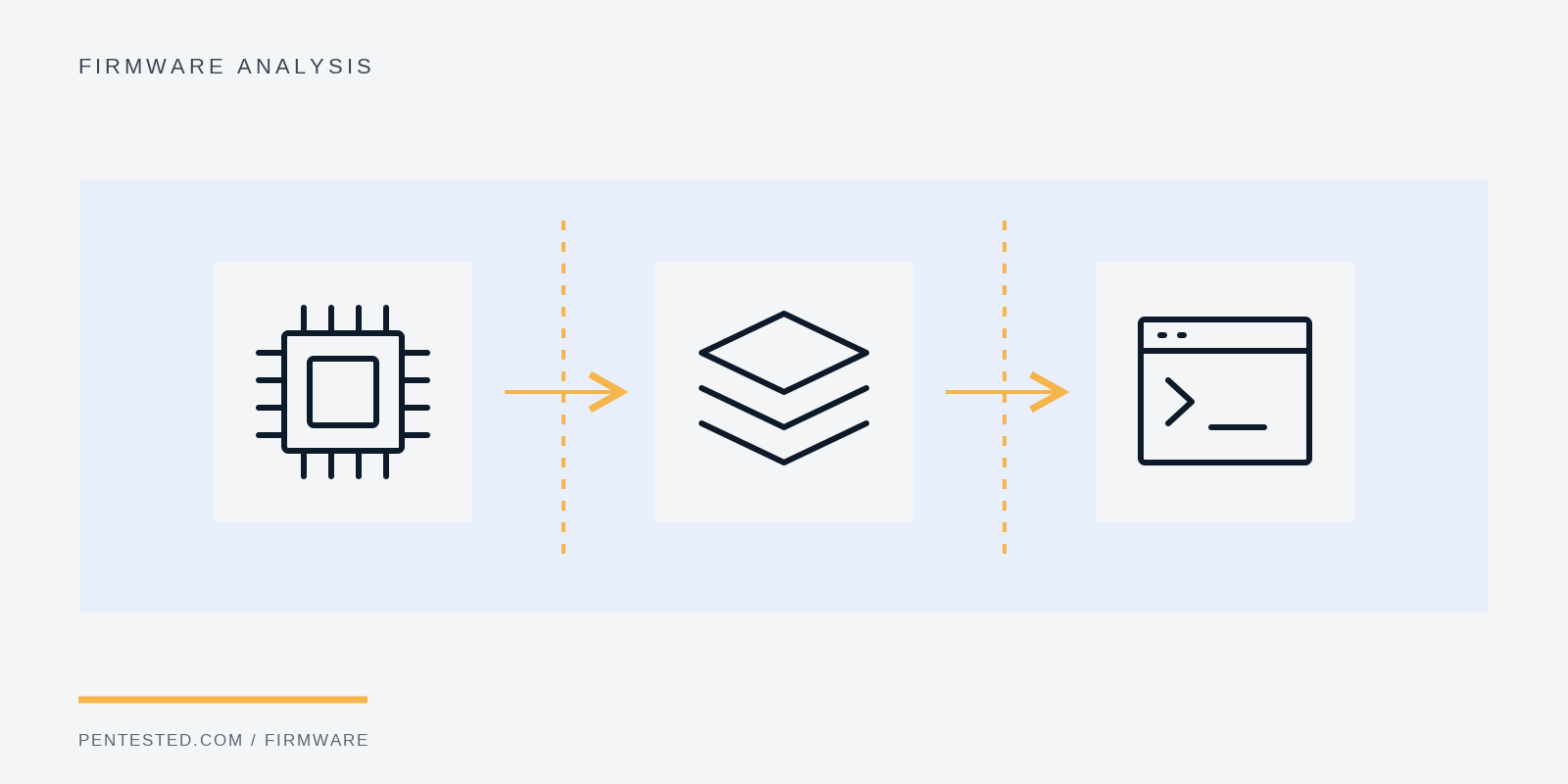
Firmware security depends on the relationship between the distributed image, installed configuration and code that actually executes. Offline analysis, emulation and real-device testing provide different kinds of evidence and should be connected before a strong impact claim is made.
After identifying a vulnerability within a binary from previous steps, a proper proof-of-concept \(PoC\) is required to demonstrate the real-world impact and risk. Developing exploit code requires programming experience in lower level languages \(e.g. ASM, C/C++, shellcode, etc.\) as well as background within the particular target architecture \(e.g. MIPS, ARM, x86 etc.\). PoC code involves obtaining arbitrary execution on a device or application by controlling an instruction in memory.
It is not common for binary runtime protections \(e.g. NX, DEP, ASLR, etc.\) to be in place within embedded systems however when this happens, additional techniques may be required such as return oriented programming \(ROP\). ROP allows an attacker to implement arbitrary malicious functionality by chaining existing code in the target process/binary's code known as gadgets. Steps will need to be taken to exploit an identified vulnerability such as a buffer overflow by forming a ROP chain. A tool that can be useful for situations like these is Capstone's gadget finder or ROPGadget
Why it matters
Consider a realistic failure: a patched normal service leaves the same vulnerable component in the recovery image.
A firmware weakness may expose device credentials, permit privileged actions or affect availability. The practical consequence depends on reachable services, execution privileges and the trust placed in the device by other components.
Firmware evidence should identify the image, installed configuration and execution conditions. Static analysis, emulation and hardware testing answer different questions and should support a consistent conclusion.
How penetration testers check for it
Reproduce the original issue and inspect affected variants, versions and update paths.
- Scoping - Use ISTG's device model to identify all device components and define test scope.
- Use FSTM when you need deep technical guidance on firmware extraction, binary analysis, emulation, and exploitation.
- Use ISTG when you need a structured checklist covering the entire IoT device attack surface.
- Use Both for enterprise IoT security assessments requiring comprehensive coverage and standardized reporting.
- Review privileges and externally influenced inputs.
- Preserve reproducible evidence and representative recovery conditions.
How to fix it
Verify the actual release artefacts and retain focused regression tests for the corrected boundary.
- Remove unnecessary code, accounts and capabilities.
- Use safe input handling and narrow privileged interfaces.
- Protect secrets and authenticate relevant executable content.
- Verify fixes in the actual production and recovery artefacts.
A suspicious string or an emulation result is not enough to establish a working compromise. Validate the path and explain any environmental assumptions that affect the conclusion.
Recheck the changed behaviour against the original failure conditions and the legitimate user journey. Keep enough evidence to show which release and configuration were verified, and include related entry points that depend on the same security decision.
Related issues
- Chaining firmware weaknesses across device trust boundaries
- Validating firmware memory corruption and control-flow impact
- Operating a vulnerability disclosure and remediation workflow
Read about our methodology or contact pentested.com to discuss your firmware and embedded systems.