Implementing centralised application access control
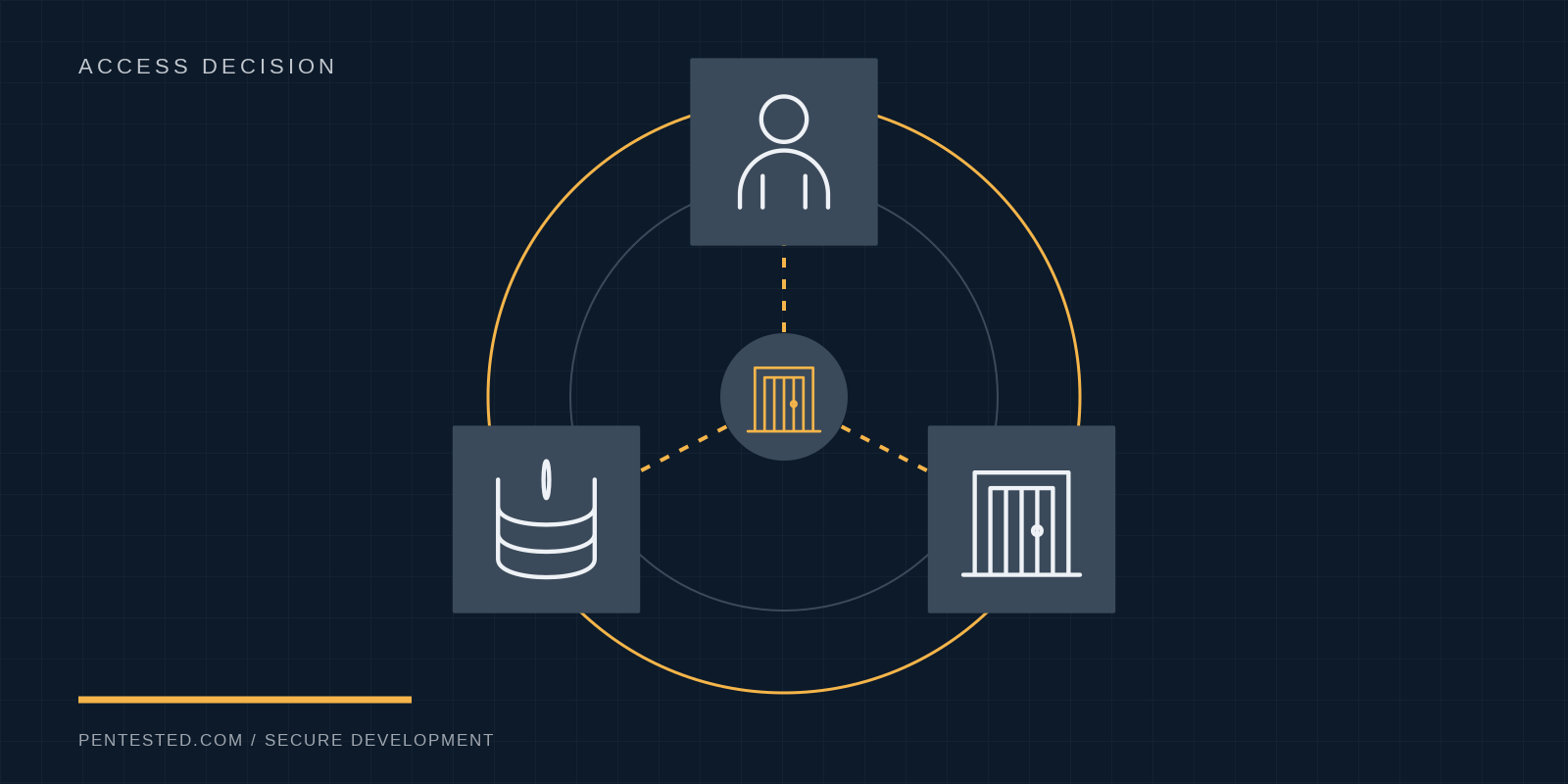
Implementing centralised application access control connects a security requirement to the behaviour of a real feature. The relevant controls need to remain effective across custom code, integrations and the production configuration. Understanding centralised application access control helps establish which security property the feature needs and where that property is actually enforced.
What does this involve?
Authorisation determines which resources and operations an established identity may use. It must be enforced where protected data is read or changed. User interface restrictions, obscure identifiers and documentation can help usability, but they do not replace the service's own permission decision.
Why it matters
Consider a realistic failure: one application route relies on its own permission check while another route performs the same operation without it.
A missing check can expose another account's information or let an ordinary user perform a privileged action. The result should be described by the actual records and operations reached, including whether access crosses a customer or organisational boundary.
Implementation guidance should be applied to a real feature and its deployment. Framework defaults, custom handlers and integrated services all influence whether the intended protection remains effective.
How penetration testers check for it
Trace the relevant feature from its entry point to the data or operation it protects, including custom code and alternate paths.
- Compare users with different roles and ownership relationships.
- Exercise read, change, delete and alternate access paths.
- Test nested resources, background processing and state changes.
- Confirm rejection as well as the legitimate successful journey.
How to fix it
Use the appropriate maintained mechanisms and verify the result in the actual production configuration.
- Define explicit access rules and default-deny behaviour.
- Bind resource selection to trusted ownership and tenant context.
- Enforce permission checks at each protected operation.
- Maintain regression cases for unauthorised users and changed permissions.
A successful response alone does not prove unauthorised access. Establish whose resource was affected and what the caller was legitimately entitled to do.
Recheck the changed behaviour against the original failure conditions and the legitimate user journey. Keep enough evidence to show which release and configuration were verified, and include related entry points that depend on the same security decision.
Related issues
- Automating permission tests from application access rules
- Implementing precise cross-origin access policies
- Configuring application database access with least privilege
Read about our methodology or contact pentested.com to discuss secure development and code review.


