API security logging and incident reconstruction
API logs should explain important access and state changes without creating another store of secrets. Understanding API security logging and incident reconstruction helps establish which security property the feature needs and where that property is actually enforced.
What does this involve?
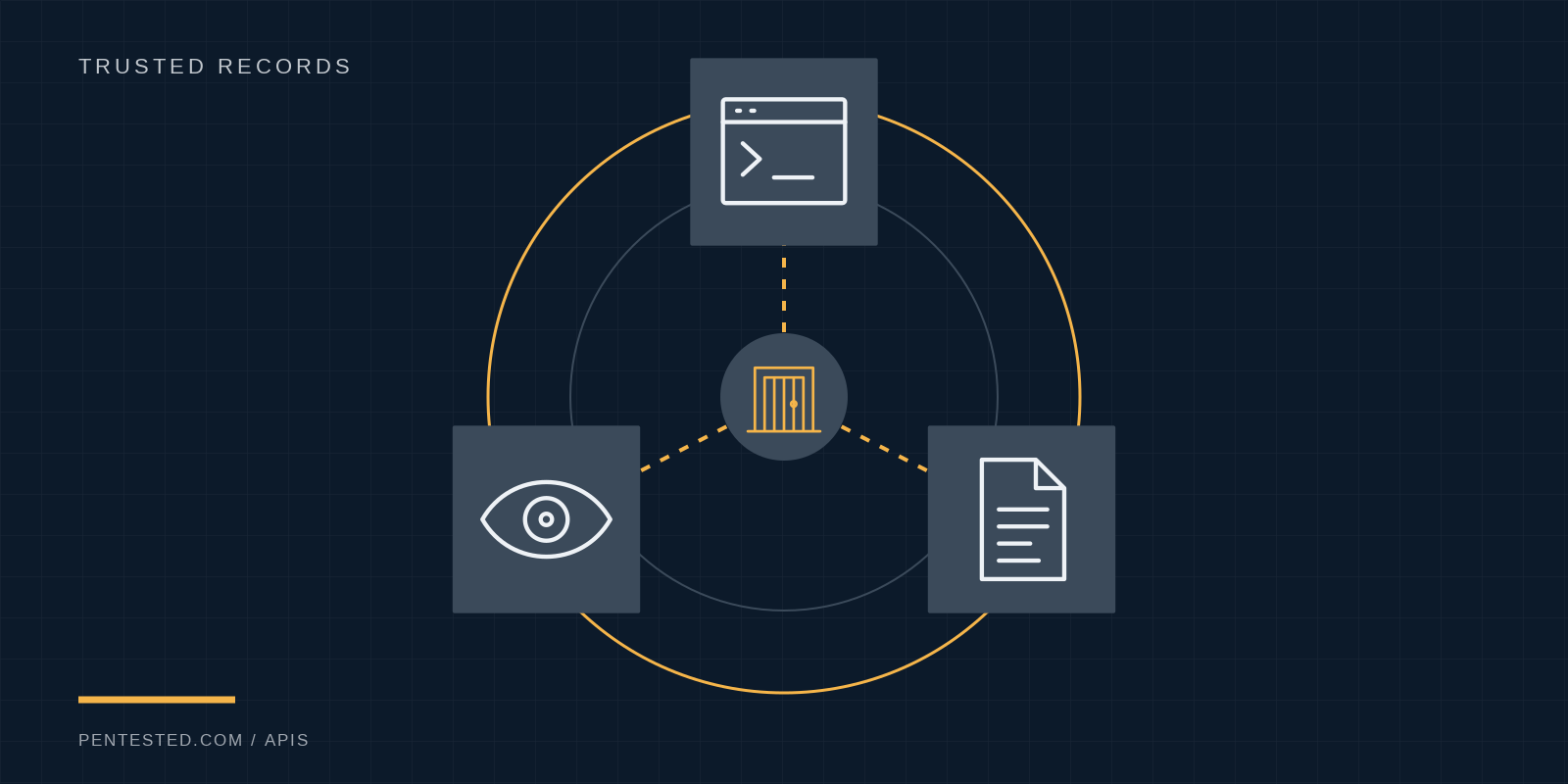
Useful security records describe important actors, resources and state changes without becoming another source of secrets. Their value depends on reliable event coverage, correlation and access protection as well as the volume of information collected.
This section ensures a clear and complete inventory of logging across the application stack. This is essential for effective security monitoring, incident response, and compliance.
This section provides requirements to ensure that security logs are consistently structured and contain the expected metadata. The goal is to make logs machine-readable and analyzable across distributed systems and tools.
Why it matters
Consider a realistic failure: an incident cannot be reconstructed because requests lack trusted actor and object context.
Missing or misleading records can delay detection and make an incident harder to reconstruct. Excessive capture can expose credentials or confidential content to people and systems that did not otherwise need it.
An API review follows the server-side behaviour behind the interface. Direct requests, alternate methods and background operations can reveal boundaries that the normal frontend journey does not exercise.
How penetration testers check for it
Review event coverage, correlation, token redaction and log permissions.
- Confirm that an inventory exists documenting the logging performed at each layer of the application's technology stack, what events are being logged, log formats, where that logging is stored, how it is used, how access to it is controlled, and for how long logs are kept.
- Confirm that each log entry includes necessary metadata that would allow for a detailed investigation of the timeline when an event happens.
- Confirm that time sources for all logging components are synchronized, and that timestamps in security event metadata use UTC or include an explicit time zone offset. UTC is recommended to ensure consistency across distributed systems and to prevent confusion during daylight saving time transitions.
- Confirm that the application only stores or broadcasts logs to the files and services that are documented in the log inventory.
- Confirm that logs can be read and correlated by the log processor that is in use, preferably by using a common logging format.
- Confirm that when logging sensitive data, the application enforces logging based on the data's protection level. For example, it may not be allowed to log certain data, such as credentials or payment details. Other data, such as session tokens, may only be logged by being hashed or masked, either in full or partially.
- Confirm that all authentication operations are logged, including successful and unsuccessful attempts. Additional metadata, such as the type of authentication or factors used, should also be collected.
- Confirm that failed authorisation attempts are logged. For L3, this must include logging all authorisation decisions, including logging when sensitive data is accessed (without logging the sensitive data itself).
- Confirm that the application logs the security events that are defined in the documentation and also logs attempts to bypass the security controls, such as input validation, business logic, and anti-automation.
- Confirm that the application logs unexpected errors and security control failures such as backend TLS failures.
- Confirm that all logging components appropriately encode data to prevent log injection.
- Confirm that logs are protected from unauthorised access and cannot be modified.
- Confirm that logs are securely transmitted to a logically separate system for analysis, detection, alerting, and escalation. The aim is to ensure that if the application is breached, the logs are not compromised.
- Confirm that a generic message is returned to the consumer when an unexpected or security-sensitive error occurs, ensuring no exposure of sensitive internal system data such as stack traces, queries, secret keys, and tokens.
- Confirm that the application continues to operate securely when external resource access fails, for example, by using patterns such as circuit breakers or graceful degradation.
- Confirm that the application fails gracefully and securely, including when an exception occurs, preventing fail-open conditions such as processing a transaction despite errors resulting from validation logic.
- Confirm that a "last resort" error handler is defined which will catch all unhandled exceptions. This is both to avoid losing error details that must go to log files and to ensure that an error does not take down the entire application process, leading to a loss of availability.
- Review redaction and resistance to misleading event content.
- Assess access, integrity and retention.
How to fix it
Record useful security context and protect sensitive values and retained audit data.
- Define meaningful events and consistent fields.
- Exclude unnecessary secrets and personal information.
- Protect log access and important audit records.
- Verify that monitoring and investigation workflows can use the retained evidence.
A complete request or response is rarely necessary for every event. Capture should be justified by an operational purpose and protected according to the information it contains.
Recheck the changed behaviour against the original failure conditions and the legitimate user journey. Keep enough evidence to show which release and configuration were verified, and include related entry points that depend on the same security decision.
Related issues
- Building repeatable API authorisation regression tests
- gRPC API metadata, method access and message limits
- WebSocket API authentication and message authorisation
Read about our methodology or contact pentested.com to discuss your APIs and integrations.