API race conditions and transaction integrity
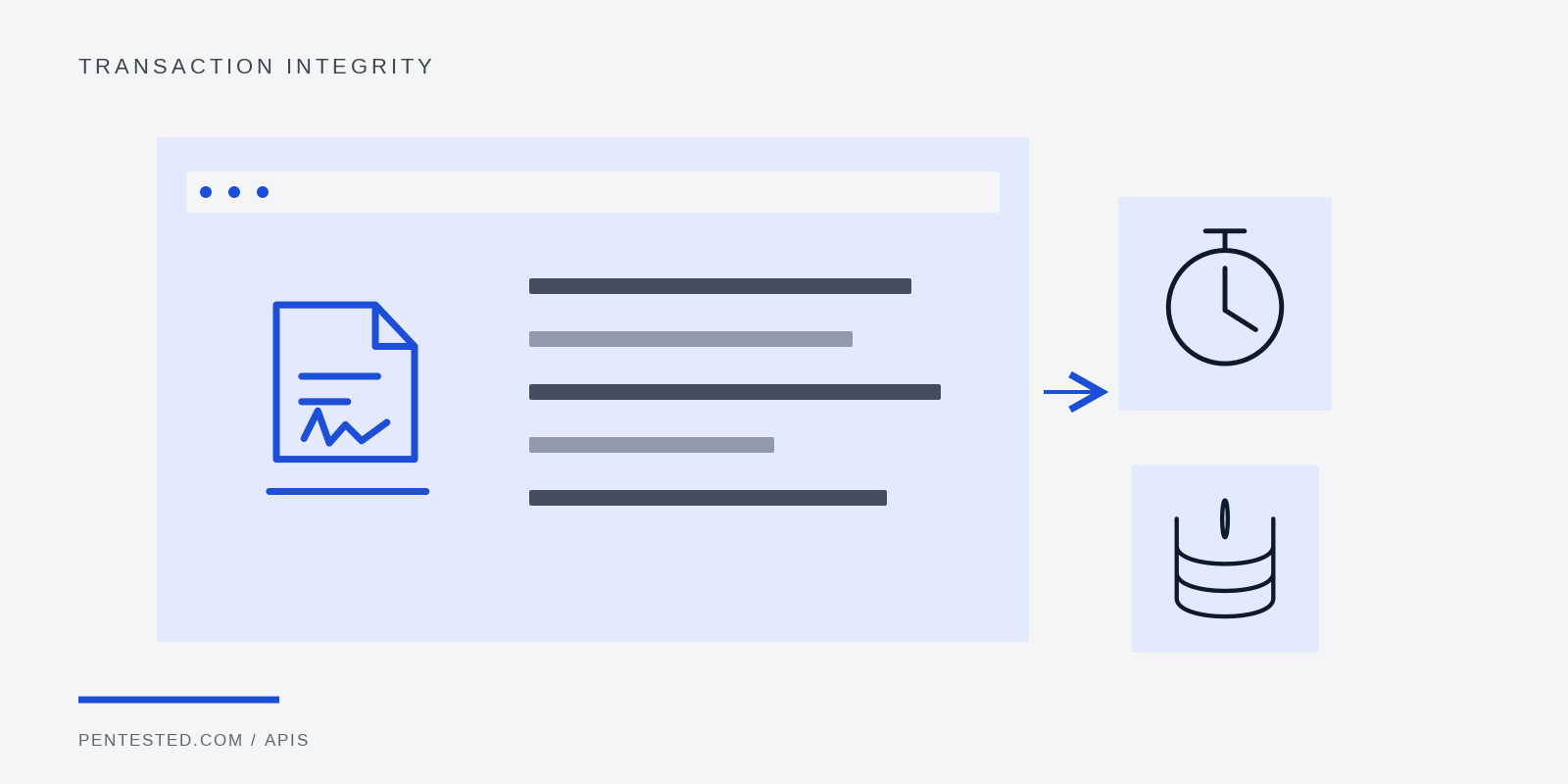
Concurrent requests can violate rules that appear correct when operations run one at a time. Understanding API race conditions and transaction integrity helps establish which security property the feature needs and where that property is actually enforced.
What does this involve?
Business logic security checks whether the application preserves the intended rules across a complete sequence of actions. State transitions, ownership, approval and retry handling can matter more than the validity of any individual input.
Concurrency issues such as race conditions, time-of-check to time-of-use (TOCTOU) vulnerabilities, deadlocks, livelocks, thread starvation, and improper synchronisation can lead to unpredictable behaviour and security risks. This section includes various techniques and strategies to help mitigate these risks.
Why it matters
Consider a realistic failure: two simultaneous withdrawals both observe the same available balance.
Legitimate features can cause harm when used out of sequence, repeatedly or under an identity that should not control the current state. Financial loss, inventory disruption and unauthorised changes depend on the particular workflow.
An API review follows the server-side behaviour behind the interface. Direct requests, alternate methods and background operations can reveal boundaries that the normal frontend journey does not exercise.
How penetration testers check for it
Test race-sensitive state transitions and inspect committed business outcomes.
- Confirm that shared objects in multi-threaded code are accessed safely by using thread-safe types and synchronisation mechanisms like locks or semaphores to avoid race conditions and data corruption.
- Confirm that checks on a resource's state, such as its existence or permissions, and the actions that depend on them are performed as a single atomic operation to prevent time-of-check to time-of-use (TOCTOU) race conditions. For example, checking if a file exists before opening it, or verifying a user’s access before granting it.
- Confirm that locks are used consistently to avoid threads getting stuck, whether by waiting on each other or retrying endlessly, and that locking logic stays within the code responsible for managing the resource to ensure locks cannot be inadvertently or maliciously modified by external classes or code.
- Confirm that resource allocation policies prevent thread starvation by ensuring fair access to resources, such as by leveraging thread pools, allowing lower-priority threads to proceed within a reasonable timeframe.
- Compare ownership and approval across related operations.
- Inspect committed outcomes and background side effects.
How to fix it
Use appropriate transactions, locking or atomic state changes around critical decisions.
- Represent important rules explicitly on the server.
- Bind approvals and state changes to trusted values.
- Use atomic operations where competing requests affect the same decision.
- Retain regression cases for invalid transitions and retries.
A behaviour is not automatically a vulnerability because it is unusual. The finding needs a clear violated business rule and a meaningful unauthorised consequence.
Recheck the changed behaviour against the original failure conditions and the legitimate user journey. Keep enough evidence to show which release and configuration were verified, and include related entry points that depend on the same security decision.
Related issues
- Auditing concurrency, shared state and race conditions
- API replay protection and idempotency keys
- API rate limits across users, tokens and addresses
Read about our methodology or contact pentested.com to discuss your APIs and integrations.