Sensitive data exposed in IoT I2C communication
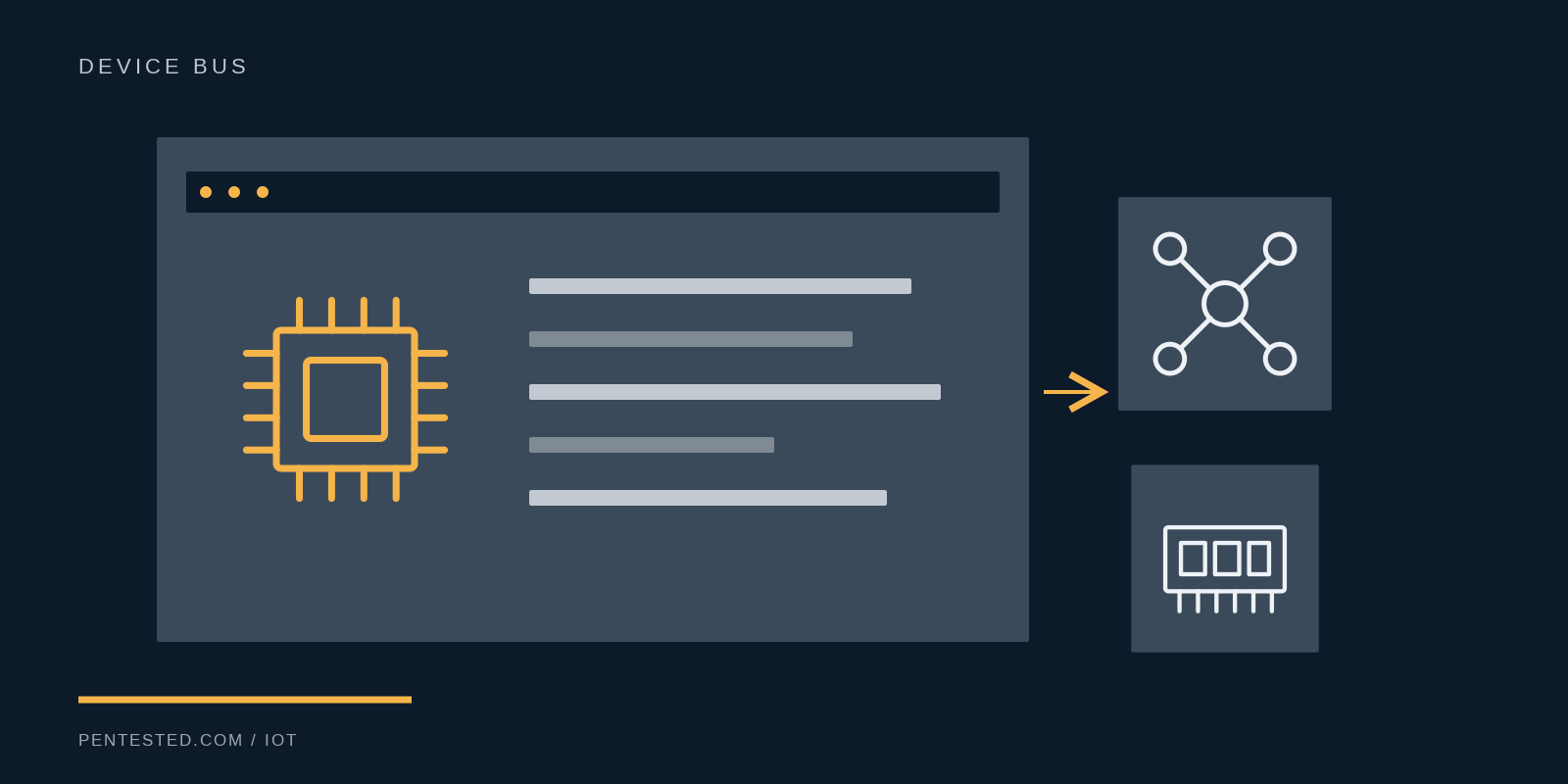
Sensitive data exposed in IoT I2C communication concerns the internal device bus or serial interface and the access conditions under which the device exposes information or performs an operation. Understanding sensitive data exposed in IoT I2C communication helps establish which security property the feature needs and where that property is actually enforced.
What does this involve?
Device security spans processing, storage and interfaces that may be physically accessible outside the operator's control. Access conditions matter: opening a case, attaching a peripheral and sending a network request represent different attacker capabilities.
I2C uses a two wire serial interface. One wire is the Serial Clock (SCL), the other one is the Serial Data (SDA). The communication between different components can be sniffed by connecting a data analyser to the SCL and SDA lines of the data bus. I2C is often used by onboard storage components, such as EEPROMs. It is possible that sensitive information will be exchanged between PCB components on the data bus.
The transmission of sensitive data should be reduced to the minimum which is required for operating the device. As I2C does not feature protective measures by design, the bus and interfaces must be secured physically to be only accessible for authorised individuals.
Why it matters
Consider a realistic failure: an accessible internal interface exposes a command, data or debugging path outside the normal user controls.
A device weakness can reveal local data, change operations or expose credentials used by the wider service. Assessment should distinguish what is obtained from the device itself from any separately demonstrated backend access.
Device findings need explicit access conditions. Record the hardware and software version, relevant interface exposure and whether the test assumes network access, an attached peripheral or access inside the enclosure.
How penetration testers check for it
Assess the stated device access level and verify the particular information, command or state change reachable through this component.
- The SCL and SDA pins/wires on the target device must be identified.
- A logic analyser or dedicated hardware tool (e.g., Bus Pirate in I2C sniffer mode, HydraBus, Saleae) must be connected to the I2C data bus and the capture settings (e.g., sampling rate, threshold voltage) have to be configured accordingly.
- The I2C communication of the target device must be captured and analysed in different states (e.g., startup, normal operation, firmware update).
- Captured traffic must be inspected for sensitive data, including keys, credentials, or configuration parameters.
- Use representative device states and controlled inputs.
- Record the actual information or behaviour reached.
How to fix it
Reduce unnecessary exposure and enforce the intended operation and data boundary at the device component that controls it.
- Remove unnecessary interfaces and capabilities.
- Enforce access checks at meaningful device boundaries.
- Protect sensitive storage and device credentials.
- Verify normal operation and recovery after changes.
Physical access is neither an automatic exemption nor proof of total compromise. The intended deployment, assets and realistic access prerequisites determine the relevance of the result.
Recheck the changed behaviour against the original failure conditions and the legitimate user journey. Keep enough evidence to show which release and configuration were verified, and include related entry points that depend on the same security decision.
Related issues
- Enumerating components on an IoT I2C bus
- Unauthorised devices interacting with IoT I2C buses
- Sensitive information in IoT serial output
Read about our methodology or contact pentested.com to discuss your connected devices.