Bluetooth Low Energy pairing and GATT access control
Bluetooth Low Energy pairing and GATT access control concerns the protocol and ecosystem trust boundary and the access conditions under which the device exposes information or performs an operation. Understanding bluetooth low energy pairing and gatt access control helps establish which security property the feature needs and where that property is actually enforced.
What does this involve?
Cryptographic protection depends on the whole operation: the algorithm, its parameters, key handling and the way results are verified. Different mechanisms provide confidentiality, integrity or evidence of origin. Substituting one property for another can leave the important business requirement unprotected.
Cryptography can be implemented in various ways. However, due to evolving technologies, new algorithms and more computing power becoming available, many old cryptographic algorithms are nowadays considered weak or insecure. Thus, either new and stronger cryptographic algorithms have to be used or existing algorithms must be adapted, e.g., by increasing the key length or using alternative modes of operation.
Only strong, state of the art cryptographic algorithms should be used. Furthermore, these algorithms must be used in a secure manner by setting proper parameters, such as an appropriate key length or mode of operation.
Why it matters
Consider a realistic failure: the protocol identity or message permissions of a device do not match the authority assumed by a connected service.
A weakness can undermine trust in stored records or messages even when their appearance does not change. Assessment should connect the defect to the data or action it protects and the capabilities available to an attacker.
Device findings need explicit access conditions. Record the hardware and software version, relevant interface exposure and whether the test assumes network access, an attached peripheral or access inside the enclosure.
How penetration testers check for it
Assess the stated device access level and verify the particular information, command or state change reachable through this component.
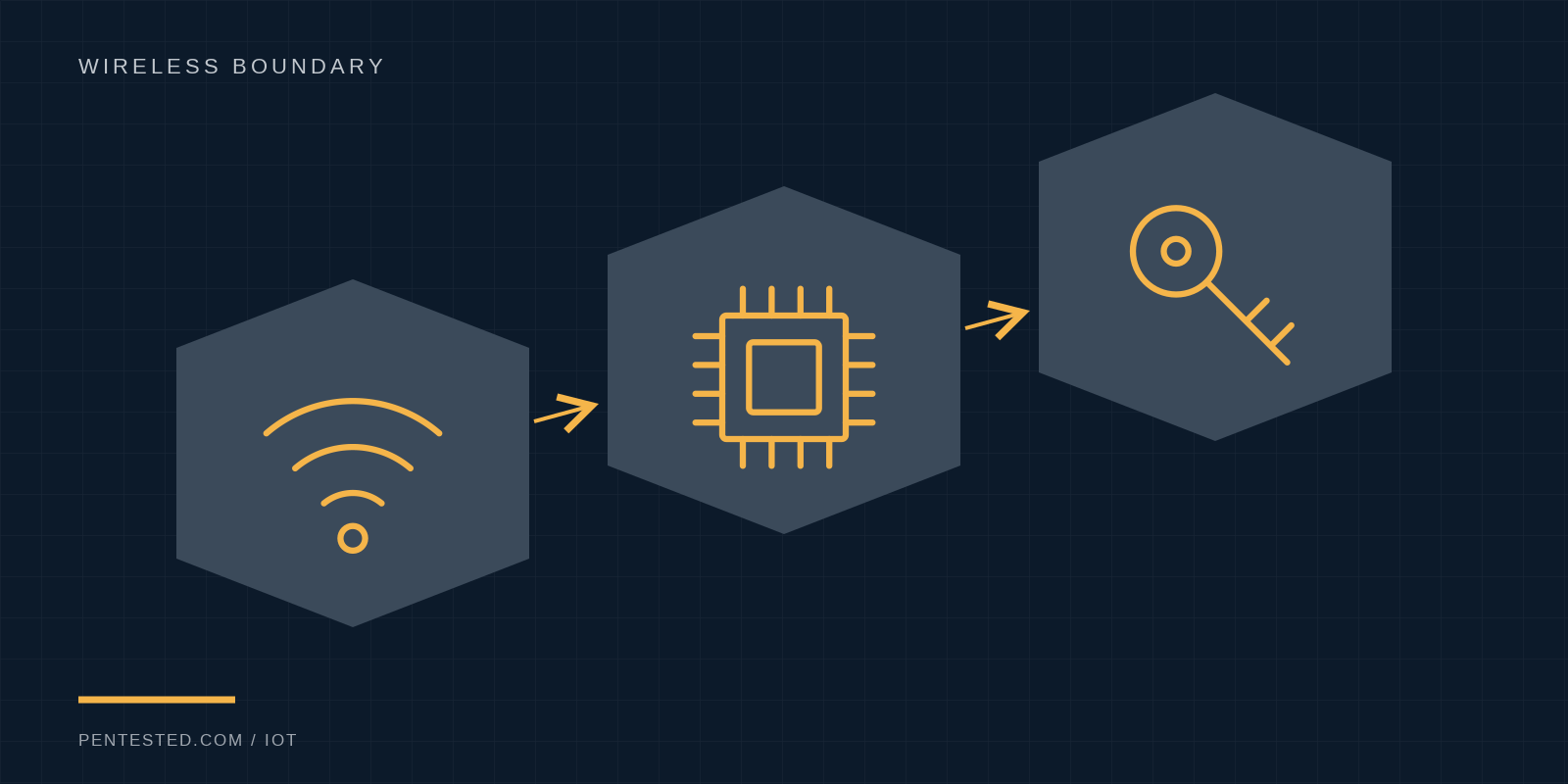
- It must be checked if authorisation checks for access to the wireless interface are implemented.
- In case that authorisation checks are in place, it must be determined whether there is a way to bypass them.
- The data, processed by the interface, must be checked for the presence of encrypted data segments. In case that encrypted data segments are found, it must be checked whether the cryptographic algorithms in use can be identified.
- Furthermore, based on ISTG-WRLS-INFO-001, it must be checked whether headers, system messages etc. disclose the usage of certain cryptographic algorithms.
- Trace key generation, access, replacement and verification.
- Test invalid inputs and failure handling with controlled data.
How to fix it
Reduce unnecessary exposure and enforce the intended operation and data boundary at the device component that controls it.
- Use maintained standard implementations and appropriate parameters.
- Protect keys throughout generation, use and retirement.
- Authenticate the content and identity that the operation actually relies on.
- Reject failed verification before trusting or processing the result.
An unusual cryptographic implementation is not enough to establish practical compromise. The report should explain the failed property and a defensible consequence.
Recheck the changed behaviour against the original failure conditions and the legitimate user journey. Keep enough evidence to show which release and configuration were verified, and include related entry points that depend on the same security decision.
Related issues
- Unauthorised access to IoT wireless interfaces
- Zigbee and Thread commissioning, keys and device trust
- MQTT topic permissions and cross-device data access
Read about our methodology or contact pentested.com to discuss your connected devices.