Auditing token claims, validity windows and sensitive contents
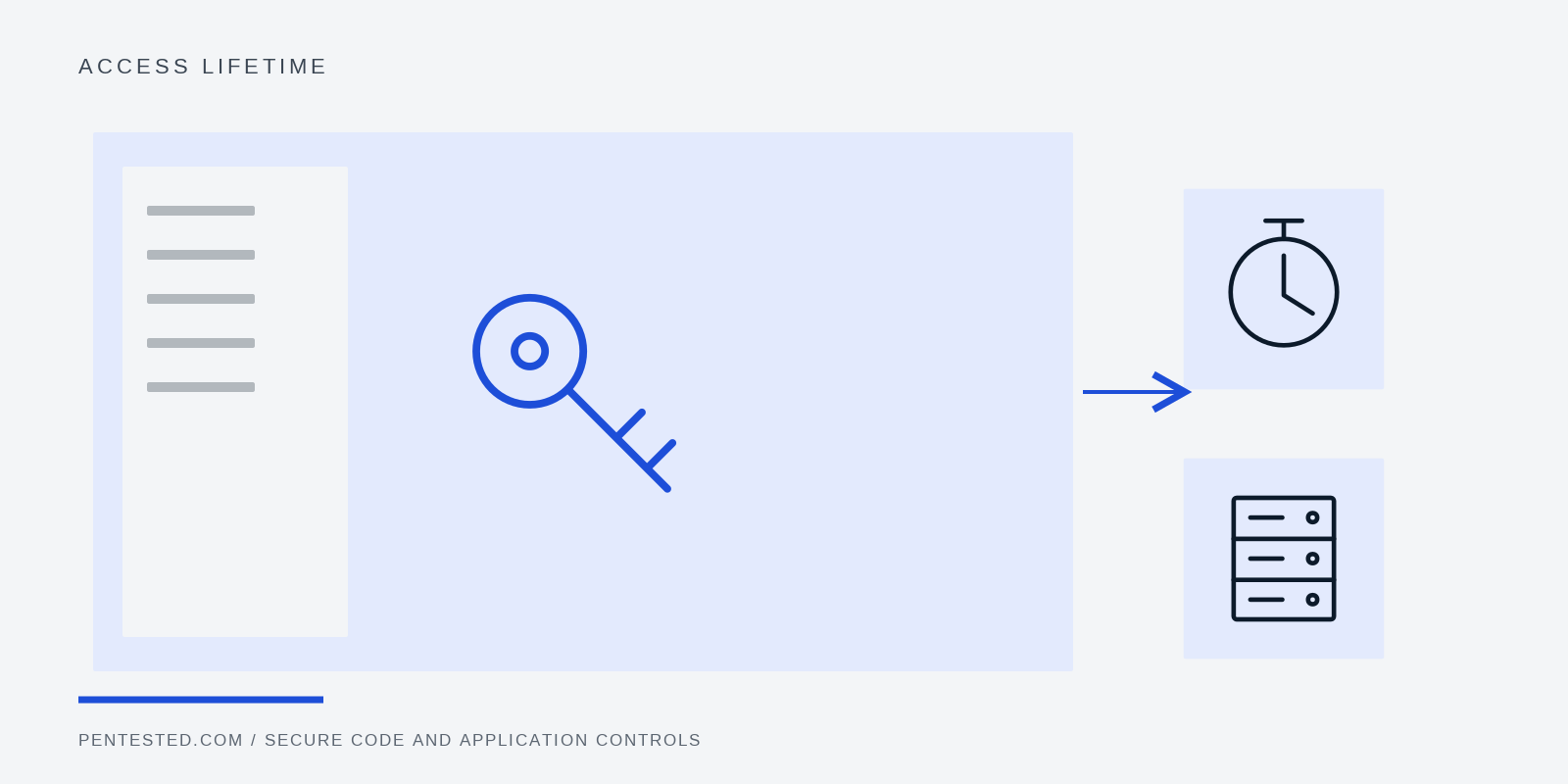
Self-contained tokens carry assertions that a trusted verifier must validate against the intended use. Understanding token claims and validity windows and sensitive contents helps establish which security property the feature needs and where that property is actually enforced.
What does this involve?
Session and token controls preserve an authentication decision over time. They need a defined scope, lifetime and invalidation policy. A token should be accepted because a trusted service has verified the relevant properties, not simply because its structure looks familiar.
Before making security decisions based on the content of a self-contained token, it is necessary to validate that the token has been presented within its validity period and that it is intended for use by the receiving service and for the purpose for which it was presented. This helps avoid insecure cross-usage between different services or with different token types from the same issuer.
Why it matters
Consider a realistic failure: a token that is well formed but intended for a different context is accepted for a protected operation.
A reusable credential can let someone continue acting as an account after the intended access should have ended. Long-lived access, excessive token contents and inconsistent revocation can increase the exposure beyond the initial event.
A code audit connects a stated requirement to the implementation responsible for enforcing it. Source review and targeted behavioural checks should explain the same boundary and any relevant exceptions.
How penetration testers check for it
Review the specific control expectations below against the code, deployment and observable application behaviour.
- Verify that, if a validity time span is present in the token data, the token and its content are accepted only if the verification time is within this validity time span. For example, for JWTs, the claims 'nbf' and 'exp' must be verified.
- Confirm that the service receiving a token validates the token to be the correct type and is meant for the intended purpose before accepting the token's contents. For example, only access tokens can be accepted for authorisation decisions and only ID Tokens can be used for proving user authentication.
- Confirm that the service only accepts tokens which are intended for use with that service (audience). For JWTs, this can be achieved by validating the 'aud' claim against an allowlist defined in the service.
- Verify that, if a token issuer uses the same private key for issuing tokens to different audiences, the issued tokens contain an audience restriction that uniquely identifies the intended audiences. This will prevent a token from being reused with an unintended audience. If the audience identifier is dynamically provisioned, the token issuer must validate these audiences in order to make sure that they do not result in audience impersonation.
- Test logout, permission changes and credential replacement.
- Inspect replay and concurrent use according to the documented design.
How to fix it
Implement the required boundary in the component that actually performs the sensitive operation and retain focused regression coverage.
- Use appropriately scoped credentials with bounded lifetimes.
- Validate trusted issuance and relevant claims consistently.
- Rotate and revoke according to the session model.
- Keep credentials out of unnecessary URLs, logs and persistent copies.
Some designs intentionally use short-lived credentials without immediate global revocation. Assess the complete lifetime and access model before calling that design a failure.
Recheck the changed behaviour against the original failure conditions and the legitimate user journey. Keep enough evidence to show which release and configuration were verified, and include related entry points that depend on the same security decision.
Related issues
- Reviewing self-contained token provenance and signature trust
- Auditing authorisation consistency and sensitive permission changes
- Reviewing OAuth resource server token acceptance
Read about our methodology or contact pentested.com to discuss the security of your application code.